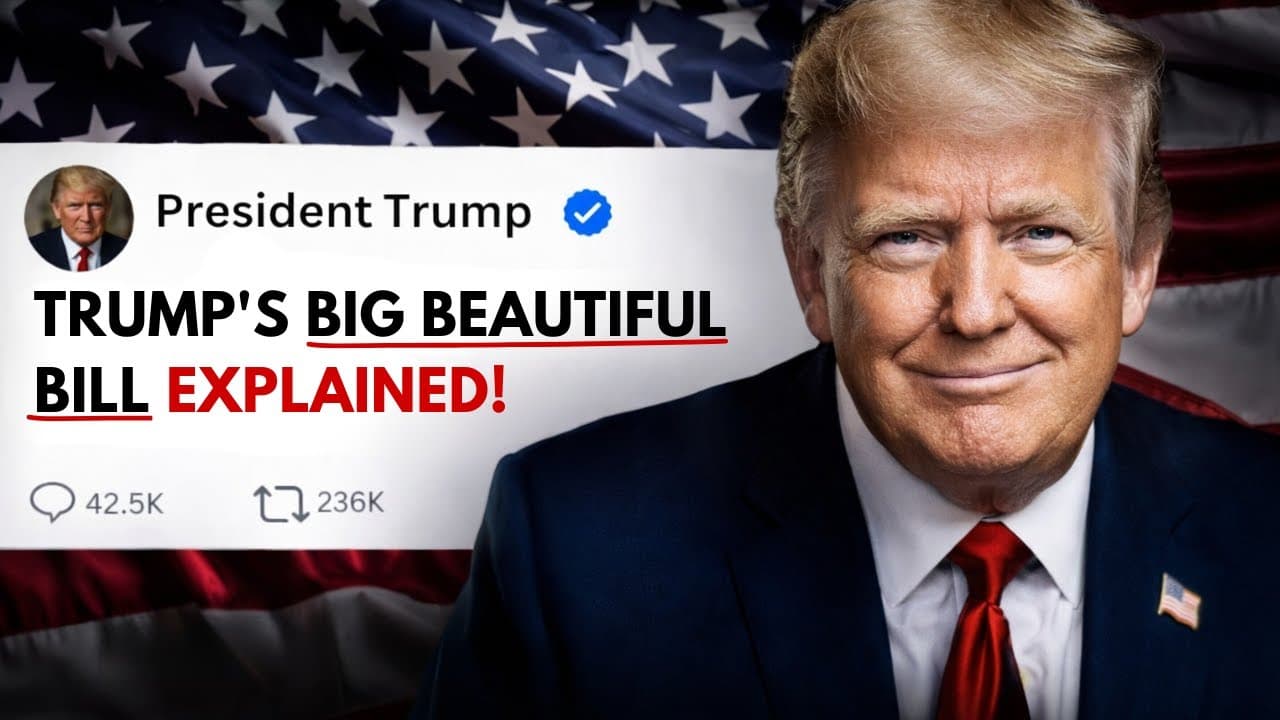
Why Did Trump's Big Bill Turn Musk Against Him?
TL;DR
Trump's proposed spending and tax bill fractured his alliance with Elon Musk because Musk believed it would worsen federal debt, reduce revenue, and threaten government support connected to his companies. Their dispute escalated into public insults, contract threats, market panic, and a one-day loss of more than $150 billion in Tesla's value after Musk had spent heavily supporting Trump's campaign.
Transcript
it's a war ladies and gentlemen elon musk and donald trump are at war meltdown the elon musk and donald trump alliance has gone up in flames elon and i had a great relationship i don't know if we will anymore disappointed to see the massive spending bill elon poured in $260 million to back trump's campaign he got trump back on twitter and even show... Read More
Key Insights
- Musk's political support for Trump included $260 million in campaign spending, activity on X, and appearances at rallies. The alliance gave Trump financial and promotional support while giving Musk access to the center of American political power.
- Musk's companies received more than $38 billion in federal funding over two decades, according to the transcript. Government contracts, grants, and tax incentives supported Tesla, SpaceX, and solar adoption, with two-thirds of that funding arriving under President Joe Biden.
- Tesla buyers could receive a $7,500 federal tax credit, while Tesla obtained $2.8 billion in credits during 2023. These incentives helped strengthen Tesla's position in the American electric vehicle market without requiring Tesla itself to fund the customer credit.
- SpaceX received a $2.9 billion NASA contract in 2021 to support an astronaut lunar landing. Trump's later threat to cancel government contracts therefore targeted a major relationship between Musk's space company and its most important client, the United States government.
- DOGE was created to cut $2 trillion in government waste, save $1 trillion by September 2025, and reduce bureaucratic barriers. Its practical authority was limited because Congress, rather than DOGE, possessed the power to change regulations.
- DOGE faced 31 lawsuits within one week, resistance from government workers, criticism from legal experts, and adverse court decisions. The transcript says it had saved $180 billion by June 2025, far below its stated $2 trillion objective.
- Musk opposed Trump's bill because he believed it could reduce United States revenue by $2.5 trillion over ten years and contribute to an economic collapse. His criticism conflicted directly with Trump's description of the proposal as a major package of tax cuts and economic measures.
- The Trump-Musk dispute created immediate business consequences because Tesla lost more than $150 billion in value in one day. The conflict also raised uncertainty around SpaceX contracts, Tesla incentives, solar tax policy, and Musk's relationship with the federal government.
Install to Summarize YouTube Videos and Get Transcripts
Explore YouTube Video Summarizer or Get YouTube Transcript Extractor
Questions & Answers
Q: Why did Elon Musk turn against Donald Trump's bill?
Elon Musk opposed the bill because he believed its combination of spending, tax cuts, and reforms would worsen America's financial position. According to the transcript, Musk estimated that it could reduce government revenue by $2.5 trillion over ten years and potentially push the United States toward another economic collapse. The disagreement transformed his close political alliance with Trump into a public conflict.
Q: What is Trump's One Big Beautiful Bill?
The transcript describes the One Big Beautiful Bill as a package combining tax cuts and reforms, with Trump presenting it as containing major tax reductions and economic development measures. Musk viewed it very differently, arguing that its spending and revenue effects endangered federal finances. The provided transcript ends during the explanation, so it does not supply a complete list of the bill's individual provisions.
Q: How did Elon Musk help Donald Trump's campaign?
Elon Musk supported Donald Trump's campaign with $260 million, helped restore Trump's presence on X, and appeared at campaign rallies. Musk publicly argued that Trump needed to win to preserve the Constitution and democracy in America. His financial support, online platform, and personal campaigning made him one of the most visible figures associated with Trump's political comeback and return to the White House.
Q: Why did Elon Musk support Trump after criticizing him?
The transcript attributes Musk's shift to regulatory pressure and concern about government debt. Tesla faced investigations involving self-driving vehicles, SpaceX encountered approval delays, Neuralink faced opposition after monkey deaths, and more than 20 government cases reportedly involved Musk's companies. Trump also promised to cut wasteful spending, which aligned with Musk's concerns about the country's $36 trillion debt in 2025.
Q: How much government support did Musk's companies receive?
According to the transcript, Musk's companies received more than $38 billion in federal funding across two decades, with two-thirds arriving during Joe Biden's presidency. Examples included a $7,500 federal credit for Tesla buyers, $2.8 billion in Tesla credits during 2023, a $2.9 billion NASA contract in 2021, and a solar credit covering 30 percent of installation costs.
Q: Why did the Department of Government Efficiency fail?
DOGE struggled because it faced 31 lawsuits within one week, resistance from government employees, criticism that its actions represented unconstitutional overreach, and court decisions blocking spending cuts. It was also responsible for reform without possessing legal authority to change regulations, since only Congress could do that. The transcript says it saved $180 billion by June 2025 against a stated $2 trillion goal.
Q: How did the Trump-Musk feud affect Tesla and SpaceX?
The public dispute created immediate market and government-contract risks. Tesla lost more than $150 billion in value in one day, while Trump threatened to cancel billion-dollar contracts involving SpaceX. Musk responded by announcing that SpaceX would begin decommissioning its Dragon spacecraft immediately. The confrontation therefore exposed both Tesla's market value and SpaceX's government business to political uncertainty.
Q: What does the Trump-Musk conflict show about business and political power?
The conflict shows that political access can help business leaders pursue deregulation and spending reform, but it can also create concentrated risks when their companies depend on public contracts and incentives. Musk supported Trump with money, campaigning, and X, then led DOGE. Once they disagreed over the bill, government contracts, Tesla's valuation, EV credits, and solar support became points of vulnerability.
Summary & Key Takeaways
-
Elon Musk spent $260 million supporting Trump's campaign, promoted him on X, and appeared at rallies. After Trump returned to the White House, Musk led the Department of Government Efficiency, or DOGE. Their alliance deteriorated when Musk publicly criticized Trump's major spending and tax bill as damaging to federal finances.
-
Musk's companies benefited extensively from government policy, including EV tax credits, a $2.9 billion NASA lunar contract, solar tax incentives, and more than $38 billion in federal funding over two decades. This dependence made Trump's threat to cancel SpaceX contracts potentially consequential for Musk's broader business empire and government-backed projects.
-
DOGE sought to cut $2 trillion in waste, save $1 trillion by September 2025, and reduce bureaucracy. Lawsuits, worker opposition, court challenges, and limited legal authority constrained its efforts. The transcript says DOGE reported $180 billion in savings by June 2025, after which Musk stepped down and opposed Trump's bill.
Read in Other Languages (beta)
Share This Summary 📚
Summarize YouTube Videos and Get Video Transcripts with 1-Click
Try YouTube Summary with ChatGPT & Claude or YouTube Transcript Generator
Explore More Summaries from Think School 📚




Summarize YouTube Videos and Get Video Transcripts with 1-Click
Try YouTube Summary with ChatGPT & Claude or YouTube Transcript Generator