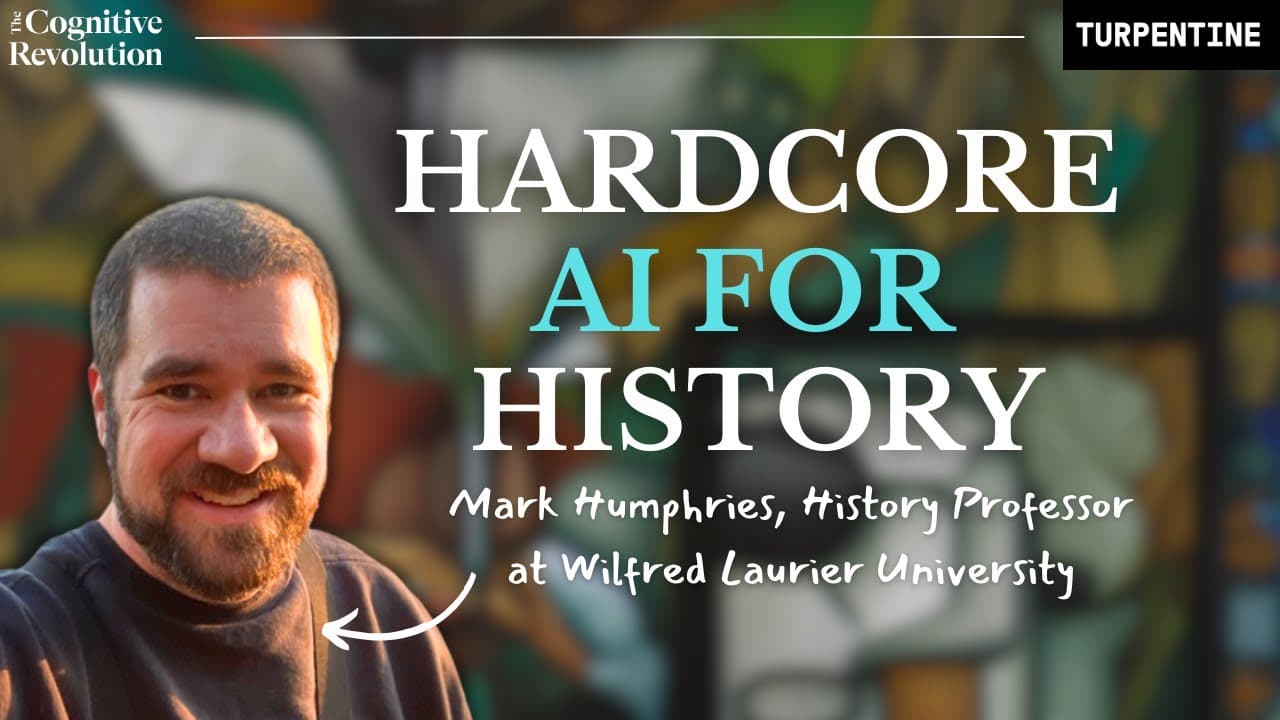
Hardcore AI for History with Mark Humphries, History Professor at Wilfred Laurier University
TL;DR
AI revolutionizes historical research by processing vast archival data efficiently.
Transcript
the vast vast majority of people are still you know at the stage of encountering chat gbt for the first time there's a huge learning curve between wow chat gbt can write a poem in the style of Bob Dylan to you can actually use this to to do something very constructive and I'm going to trust it with my data the tricky thing is I think it also scales... Read More
Key Insights
- The integration of AI in historical research enables the processing of vast archival materials, significantly increasing research efficiency.
- AI tools like GPT-4 can now transcribe and summarize historical documents, although challenges remain in accurately interpreting older scripts.
- Fine-tuning AI models on specific historical tasks can enhance their accuracy, surpassing even GPT-4 in some cases.
- Mark Humphries has been a pioneer in adopting AI for historical research, overcoming numerous challenges to improve archival processing.
- AI's ability to handle large volumes of data is transforming fields beyond history, such as law and medicine, by increasing processing speed and accuracy.
- The cost of using AI for transcription is dropping, making it more accessible compared to traditional human transcription methods.
- Educational institutions are slowly integrating AI, with potential for personalized learning and improved student outcomes.
- Historical lessons suggest that technological advancements create economic shifts, necessitating adaptations in social contracts and workforce skills.
Install to Summarize YouTube Videos and Get Transcripts
Explore YouTube Video Summarizer or Get YouTube Transcript Extractor
Questions & Answers
Q: How is AI transforming historical research?
AI is transforming historical research by enabling the processing of vast amounts of archival data that were previously inaccessible due to time constraints. Tools like GPT-4 can transcribe and summarize documents, increasing research efficiency and allowing historians to analyze more data than ever before. This technological advancement is revolutionizing the field by providing new insights and accelerating the pace of historical discoveries.
Q: What challenges do historians face when using AI for archival research?
Historians face several challenges when using AI for archival research, including accurately interpreting older scripts and handwritten documents. While AI tools like GPT-4 have improved in transcribing and summarizing documents, they still struggle with historical language nuances and privacy issues related to restricted archival materials. Fine-tuning AI models for specific historical tasks can help overcome some of these challenges and improve accuracy.
Q: How does the cost of using AI for transcription compare to traditional methods?
The cost of using AI for transcription is significantly lower than traditional human transcription methods. While AI transcription is not yet feasible for all archival materials, the cost is dropping as technology advances. This makes AI a more accessible option for historians, allowing them to process large volumes of documents at a fraction of the cost of hiring human transcribers. As AI technology continues to improve, it is expected to become even more cost-effective.
Q: What is the potential impact of AI on education?
AI has the potential to revolutionize education by providing personalized learning experiences and improving student outcomes. Despite current barriers to institutional adoption, AI can serve as a tutor, helping students understand complex concepts and improve their writing skills. As AI tools become more integrated into educational systems, they can assist in leveling up students' abilities and preparing them for a future where AI is an integral part of the workforce.
Q: How can students benefit from using AI in their studies?
Students can benefit from using AI in their studies by leveraging it as a tool to enhance their understanding and improve their academic performance. AI can help students edit their writing, understand complex concepts, and provide personalized feedback. By learning to use AI effectively, students can develop skills that will be valuable in their future careers, where AI is expected to play a significant role in various industries.
Q: What lessons can be learned from history regarding technological advancements?
History teaches us that technological advancements often lead to economic shifts, necessitating adaptations in workforce skills and social contracts. Past revolutions, such as the Industrial Revolution, demonstrate that while some jobs may be displaced, new opportunities arise as industries evolve. It is crucial for societies to address the social and economic impacts of technological change by developing policies that support workforce transitions and ensure equitable access to new opportunities.
Q: How does AI's current capability compare to human performance in certain tasks?
AI's current capabilities often surpass the average human performance in routine tasks, such as summarizing documents or generating content. However, AI still falls short in tasks requiring creativity, critical thinking, and deep understanding. While AI can handle large volumes of data efficiently, it lacks the ability to generate breakthrough insights or perform non-routine tasks autonomously. As AI technology continues to evolve, its capabilities are expected to improve, challenging humans to exceed the AI baseline.
Q: What are the implications of AI's rapid advancement for the workforce?
AI's rapid advancement has significant implications for the workforce, as it raises the bar for routine tasks and increases productivity expectations. While some jobs may be displaced, others will evolve, requiring workers to develop new skills to supervise and collaborate with AI technologies. It is essential for individuals and institutions to adapt to these changes by embracing lifelong learning and preparing for a future where AI is integrated into various aspects of work and life.
Summary & Key Takeaways
-
Mark Humphries, a history professor, explores the use of AI in processing archival materials, enhancing research efficiency and accuracy. AI tools like GPT-4 are revolutionizing the field by enabling historians to process vast amounts of data previously inaccessible due to time constraints.
-
Despite challenges in interpreting older scripts, AI's ability to transcribe and summarize documents is improving. Humphries' fine-tuning of AI models for specific historical tasks has shown promising results, highlighting the potential for AI to exceed baseline model capabilities.
-
The integration of AI in education is lagging due to institutional adoption barriers, but its potential benefits include personalized learning and increased productivity. Historical parallels suggest that technological advancements require adaptations in workforce skills and social contracts to mitigate economic disruptions.
Read in Other Languages (beta)
Share This Summary 📚
Summarize YouTube Videos and Get Video Transcripts with 1-Click
Try YouTube Summary with ChatGPT & Claude or YouTube Transcript Generator
Explore More Summaries from Cognitive Revolution "How AI Changes Everything" 📚






Summarize YouTube Videos and Get Video Transcripts with 1-Click
Try YouTube Summary with ChatGPT & Claude or YouTube Transcript Generator