What started the Cold War and what were its key turning points
TL;DR
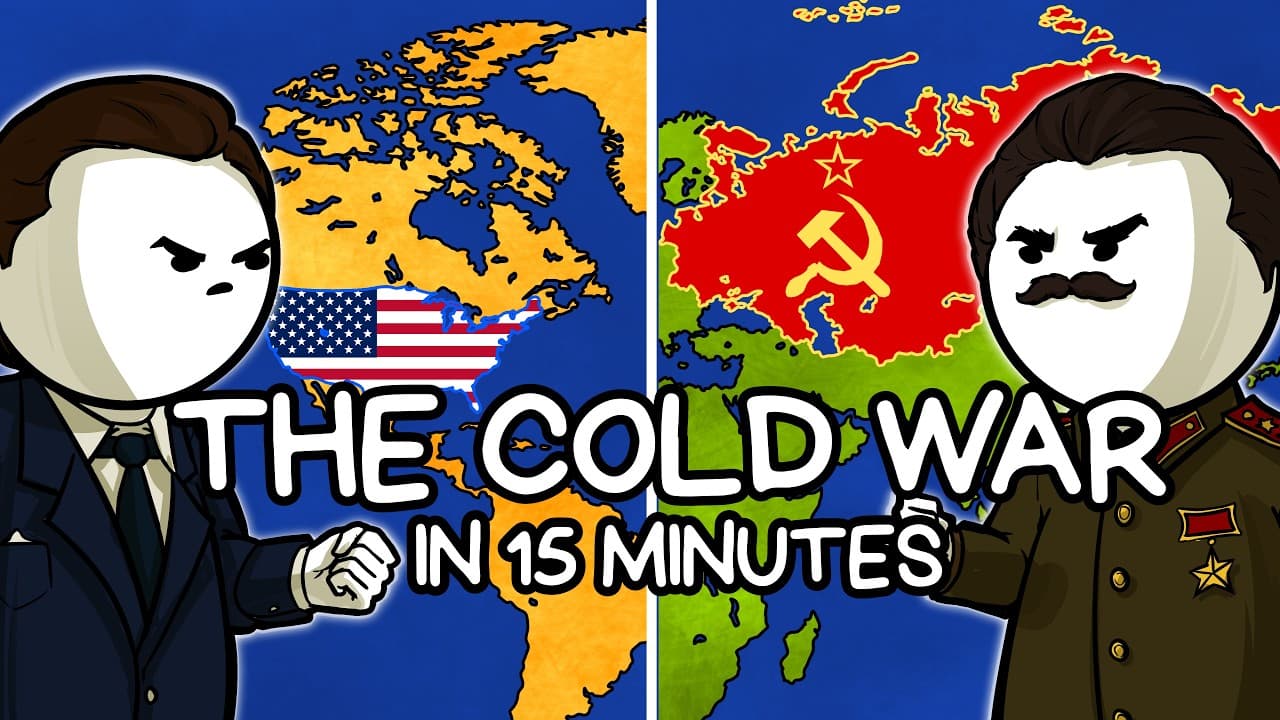
The Cold War began as a postwar rivalry between the United States and the Soviet Union rather than a friendship. It featured a vast arms race, proxy wars, and crises that almost triggered nuclear war. Major events included the Berlin Airlift, the creation of NATO and the Warsaw Pact, Korea and Vietnam wars, the Cuban Missile Crisis, and the Soviet collapse in 1991.
Transcript
The Cold War lasted 44 years, produced roughly 70,000 nuclear warheads, and killed an estimated 14 to 20 million people in proxy wars around the world. But the two countries that started it had been allies just a few years earlier. They literally fought side by side to defeat Hitler. Yeah, seriously. The same two countries that won World War II tog... Read More
Key Insights
- The Cold War began as a strategic postwar rivalry rather than a friendship, with the US and the Soviet Union pursuing opposing political systems and security interests.
- The Berlin Airlift demonstrated Western resolve to sustain a divided city without full scale war, proving air power could counter blockades and set a precedent for deterence.
- NATO and the Warsaw Pact formalized two opposing military camps, shaping alliance politics and regional security dynamics for decades.
- The Truman Doctrine and Marshall Plan framed US policy as a defense of free nations and economic rebuilding, pushing back against communist expansion.
- Nuclear and conventional arms races defined the era, with both sides expanding arsenals and delivery systems, heightening the risk of a catastrophic conflict.
- Crisis moments such as the Cuban Missile Crisis revealed the fragility of diplomacy and the importance of direct communication channels between leaders.
- Proxy wars over Korea and Vietnam illustrated how the superpowers battled indirectly, maintaining pressure without full-scale direct conflict.
- The Soviet Union’s eventual collapse in 1991 ended the Cold War and redefined global geopolitics, signaling a move toward a unipolar or multipolar world order now.
Install to Summarize YouTube Videos and Get Transcripts
Explore YouTube Video Summarizer or Get YouTube Transcript Extractor
Questions & Answers
Q: What caused the Cold War to start after World War II
The Cold War started because the wartime alliance between the United States and the Soviet Union dissolved into a competition over Europe and global influence. The United States promoted free elections and markets while the Soviet Union pursued communist governments and buffer states. This fundamental clash over governance and security structures set the stage for decades of tension.
Q: What was the purpose of the Truman Doctrine
The Truman Doctrine aimed to stop the spread of communism by providing political, military, and economic support to countries resisting subjugation by armed minorities or outside pressures. Initially focused on Greece and Turkey, the policy marked a clear U.S. commitment to containment and shaped subsequent foreign aid and military assistance strategies.
Q: Why was the Berlin Airlift significant
The Berlin Airlift was significant because it demonstrated determination to resist Soviet blockade without full-scale war. Western Allies supplied West Berlin by air for over a year, delivering millions of tons of supplies and maintaining a democratic enclave inside a Soviet-controlled area, which helped preserve Western influence in Germany.
Q: What happened during the Cuban Missile Crisis
During the Cuban Missile Crisis, the world faced the closest approach to nuclear war as the United States confronted Soviet missiles in Cuba. A naval blockade was imposed, and after tense negotiations, missiles were removed in exchange for U.S. concessions, including secret removal of missiles from Turkey, and a direct line was established to prevent similar escalations.
Q: What was the outcome of the Korean War
The Korean War ended with an armistice in 1953 but without a formal peace treaty, leaving North and South Korea technically at war. The conflict solidified the division of the Korean peninsula, increased U.S. military presence in Asia, and entrenched the global pattern of Cold War proxy conflicts.
Q: How did space and missile competition shape the Cold War
The space and missile competition, highlighted by the launch of satellites and ballistic missiles, accented fears of technological inferiority and strategic vulnerability. It spurred investments in science and defense, led to joint and rival space programs, and pushed both sides to advance technologies that defined later geopolitical and military strategies.
Q: What role did the Vietnam War play in the Cold War
The Vietnam War represented a major Cold War proxy conflict where the United States aimed to prevent a communist takeover in South Vietnam. It showcased the limits of military power in achieving political goals abroad, contributed to domestic debates on war and governance, and illustrated how superpowers influenced regional conflicts.
Q: How did the Cold War end
The Cold War ended with the dissolution of the Soviet Union in 1991, driven by internal economic problems, political reforms, and growing calls for independence within Soviet satellites. The end of the Soviet regime reduced superpower tension, reshaped international alliances, and moved the world toward a new security and economic order.
Summary & Key Takeaways
-
The Cold War began with a postwar power struggle between the US and the Soviet Union, driven by differences over Europe and governance. It saw a long arms race and numerous proxy conflicts that kept global tensions high for decades. The era ended with the Soviet Union dissolving in 1991.
-
Key turning points include the Berlin Airlift, the Truman Doctrine and Marshall Plan, NATO versus the Warsaw Pact, and the Cuban Missile Crisis, each shifting the balance of fear and diplomacy between the two blocs.
-
The legacy of this conflict shaped international relations for generations, influencing global alliances, military strategy, and political ideology, and demonstrating how political choices can avert or escalate potential nuclear catastrophe.
Read in Other Languages (beta)
Share This Summary 📚
Summarize YouTube Videos and Get Video Transcripts with 1-Click
Try YouTube Summary with ChatGPT & Claude or YouTube Transcript Generator
Explore More Summaries from Unknown Frequencies 📚
Summarize YouTube Videos and Get Video Transcripts with 1-Click
Try YouTube Summary with ChatGPT & Claude or YouTube Transcript Generator