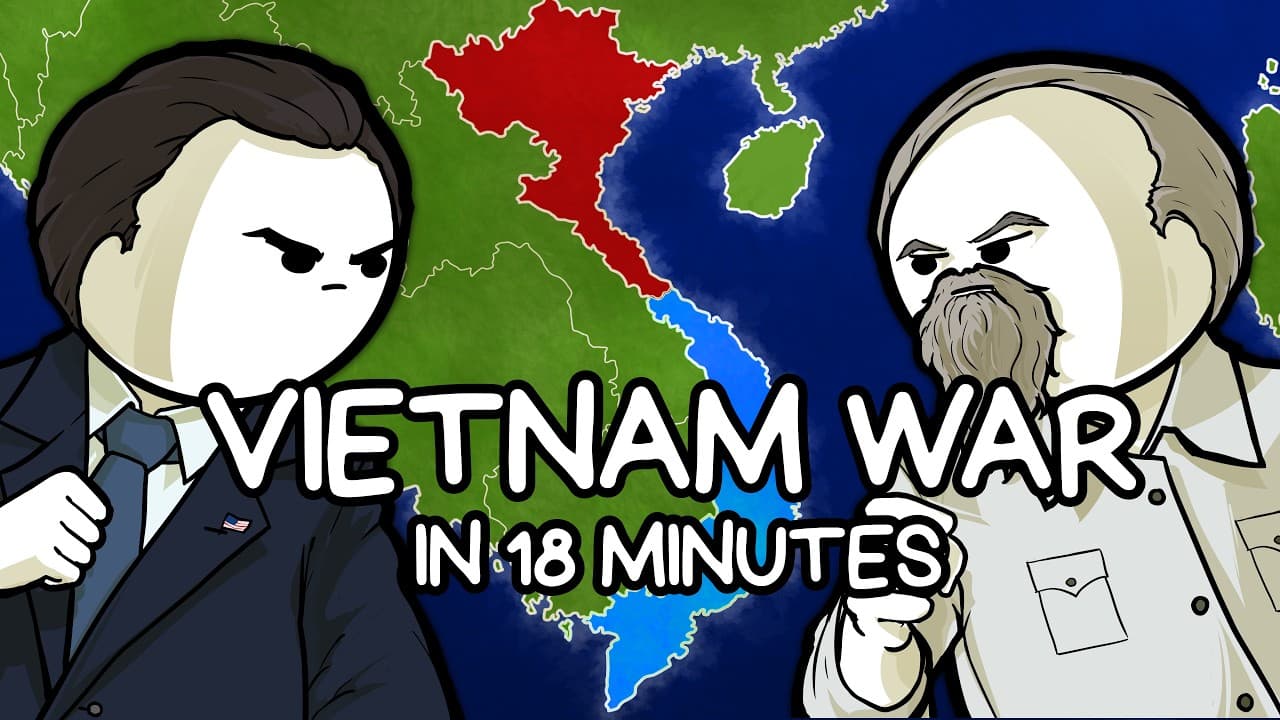
What caused the Vietnam War and how did the US lose?
TL;DR
The United States escalated the Vietnam War after supporting France and backing Ngo Dinh Diem, then launched a large bombing campaign and grew troop numbers, but could not achieve a decisive victory. Key moments include the Gulf of Tonkin incident, the Ho Chi Minh Trail, the Cu Chi tunnels, and the Tet Offensive, which exposed strategic limits.
Transcript
The Vietnam War killed an estimated 3 million Vietnamese people and 58,220 Americans. The United States dropped more bombs on Vietnam, Laos, and Cambodia than every country dropped in all of World War II combined. America won virtually every major battle and still lost. Yeah, seriously. The most powerful military on Earth spent 20 years fighting a ... Read More
Key Insights
- The Vietnam War caused 3 million Vietnamese deaths and 58,220 American deaths.
- France lost Indochina after Dien Bien Phu, and Vietnam was divided at the 17th parallel.
- The US funded roughly 80 percent of France's war costs in Indochina.
- Ngo Dinh Diem led a repressive, anti-communist South Vietnamese regime.
- The Gulf of Tonkin incident led to the Gulf of Tonkin Resolution granting war powers to the president.
- Operation Rolling Thunder subjected North Vietnam to a long bombing campaign over three and a half years.
- Ia Drang Valley marked the first major battle between American and North Vietnamese regulars and showed new military dynamics.
- The Ho Chi Minh Trail enabled sustained North Vietnamese supply lines through Laos and Cambodia.
Install to Summarize YouTube Videos and Get Transcripts
Explore YouTube Video Summarizer or Get YouTube Transcript Extractor
Questions & Answers
Q: What caused the Vietnam War and how did the US get involved?
The roots lie in colonial history, with France in Indochina and Ho Chi Minh leading a resistance against Japanese occupation. After World War II, France tried to reassert control and the United States funded much of the French war effort as part of a broader aim to contain communism in Asia. The conflict escalated from a guerrilla struggle to a full scale war as the US backed South Vietnam and increased military presence. Factors include the 1954 Geneva Conference, the division of Vietnam at the 17th parallel, and US belief in the domino theory that Southeast Asia would fall to communism if one country did. This culminated in significant troop deployments, sustained bombing, and a strategy focused on body counts rather than decisive political outcomes, ultimately leading to American withdrawal and a loss in a war that was costly in lives and credibility.
Q: What was the Gulf of Tonkin incident and its effect?
The Gulf of Tonkin affair involved reports of attacks on US ships, notably the destroyer Maddox. The second attack was later shown to be unverified, and declassified documents confirmed it did not occur. Nevertheless, Congress passed the Gulf of Tonkin Resolution, granting the president authority to use military force in Southeast Asia. This effectively expanded US involvement from advisory roles to full scale warfare, enabling operations across Vietnam, Laos, and Cambodia and paving the way for sustained bombing campaigns and troop escalations.
Q: How did US military strategy evolve during the war?
US strategy shifted from advising to fighting, with a heavy emphasis on search and destroy, air mobility, and large scale bombing. Troop numbers rose to several hundred thousand, and efforts like Rolling Thunder aimed to pressure North Vietnam but did not stop supply lines such as the Ho Chi Minh Trail. The approach often treated body counts as success metrics, while traditional ground battles and tactical innovations revealed the limits of air power and technology against a determined insurgency and integrated North Vietnamese defense.
Q: What role did Ho Chi Minh and the Viet Minh play before US escalation?
Ho Chi Minh led the Viet Minh in fighting Japanese occupation and later coordinated with OSS agents during World War II. After Japan’s surrender, he declared Vietnamese independence and sought international support. The Viet Minh’s guerrilla warfare alongside Chinese and Soviet support pressured French colonial forces, culminating in the decisive Dien Bien Phu battle where French control ended and the Vietnamese division began.
Q: Why did the US support a government in South Vietnam like Ngo Dinh Diem's regime?
Diem’s government represented a non communist alternative in the region during a period of Cold War fear of communism spreading through Southeast Asia. His anti-communist stance and alignment with Western interests made him a preferred partner in South Vietnam despite his illegitimacy and repression of Buddhist groups. The US continued support to maintain a bulwark against communism and to stabilize the region, even as the regime faced escalating internal dissent and eventual collapse.
Q: What were the major battles and tactics that defined the war’s early years?
Ia Drang Valley in 1965 marked the first major battle between US forces and North Vietnamese regulars and introduced air mobility and firepower as core strategies, while the North Vietnamese learned to fight at close range. The Cu Chi tunnels and Ho Chi Minh Trail demonstrated how Viet Cong and North Vietnamese forces used terrain and underground networks to counter American superiority in conventional warfare and to sustain extended operations despite heavy bombardment.
Q: How did public perception and political factors influence the outcome?
Despite initial military successes in several engagements, the war’s political and public dimensions eroded support as casualty figures rose and credibility suffered from controversial decisions like the Tonkin resolution and the escalation of bombing campaigns. The Tet Offensive exposed the gap between American battlefield perception and the political reality back home, contributing to shifts in policy and sustained calls for withdrawal.
Q: What ultimately ended US involvement in Vietnam?
The long conflict concluded with American withdrawal and the fall of Saigon in 1975, after two decades of fighting, massive bombing, and shifting political strategies. The combined effect of military stalemate, domestic opposition, and the inability to achieve clear political objectives led to a reassessment of interventionist policies and a lasting impact on US foreign policy.
Summary & Key Takeaways
-
The video traces a century of conflict starting with French colonial rule, showing how Vietnam was divided after Dien Bien Phu and how the United States became involved to prevent a wider spread of communism. It highlights misjudgments, mass bombings, and the resilience of Vietnamese forces that outlasted American force projections.
-
The narrative emphasizes the shift from advisory roles to full scale war, the controversy around the Tonkin incident, and the eventual fall of Saigon as the culmination of a drawn out struggle that defied conventional notions of victory.
-
The video culminates in reflections on why the US, despite overwhelming military power, failed to secure political objectives in Vietnam and how the conflict reshaped American and global attitudes toward war.
Read in Other Languages (beta)
Share This Summary 📚
Summarize YouTube Videos and Get Video Transcripts with 1-Click
Try YouTube Summary with ChatGPT & Claude or YouTube Transcript Generator
Explore More Summaries from Unknown Frequencies 📚

Summarize YouTube Videos and Get Video Transcripts with 1-Click
Try YouTube Summary with ChatGPT & Claude or YouTube Transcript Generator