How Do AI Agents Work Beyond the Language Model?
TL;DR
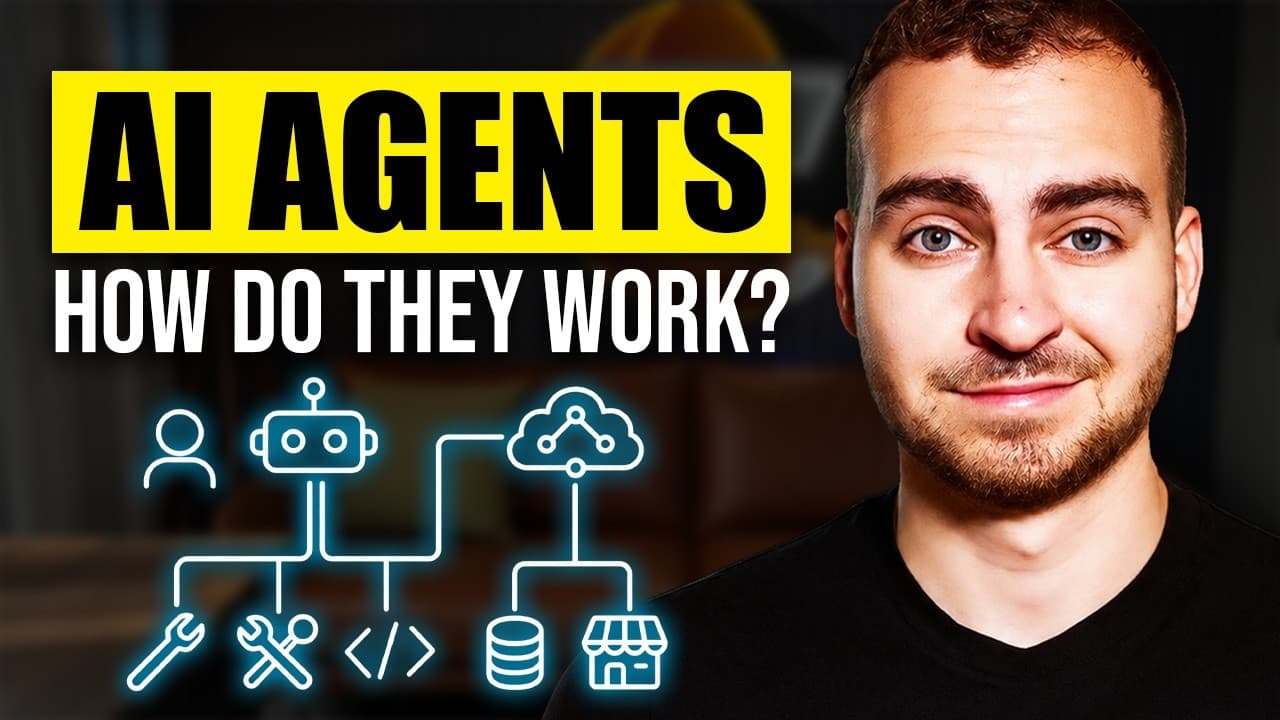
An AI agent is a model placed inside a software loop that selects actions, executes them through tools, observes the results, and continues until its goal is complete. A practical agent also needs a harness, MCP servers, task-specific skills, isolated sandboxes, and production controls such as subagents, approvals, and observability.
Transcript
Everyone is talking about AI agents right now, and almost nobody can tell you what one actually is. Now ask someone to explain the difference between an agent and ChatGPT, and you're going to get a lot of random hand-waving. But here's the thing. The model. So the actual AI is maybe 20% of an agent. The other 80% is stuff that nobody explains. So w... Read More
Key Insights
- An AI model is a text-processing function rather than a complete agent. By itself, it cannot search the web, read files, run code, or remember previous messages. Those capabilities come from the software, tools, stored context, and execution environment surrounding the model.
- An AI agent is created by placing a model inside an iterative loop. The model examines a goal, chooses an action, receives the executed action's result, and repeats the process until the task is complete or another stopping condition is reached.
- A harness is the software runtime that orchestrates an agent. It sends prompts, interprets requested actions, executes tool calls, manages context so history remains usable, and preserves state so a long-running task can continue after a restart.
- Model Context Protocol is a common interface for connecting agents to external tools. An MCP server advertises capabilities such as web search, calendar access, or database queries, allowing a compatible harness to discover and invoke those tools without a separate custom integration for each agent.
- A skill is a task-specific instruction file, commonly named SKILL.md. It can define required steps, output formats, preferred tools, and known pitfalls. The agent loads the full instructions only when relevant, which prevents unrelated guidance from consuming unnecessary context.
- A sandbox is a disposable, isolated computer environment for executing code. It gives an agent scoped capabilities for data analysis, file processing, or report generation while reducing the risk that a faulty command will access local files, credentials, or the user's primary machine.
- A production agent needs controls beyond its basic reasoning loop. Subagents divide large tasks among parallel workers, approvals require human consent before sensitive actions, and observability records each step, tool call, and result so failures can be investigated rather than guessed at.
- TrueForge is presented as an MIT-licensed, open-source, model-agnostic harness that can run locally and be deployed on a server or with Kubernetes. The demonstration describes connecting tools, adding skills and sandboxes, and avoiding dependence on a single model provider's managed harness.
- More videos from this channel:
- More from this channel: Tech With Tim
Install to Summarize YouTube Videos and Get Transcripts
Explore YouTube Video Summarizer or Get YouTube Transcript Extractor
Questions & Answers
Q: What is the difference between an AI model and an AI agent?
An AI model is essentially a function that accepts text and produces text. On its own, it cannot search the web, inspect files, execute code, or remember earlier messages. An AI agent combines that model with a software loop, tools, context management, stored state, and an execution environment, allowing it to take real actions and revise its approach based on observed results.
Q: How does an AI agent complete a task?
An AI agent works through a repeated goal, action, and observation cycle. The model examines the current goal and available context, selects an action, and asks the surrounding system to execute it. The result is returned to the model, which decides what to do next. This process can include searching, reading results, writing code, running it, checking the output, and correcting mistakes.
Q: What is an AI agent harness?
An AI agent harness is the software runtime that connects the model to the rest of the system. It sends prompts to the model, receives requested actions, executes tool calls, and returns results. It also manages the context window so accumulated history does not overwhelm the model and keeps state so longer tasks can survive interruptions or restarts.
Q: What does MCP do for AI agents?
Model Context Protocol provides a standardized way for AI agents to access tools. Instead of building and maintaining a separate integration for every search service, calendar, or database, developers can expose those capabilities through MCP servers. A compatible harness can discover the tools offered by a server and make them available to the model through one common communication pattern.
Q: What are skills in an AI agent system?
Skills are task-specific instruction files that tell an agent how to perform particular work well. A skill can describe the required procedure, expected report format, tools to use, and pitfalls to avoid, much like an onboarding guide or standard operating procedure. The system can advertise available skills while loading their complete instructions only when they become relevant to the current task.
Q: Why do AI agents need sandboxes?
AI agents need sandboxes because useful tasks often involve executing code, processing files, analyzing data, or generating reports. Running arbitrary model-selected commands directly on a personal computer could expose files and credentials or damage the system. A sandbox provides an isolated, disposable computer with scoped access, letting the agent execute necessary code without placing the user's primary machine at the same level of risk.
Q: What features make an AI agent ready for production?
A production agent adds subagents, approval controls, and observability to the core model and tool loop. Subagents divide a large assignment across parallel workers instead of relying on one context window. Approvals pause sensitive operations until a human authorizes them. Observability records every step, tool call, and result, allowing operators to trace failures and identify opportunities to improve the system.
Q: How can an open-source harness reduce provider lock-in?
A model-agnostic, open-source harness separates the agent's surrounding runtime from a particular model provider. Developers can connect different hosted models, local models, or open-weight models while retaining the same orchestration, tools, skills, and deployment approach. The example harness, TrueForge, is presented as locally runnable and deployable on a server or with Kubernetes, giving users control over infrastructure and model selection.
Summary & Key Takeaways
-
An AI model alone is essentially a function that receives text and returns text. It becomes an agent when software repeatedly gives it a goal, executes its requested actions, returns the results, and lets it choose the next step. This loop enables web searches, file processing, code execution, and iterative correction.
-
The agent harness is the runtime that coordinates the complete process. It sends prompts to the model, executes tool calls, manages the limited context window, and preserves state for longer tasks. A model-agnostic harness can support provider-hosted or local open-weight models, allowing developers to change models without replacing the surrounding agent system.
-
MCP servers provide standardized tool access, skills supply task-specific operating instructions, and sandboxes isolate code execution from the user's computer. Production systems add subagents for parallel work, approvals for sensitive operations, and observability for reviewing every step, tool call, and result. Together, these components turn a demonstration into a deployable agent.
Read in Other Languages (beta)
Share This Summary 📚
Summarize YouTube Videos and Get Video Transcripts with 1-Click
Try YouTube Summary with ChatGPT & Claude or YouTube Transcript Generator
Explore More Summaries from Tech With Tim 📚
Summarize YouTube Videos and Get Video Transcripts with 1-Click
Try YouTube Summary with ChatGPT & Claude or YouTube Transcript Generator