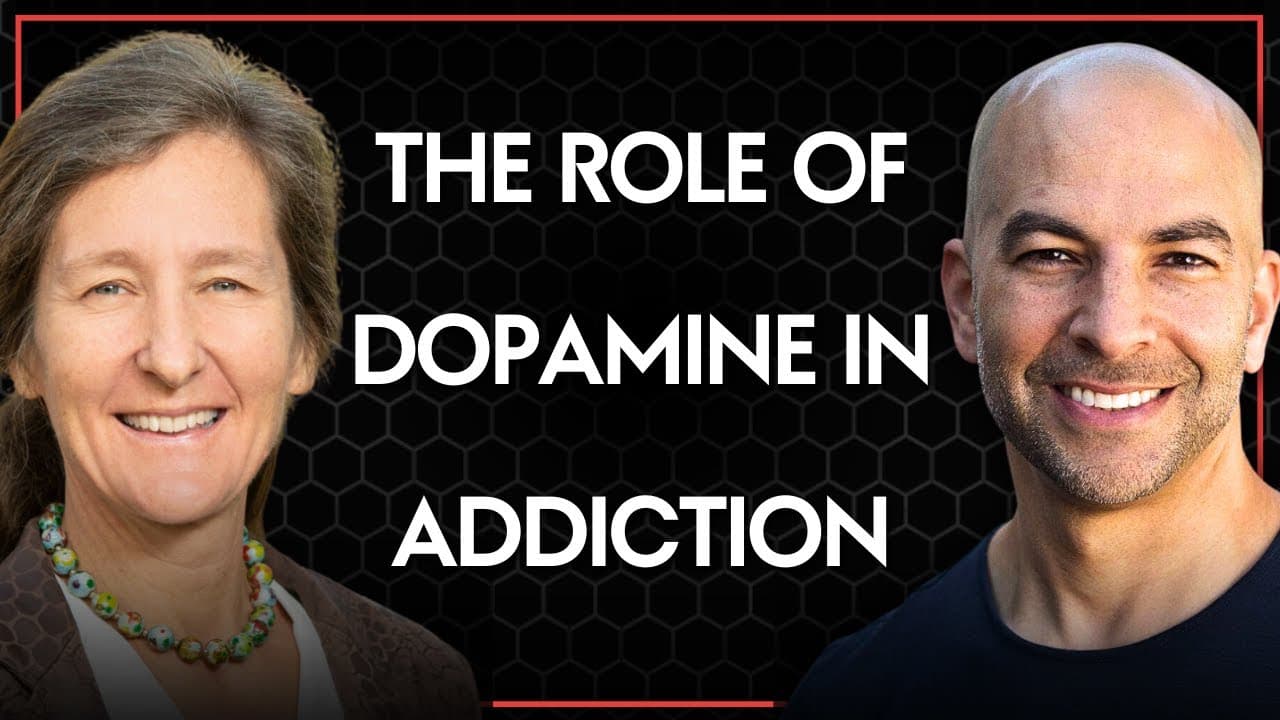
How does dopamine drive addiction and motivation?
TL;DR
Dopamine acts as the final common pathway for reinforcement in the brain, signaling reward, pleasure, and motivation. The prefrontal cortex functions as a brake that enables delayed gratification and future planning, reducing addiction risk when it works well. Addictive behaviors emerge when the balance shifts between brakes and accelerators in the reward circuitry.
Transcript
obviously one of the things that anyone who's familiar with you um thinks about is this role of dopamine and understanding addiction this clearly plays into a big part of your clinical practice as a psychiatrist um but I also realize that terms get thrown around quite Loosely and sometimes it can just be helpful for people to understand uh a little... Read More
Key Insights
- Dopamine is the brain’s chemical messenger for pleasure, reward, and motivation. It functions as the final common pathway for reinforcing effects across many substances and activities.
- The core reward circuit includes the prefrontal cortex, nucleus accumbens, and ventral tegmental area where dopamine release signals salience and drives approach behavior.
- The prefrontal cortex provides inhibitory control or brakes, enabling delayed gratification and planning for future consequences to reduce impulsive actions.
- Addiction can result from reduced brake function or heightened accelerator activity, or a combination of both within the same circuit.
- The reward system is highly conserved across species, indicating a shared, ancient mechanism for seeking rewards and avoiding harm.
- Dopamine also plays a critical role in movement, which explains why disorders like Parkinson’s involve dopamine depletion and treatment risks.
- Pharmacological interventions that alter dopamine can influence both motor and reward pathways, with potential for unintended addictive behaviors.
- Recovery from addiction often involves strategies that strengthen the brain’s brakes, such as cognitive and behavioral approaches that modify timing and choices.
Install to Summarize YouTube Videos and Get Transcripts
Explore YouTube Video Summarizer or Get YouTube Transcript Extractor
Questions & Answers
Q: A real search query question about the video (e.g. 'How to...', 'What is...', 'Why does...', 'When should...'). Question 1
What is dopamine and how does it relate to reward and motivation in the brain? Dopamine is described as the final common pathway for all reinforcing substances and behaviors. It is released in the reward circuitry, which includes the prefrontal cortex and deeper structures like the nucleus accumbens and the ventral tegmental area. This signaling helps the brain identify what is important for survival and encourages repetition of those actions.
Q: Question 2
Why is the prefrontal cortex considered the brakes of the brain in relation to addiction? The prefrontal cortex acts as a stop function, supporting delayed gratification and the appraisal of future consequences. It engages autobiographical narrative and metacognition to guide decisions, which can dampen impulsive substance use. When this brake is strong, it helps prevent addiction; when weak, the risk of addictive behavior increases.
Q: Question 3
How does the nucleus accumbens affect addictive behavior? The nucleus accumbens is part of the accelerator mechanism in the reward circuitry, releasing dopamine to motivate approach and pursuit of rewards. It plays a central role in reinforcing behaviors and making certain actions feel rewarding, which can contribute to repeated use in addictive cycles when coupled with weakened brakes.
Q: Question 4
Are humans more susceptible to addiction due to unique brain features? The discussion suggests that addiction arises from the balance between brakes and accelerators rather than simply brain size. The reward system is evolutionarily conserved, indicating a shared vulnerability across species, while human cognitive abilities can both increase and help manage this risk.
Q: Question 5
What happens when dopamine signaling is altered in disease or treatment? Dopamine is involved in movement and reward, so treatments that increase dopamine for motor improvement can inadvertently affect reward pathways and lead to compulsive behaviors in some patients. This shows the interconnectedness of motor and reward circuits in clinical outcomes.
Q: Question 6
How can understanding dopamine help in recovery from addiction? Recognizing that addiction involves imbalances between brakes and accelerators suggests approaches that strengthen self control and future planning. Interventions that engage the prefrontal cortex and cognitive strategies can reduce impulsive seeking and support sustained recovery.
Q: Question 7
What does the term reward circuitry imply about learning and behavior? Reward circuitry signals what is salient or important for survival and drives learning by reinforcing actions that lead to rewards. Dopamine release in these circuits strengthens associations, which can promote repetition of both healthy behaviors and addictive patterns depending on context and control signals.
Q: Question 8
Why is it important that dopamine’s role is described as a final common pathway? This framing emphasizes that many different substances and behaviors can converge on the same dopamine-driven reinforcement system, explaining why diverse addictions share similar neural mechanisms and why cross-substance treatment strategies may be effective.
Summary & Key Takeaways
-
Dopamine is a neurotransmitter that regulates pleasure, reward, and motivation, serving as a final common pathway for reinforcing substances and behaviors.
-
The reward circuitry comprises the prefrontal cortex and deeper brain structures like the nucleus accumbens and the ventral tegmental area, where dopamine release signals salience.
-
The prefrontal cortex acts as a brake, supporting delayed gratification and future planning to help prevent addiction, while the nucleus accumbens acts as an accelerator.
-
Addiction can arise from imbalances in these control networks, such as weaker brakes or stronger accelerators, in both humans and across species.
-
The system is evolutionarily conserved, indicating that dopamine’s role in reward is a basic, long-standing mechanism for behavior.
-
Parkinson’s treatment with a dopamine precursor can inadvertently affect reward pathways and trigger addictive behaviors in some patients.
-
The timing and context of dopamine signaling influence whether a behavior is repeated, shaped by learned relevance and survival value.
-
Understanding these pathways helps explain why overcoming addiction can involve mobilizing cognitive and behavioral strategies that engage the prefrontal brakes.
Read in Other Languages (beta)
Share This Summary 📚
Summarize YouTube Videos and Get Video Transcripts with 1-Click
Try YouTube Summary with ChatGPT & Claude or YouTube Transcript Generator
Explore More Summaries from Peter Attia MD 📚




Summarize YouTube Videos and Get Video Transcripts with 1-Click
Try YouTube Summary with ChatGPT & Claude or YouTube Transcript Generator