How to Build a Viral Content System with AI
TL;DR
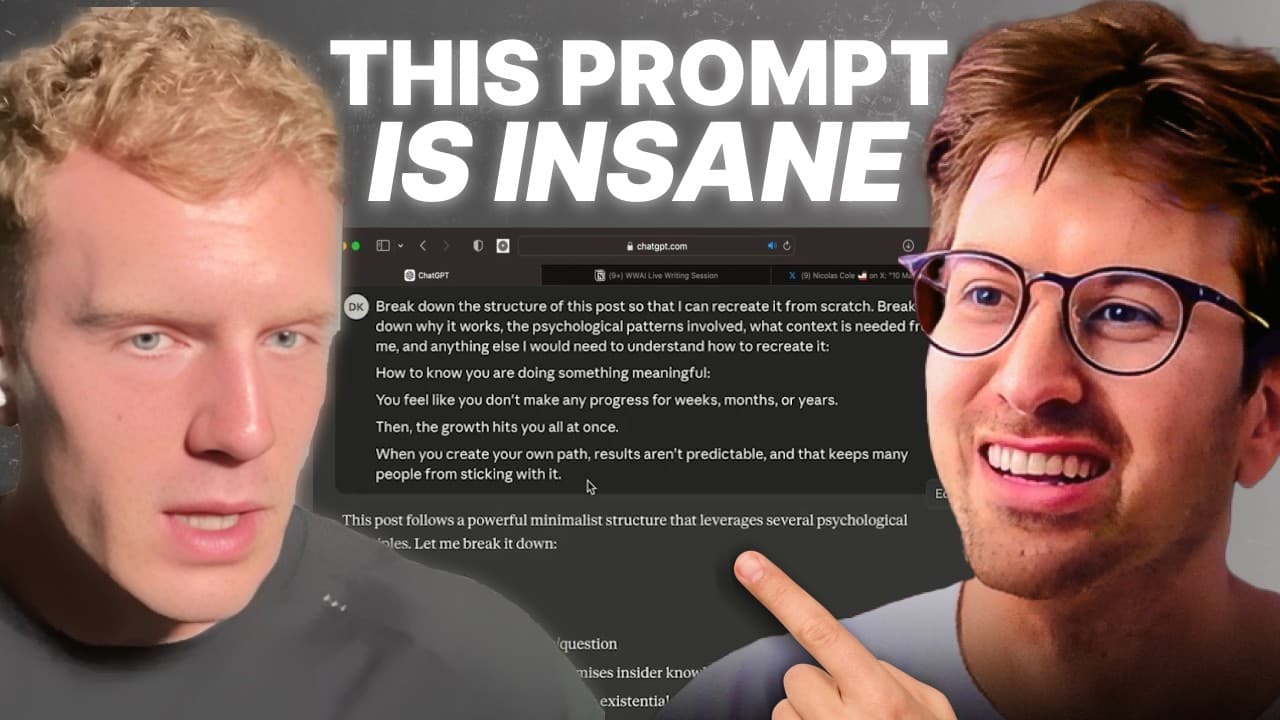
The video explains a repeatable content engine that starts with testing ideas on Twitter and then repurposing successful concepts into newsletters, YouTube videos, and other formats. It emphasizes using AI to research, summarize, and generate prompts, while maintaining a unique voice and avoiding mere copying.
Transcript
If you've been on the internet, you've seen Danco. He's got millions of followers and I've seen him everywhere. So, I reached out to him and I was like, "How do you do it?" And he told me that his secret is LLM's, AI, and prompts. So, in this episode, he shows his exact playbook for coming up with ideas, creating the content, and most importantly, ... Read More
Key Insights
- AI is used to augment but not replace human idea generation.
- Twitter serves as a rapid feedback loop to vet concepts before broader production.
- A weekly content plan plus 2–3 daily posts builds steady momentum across platforms.
- Newsletter ideas can derive from high performing tweets or successful videos.
- AI prompts help summarize long videos and extract actionable points.
- Cross-platform repurposing is structured so ideas flow from text to video to social clips.
- Understanding human psychology improves engagement and distribution outcomes.
- The system emphasizes preserving a unique voice while leveraging AI to scale.
- More videos from this channel:
- More from this channel: Greg Isenberg
Install to Summarize YouTube Videos and Get Transcripts
Explore YouTube Video Summarizer or Get YouTube Transcript Extractor
Questions & Answers
Q: How can Twitter be used as a litmus test for content ideas
Twitter is used as the first testing ground to validate the appeal of ideas before investing in longer formats. By posting concise thoughts or threads, creators gauge engagement signals such as likes, retweets, and comments. Successful tweets indicate ideas with potential for newsletters, videos, and multi‑platform formats, enabling efficient prioritization.
Q: What is the role of newsletters in the content engine
Newsletters act as the weekly hub of content that can be expanded into YouTube videos and other formats. They consolidate ideas, provide a deeper dive, and create cornerstone content that can be repurposed. The process also feeds back into idea generation for social posts by highlighting themes that resonate with the audience.
Q: How are AI tools used to research topics
AI tools are used to gather and summarize information from multiple sources, including videos and books, to extract relevant points. They help convert hours of content into concise insights, enabling writers to assemble informed outlines. The AI acts as a research assistant that accelerates ideation without replacing the creator’s perspective.
Q: What is the process for generating ideas from YouTube
The process involves looking at popular or high‑quality videos in a niche, noting topics and angles, and then writing your own perspective. The goal is not to copy but to adapt a concept with a unique viewpoint. This topic selection informs newsletters and social content while leveraging existing audience interest.
Q: How does the workflow handle cross‑platform repurposing
The workflow starts with a core idea, often drafted as a Twitter post, then expands it into a newsletter topic, which in turn becomes a YouTube video or podcast. From there, the content is sliced into social clips and shorter posts for various platforms, maintaining consistency and coherence across formats.
Q: What prompts strategies are highlighted for AI use
Prompts are designed to extract key points, summarize long content, and generate new perspectives. They guide AI to stay aligned with the creator’s voice, extract actionable insights, and surface angles that fit different formats. Effective prompts reduce boilerplate and preserve originality while accelerating production.
Q: Why focus on human psychology in content creation
Understanding human psychology helps predict what will engage audiences, influence behavior, and drive distribution. By applying psychology insights, content aligns with what viewers find compelling, which improves engagement metrics and the likelihood of content being recommended by algorithms across platforms.
Q: What is the creator’s stance on using AI with original voice
The creator emphasizes augmenting the workflow with AI rather than letting AI replace personal voice. The aim is to maintain a unique perspective and storytelling style while using AI to research, summarize, and generate ideas efficiently. This balance helps scale production without eroding authenticity.
Summary & Key Takeaways
-
The host describes a two-tier workflow that validates ideas on Twitter before expanding to newsletters and video formats, ensuring a scalable content system. It highlights the role of AI in researching and shaping ideas while preserving a distinctive authorial voice. The approach aims to maximize distribution across platforms by leveraging early testing feedback.
-
A central theme is using Twitter as a litmus test to filter and refine ideas, then using newsletters and YouTube as amplification channels. The process includes weekly planning, daily posts, and repurposing content with AI tools to save time and increase consistency.
-
The interview covers practical prompt strategies, tooling choices, and routines for producing content at scale. It stresses concrete steps for idea generation, research, and cross-platform adaptation, with attention to psychology-based engagement and the importance of not simply copying others but adding original perspectives.
Read in Other Languages (beta)
Share This Summary 📚
Summarize YouTube Videos and Get Video Transcripts with 1-Click
Try YouTube Summary with ChatGPT & Claude or YouTube Transcript Generator
Explore More Summaries from Greg Isenberg 📚






Summarize YouTube Videos and Get Video Transcripts with 1-Click
Try YouTube Summary with ChatGPT & Claude or YouTube Transcript Generator