How Rowan Cheung Uses AI Agents to Scale The Rundown
TL;DR
A 15-person team can operate like a 50-person company by using AI agents across content and operations. The Rundown clones a founder's face and voice with HeyGen and 11Labs to turn written newsletter stories into short-form video, showing the AI avatar for only the first three to four seconds and filling the rest with B-roll. In under a year this workflow grew to over 150,000 followers.
Transcript
Rowan Chung is the genius behind The Rundown. Now, The Rundown AI is a media company for AI that's generating millions of dollars a year. Now, I thought that The Rundown had 50, 100, 150 employees. No, it's a lot less than that. He just uses AI agents to actually scale the business. In this episode, he unveils it all, and I think it's for the f... Read More
Key Insights
- The Rundown AI is a media company generating millions of dollars a year with a team of about 15 people that operates at the speed of a 50-person organization by leaning heavily on AI agents.
- AI avatar video works best when the cloned face is shown for only the first three to four seconds, because video avatar quality still lags while AI voice is advanced enough to sometimes sound better than the real speaker.
- The avatar workflow uses HeyGen for the face and 11Labs for the voice, generated separately rather than through HeyGen's built-in 11Labs integration because doing the voice directly in 11Labs yields higher quality before stitching.
- AI avatar content is not one-click generation; it requires a talented editor doing heavy storytelling, B-roll, and manual editing, and an editor sometimes notes it would be faster to just narrate it live.
- Story selection determines virality more than production polish, since boring content wrapped in beautiful short-form still goes nowhere, so choosing stories with breakout potential is the critical step.
- Being openly transparent that the avatar is AI-generated preserved audience acceptance, letting viewers see the founder practicing what he preaches rather than feeling deceived.
- AI avatars are not right for everyone; a publicly traded company CEO should stay authentic because the human element becomes the real moat amid seas of AI-generated content.
- Voice dictation combined with Claude trained on a person's writing style can produce social posts that are about 90% ready, and Lindy can act as a 24/7 meeting-scheduling agent without Calendly links.
Install to Summarize YouTube Videos and Get Transcripts
Explore YouTube Video Summarizer or Get YouTube Transcript Extractor
Questions & Answers
Q: How does The Rundown make videos without the founder filming?
They clone the founder's face using HeyGen and his voice using 11Labs, then have an editor take his original newsletter writing, reshape it into a short-form script, and run it through the AI avatar. The avatar is shown for only the first three to four seconds, with B-roll and storytelling filling the rest. It still requires heavy manual editing and a talented editor, but it lets a founder with no time create short-form content from writing he already produces.
Q: What AI tools are used to create the AI avatar videos?
The workflow uses HeyGen for the avatar face and 11Labs for the voice. Although HeyGen offers an 11Labs integration, Rowan recommends generating the voice separately directly in 11Labs because it produces higher quality, then stitching the pieces together. He also mentions tools like Gumloop and Lindy to pull in stories gaining traction on places like Reddit, which makes story selection easier for people who aren't writing thousands of words a day themselves.
Q: Why is the AI avatar only shown for a few seconds in each video?
Rowan explains that the avatar portion of the video isn't that great because AI video still lags behind. By showing the avatar for only the first three or four seconds, it looks more real, and the rest of the video relies on B-roll. The audio is a different story: voice AI is very advanced, and the AI-generated voice sometimes sounds better than Rowan himself, since he mispronounces things. So they lean on strong voice and minimal avatar exposure.
Q: How many followers did the AI avatar strategy generate?
In under a year of running the AI avatar experiment, The Rundown grew the account to over 150,000 followers, which Rowan considers a success. They openly announced on Twitter that it was an experiment using an avatar and that they were not trying to fool anyone. Several videos went viral, including one with 120,000 likes about Anguilla and .ai domains being a top revenue source, demonstrating the reach the workflow can achieve when stories are chosen well.
Q: What mistakes do people make when copying the AI avatar workflow?
The biggest mistake is picking boring stories that won't go viral in short form, because even the most beautifully produced short-form video goes nowhere if the underlying content is dull. The second mistake is assuming it's a one-click generation process. In reality it takes a lot of work, a break in the daily workflow that consumes mental capacity, and a really talented editor who handles storytelling and stitches the pieces together. People who skip training the avatar in HeyGen get poor results.
Q: Who should not use an AI avatar for their videos?
Rowan says a regular everyday CEO, especially at a publicly traded company, probably shouldn't use an AI avatar because there is an element of AI hate, where audiences see it as less authentic. Such leaders should strive to be as authentic as possible and push for the human element and human experience. As AI-generated content floods the internet, that human layer becomes the real moat. It worked for Rowan only because he is openly the AI guy and transparent about it.
Q: When does an AI avatar actually make sense to use?
It makes sense in edge cases where a founder has no time and is already writing content that can be repurposed into short form, making it a no-brainer. Rowan also cites a CEO from Switzerland who had to record videos in four different languages every single day, which consumed hours; for him the avatar was genuinely useful. So the strongest use cases are time-strapped writers and people needing to produce the same content across multiple languages efficiently.
Q: What other AI workflows does The Rundown use internally?
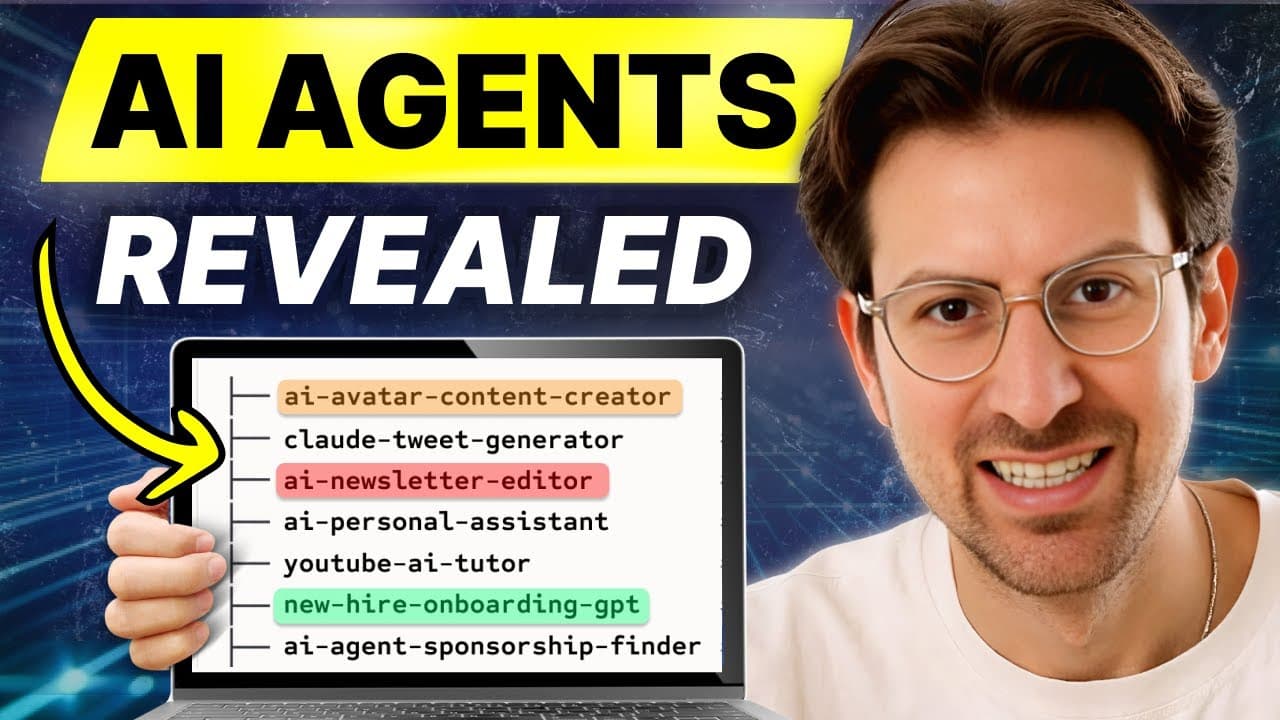
Beyond the AI avatar, Rowan shares workflows including an AI Tweet Generator that combines voice dictation with Claude trained on his personal writing style to make posts about 90% ready, an AI Newsletter Editor, a Lindy AI agent that schedules meetings 24/7 without Calendly links, Perplexity used as an AI tutor for YouTube videos, a custom GPT for new-hire onboarding containing company SOPs and policies, and an email manager and sponsorship-finder AI agent.
Summary & Key Takeaways
-
Rowan Cheung, founder of The Rundown AI, runs a media company earning millions per year with a team of roughly 15 that performs like a 50-person team. He shares seven internal AI workflows spanning business operations and content creation, offering free templates and prompts listeners can copy.
-
The flagship workflow clones Rowan's face with HeyGen and his voice with 11Labs so an editor can push his existing newsletter writing into short-form video without him filming. The avatar appears only three to four seconds while B-roll carries the rest, growing the account past 150,000 followers in under a year.
-
Success depends on picking breakout-worthy stories and doing substantial manual editing rather than expecting one-click output. Transparency about using an avatar preserved trust, and Rowan notes it suits time-strapped founders or multilingual cases but not authenticity-dependent public-company CEOs whose human element is their moat.
Read in Other Languages (beta)
Share This Summary 📚
Summarize YouTube Videos and Get Video Transcripts with 1-Click
Try YouTube Summary with ChatGPT & Claude or YouTube Transcript Generator
Explore More Summaries from Greg Isenberg 📚


Summarize YouTube Videos and Get Video Transcripts with 1-Click
Try YouTube Summary with ChatGPT & Claude or YouTube Transcript Generator