How to use AI to outpace coworkers with CO INTELLIGENCE
TL;DR
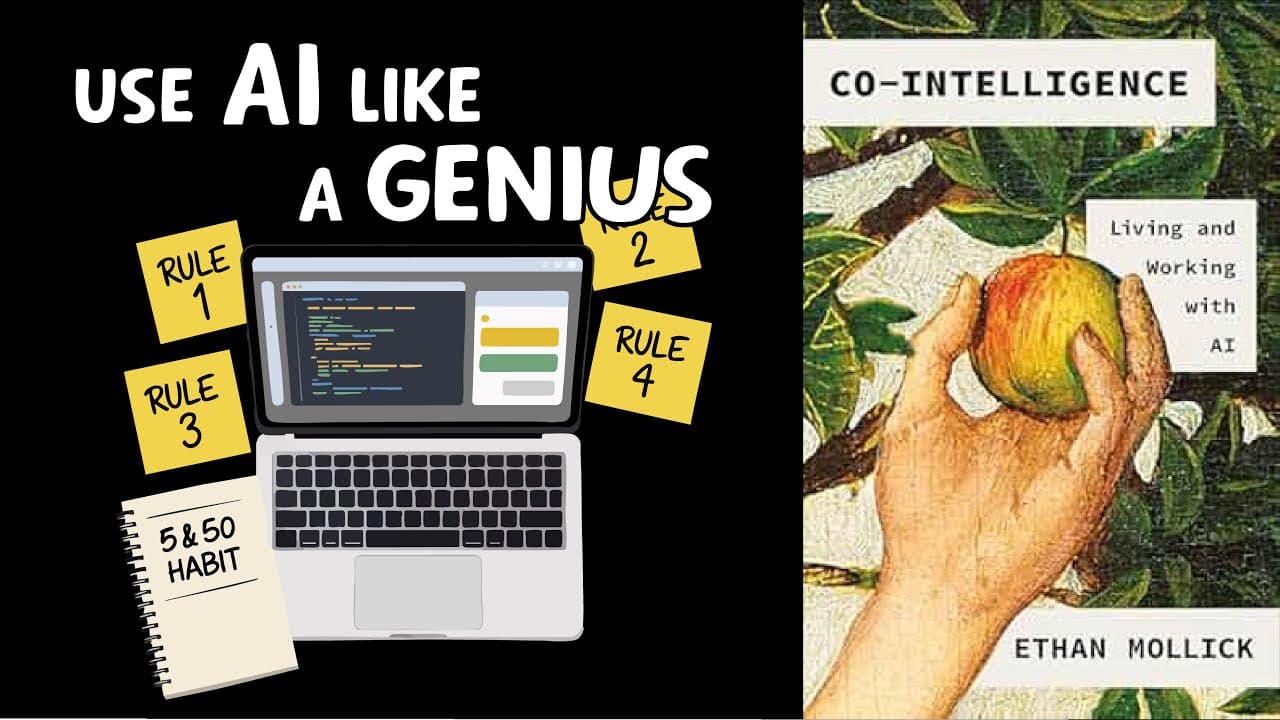
The video explains four core rules for using AI effectively and a five and 50 habit to amplify human work. It emphasizes inviting AI to the table, comparing four major LLMs, pushing for extensive variations, and verifying critical facts before sharing. The takeaway is to leverage AI to enhance creativity while maintaining human judgment.
Transcript
I recently read co-intelligence living and working with AI by Ethan Mollik. After finishing co-intelligence, I walked away with four rules for using AI and developed a new prompting habit called five and 50. If you use these rules and adopt a similar habit, you'll be one of the last people to be replaced by AI because you'll be using it better than... Read More
Key Insights
- AI operates by building detailed maps of intellectual domains, enabling fast direction finding without storing training data, which can lead to plausible but not always accurate outputs.
- The key to productive AI use is inviting AI into every task, problem, and decision, starting with one of the big four LLMs and iterating to assess usefulness across contexts.
- AI responses should be treated as guides that require human review and verification, especially for critical facts or potential reputation damage, using cross model checks and credible sources.
- Push AI to extreme lengths, generating dozens of options to uncover novel and high quality ideas that would not emerge from standard prompts.
- Give AI a clear character, constraints, and context to produce sharper, more relevant outputs, such as acting like a senior marketer with defined goals and limits.
- Maintain a robust verification workflow by asking AI to list verifiable facts and then having multiple models verify those facts, reducing the risk of hallucinations.
- Adopt a five and 50 habit: prompt iteratively five times, and push at least one output to 50 variations to identify truly strong ideas.
- The overarching message is that learning to use AI well amplifies human creativity rather than replacing it, provided one keeps a critical eye and a final check.
- More videos from this channel:
- More from this channel: Productivity Game
Install to Summarize YouTube Videos and Get Transcripts
Explore YouTube Video Summarizer or Get YouTube Transcript Extractor
Questions & Answers
Q: A real search query question about the video (e.g. 'How to...', 'What is...', 'Why does...', 'When should...'). Question 1
To maximize AI usefulness, invite an LLM to every task and decision, start with a major model like GPT, Claude, Gemini, or Grock, and evaluate its impact across weekly tasks. This approach helps identify where AI adds value, where it is neutral, and where it falls short, guiding practical integration.
Q: Question 2
The four rules from the book are explained through a restaurant chef analogy, where the sous chef represents an AI assistant. Use this metaphor to understand how to leverage AI as a capable helper while maintaining human oversight, especially in critical or high stakes outputs.
Q: Question 3
The five and 50 habit asks you to draft an initial prompt and then improve it five times, refining role, context, and constraints. For at least one part of the output, you should push for 50 variations to surface exceptional options that surpass conventional results and surprise you.
Q: Question 4
Push AI to extreme lengths by asking for more options, like generating 50 subject lines or alternative approaches. Although most may be weak, the rare good options emerge through deliberate curation, enabling more creative and effective final outputs.
Q: Question 5
The video warns that AI can hallucinate, because the model does not store or verify training data. While hallucinations are decreasing with model improvements, users must still verify facts and use credible sources especially when outputs affect reputation or decision making.
Q: Question 6
Verifying AI outputs involves asking the model to list all verifiable facts from its previous answer and then using two other models or sources to verify those facts. This triangulation helps ensure factual accuracy and reduces the risk of disseminating misinformation.
Q: Question 7
The four rules should be applied across tasks and decisions, including when privacy settings are adjusted, so that AI can be helpful without compromising personal data. This encourages responsible experimentation while maintaining data control.
Q: Question 8
A practical takeaway is to treat AI as a collaborator who can offer rapid, creative direction, but humans must still finalize and check outputs before sharing, especially when issues like accuracy, tone, or ethics are at stake to protect credibility.
Summary & Key Takeaways
-
A concise overview of the four rules for using AI and the five and 50 habit, illustrating how to collaborate with LLMs to improve decision making and creativity without blindly trusting AI outputs.
-
An explanation of the limitations of AI, including data not being stored or verified, and the importance of verification and final checks before sending outputs to others.
-
A practical guide to adopting an AI driven workflow, with emphasis on experimentation, role playing, and varying prompts to generate a broad set of options prior to selection.
Read in Other Languages (beta)
Share This Summary 📚
Summarize YouTube Videos and Get Video Transcripts with 1-Click
Try YouTube Summary with ChatGPT & Claude or YouTube Transcript Generator
Explore More Summaries from Productivity Game 📚



Summarize YouTube Videos and Get Video Transcripts with 1-Click
Try YouTube Summary with ChatGPT & Claude or YouTube Transcript Generator