How to Make Work Enjoyable With Feel-Good Productivity
TL;DR
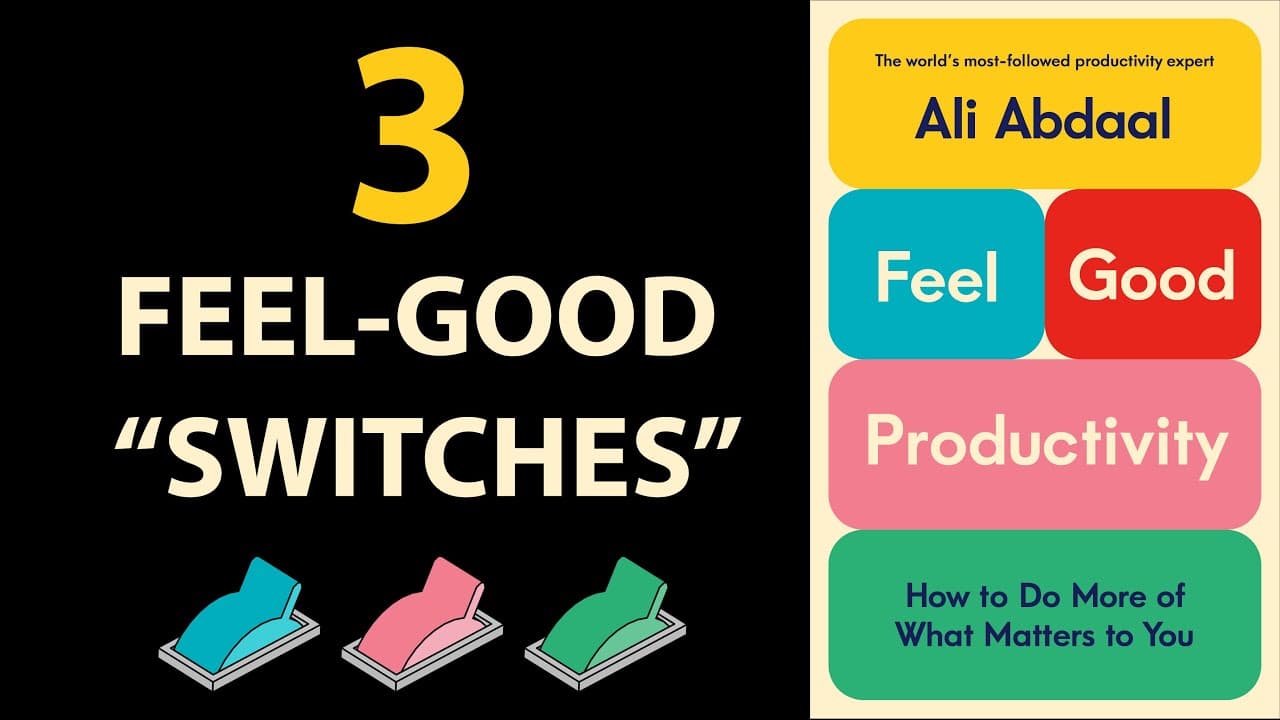
Feeling good while you work raises your energy and creativity, and that boosts productivity, which makes you feel even better. To start this cycle, keep asking, 'What would this look like if it were fun?' Then turn on three feel-good switches: curiosity through daily side quests, connection by working alongside others, and confidence by copying the assurance of an expert.
Transcript
I recently read Feelgood productivity by Ali abdal how does someone work as a full-time doctor and create a YouTube channel with several million subscribers Well author Ali abdal knows because that's precisely what he did and he did it with minimal suffering instead of grinding out 100h hour work weeks and hoping to feel good after achieving someth... Read More
Key Insights
- Feel-good productivity is a virtuous cycle: feeling good while working increases energy and creativity, which boosts productivity, and being productive in turn makes you feel even better. Ali Abdaal used this approach instead of grinding through 100-hour work weeks.
- The central question for enjoyable work is 'What would this look like if it were fun?' Repeating it helps you find ways to turn ordinary work tasks into experiences you enjoy.
- Curiosity, connection and confidence are the three feel-good conditions. They work like light switches you turn on before starting work, and they trigger the feel-good hormones dopamine, oxytocin and serotonin.
- A daily side quest is one of the best ways to turn on curiosity. Matthew Dicks made his McDonald's drive-thru job exciting with an upselling game, such as declaring a 'barbecue sauce day' and pitching the sauce with every order.
- Side quests can be small and scheduled between work blocks. Examples include building a work playlist, working from a park or cafe, seeing how much you can finish in a 20-minute timer, or rating your calm after a 5-minute meditation.
- Recruiting a sidekick turns on the connection switch, and that person does not even need to talk to you. Ali attended The Writer's Hour, a free virtual co-working session hosted by the London Writer Salon, where hundreds of writers worked in tandem for 50 minutes.
- Virtual co-working spaces such as Focusmate, Flow Club and Cave Day make connection easy. If none is available, spend 20 seconds with your eyes closed picturing people who are working toward similar goals, as if you are all on one team.
- Copying the confidence of a skilled person helps you get past fear and uncertainty. In a Clemson University study, students who watched an expert climber before climbing had less self-doubt, enjoyed climbing more and reached their objectives faster.
Install to Summarize YouTube Videos and Get Transcripts
Explore YouTube Video Summarizer or Get YouTube Transcript Extractor
Questions & Answers
Q: What is feel-good productivity?
Feel-good productivity is the idea that you should feel good while you work instead of hoping to feel good after a big achievement. As Ali Abdaal puts it, step one is to feel good and step two is to do more of what matters. Feeling good increases energy and creativity, which boosts productivity, and being productive makes you feel even better, forming a virtuous cycle.
Q: How can I make boring work tasks more fun?
Keep asking yourself, 'What would this look like if it were fun?' until you find a way to turn the task into something enjoyable. Speed this up by turning on three feel-good conditions: curiosity, connection and confidence. In practice, that means adding a daily side quest, working alongside other people, and borrowing the confidence of an expert who does the same task well.
Q: What are the three feel-good conditions for productivity?
The three feel-good conditions are curiosity, connection and confidence. They work like light switches you can turn on before you start working. Turning them on triggers the feel-good hormones dopamine, oxytocin and serotonin, which fuel a highly productive state. Curiosity comes from side quests, connection from sidekicks or co-workers, and confidence from copying skilled experts.
Q: What is a work side quest and what are some examples?
A side quest is a small, playful challenge added to your workday to spark curiosity. Matthew Dicks, a world champion storyteller, invented an upselling game at a McDonald's drive-thru, where he would pitch barbecue sauce on every order for a whole day. Other examples are building a work playlist, working in a park or cafe, racing a 20-minute timer, or rating your calm after a 5-minute meditation between work blocks.
Q: How does virtual co-working help with focus?
Working in tandem with others turns on the connection switch, even when everyone is working on different things. While writing his book, Ali Abdaal joined The Writer's Hour, a free Zoom session from the London Writer Salon where a few hundred writers met four times every weekday. A facilitator gave a 5-minute motivational message, people posted their intentions in the chat, and then everyone worked for 50 minutes. Ali found it kept him energized and focused.
Q: Where can I find virtual co-working sessions?
Virtual co-working spaces are widely available through sites such as Focusmate, Flow Club and Cave Day, and The Writer's Hour from the London Writer Salon is free for writers. The goal is to be around people, online or in person, who are doing similar work. If that is not possible, take 20 seconds before you start to close your eyes and imagine others working toward similar goals, as if you are on one team.
Q: How do I overcome procrastination caused by fear or uncertainty?
You put off work when it creates fear of not meeting expectations or uncertainty about what to do next. One way past this is to copy the confidence of a highly skilled person. Watch a YouTube video of someone doing the task well, or close your eyes and imagine an expert doing it, then act with their confidence for the next 10 minutes. Even if the first output is weak, you usually gain momentum and a few good ideas.
Q: What did the Clemson University climbing study find?
Clemson University researchers split students at a rock climbing wall into two groups. One group watched a short video of an expert confidently climbing a similar wall, and the other watched nothing. Both groups then got the same instructions and objectives. The group that watched the expert had less self-doubt, enjoyed climbing more and reached their climbing objectives faster, which shows how copying a skilled person's confidence improves both enjoyment and performance.
Summary & Key Takeaways
-
Ali Abdaal worked as a full-time doctor while building a YouTube channel with several million subscribers, and he did it without endless grinding. His method is to feel good first. Feeling good raises energy and creativity, which raises productivity, which makes you feel better again. This forms a self-reinforcing cycle anyone can start.
-
To start the cycle, ask 'What would this look like if it were fun?' and turn on three switches. Curiosity comes from daily side quests, like Matthew Dicks' barbecue sauce upselling game. Connection comes from working alongside others, such as in virtual co-working sessions like The Writer's Hour, Focusmate, Flow Club or Cave Day.
-
Confidence comes from copying skilled experts. Clemson students who watched an expert climber had less self-doubt and climbed faster. Ali pictured a master magician when performing at parties. When you resist a task, watch or imagine an expert doing it, then act with their confidence for 10 minutes to build momentum.
Read in Other Languages (beta)
Share This Summary 📚
Summarize YouTube Videos and Get Video Transcripts with 1-Click
Try YouTube Summary with ChatGPT & Claude or YouTube Transcript Generator
Explore More Summaries from Productivity Game 📚
Summarize YouTube Videos and Get Video Transcripts with 1-Click
Try YouTube Summary with ChatGPT & Claude or YouTube Transcript Generator