How to Build Reusable AI Skills Instead of Agents
TL;DR
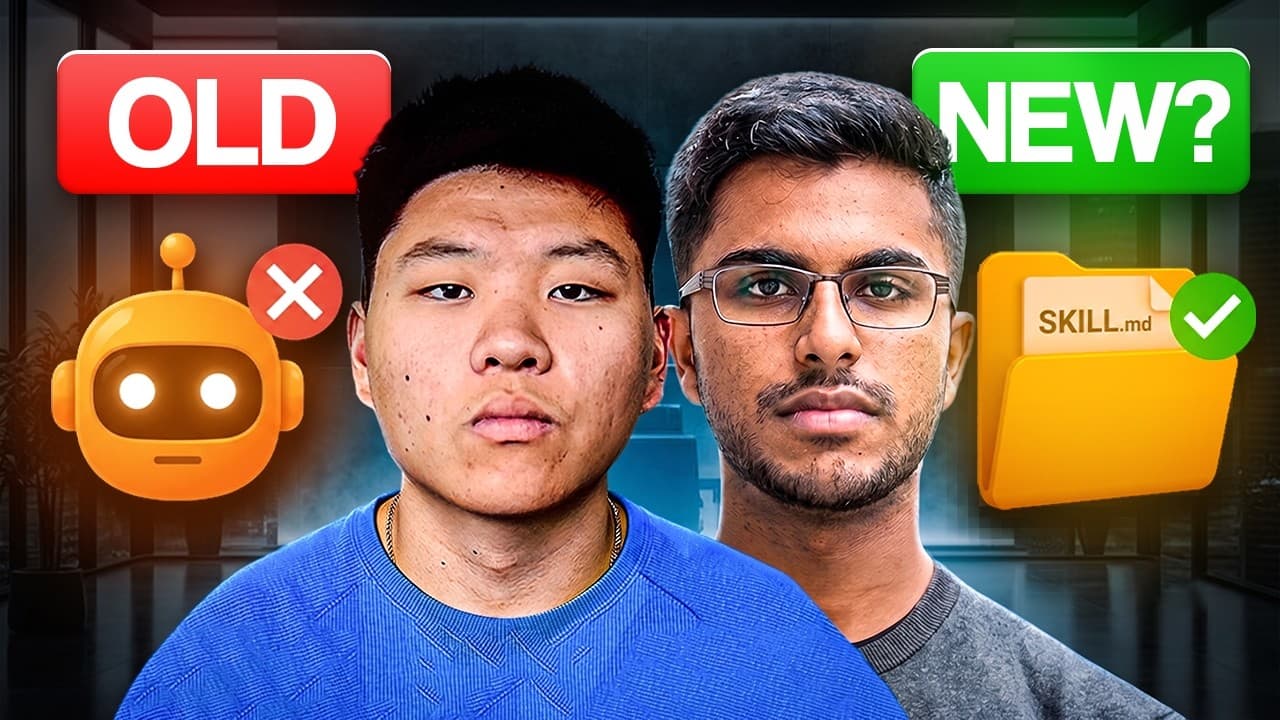
Build reusable skills around a general-purpose agent instead of creating a separate agent for every job. Store proven scripts, write precise trigger descriptions, preserve corrections as durable instructions or references, and require the system to inspect and revise its own output. This approach reduces repeated work, improves consistency, and lets workflows become more reliable over time.
Transcript
So, Enthropic Engineers just said that they stopped building agents and they started building something completely different. So, if you're still focused on building agents, you're probably wasting hours on something that'll never work the way that you actually want it to. But if you focus on what these engineers are actually building, you'll have ... Read More
Key Insights
- A reusable skill gives a general-purpose agent specialized capabilities by packaging the process, context, scripts, and examples for one job. This avoids rebuilding a separate agent whenever the user needs a presentation, research report, LinkedIn post, or another recurring deliverable.
- Proven scripts should be stored as tools for future runs instead of regenerated from scratch. Reusing working code reduces token consumption, limits variation between runs, and allows the agent to focus on new content rather than repeatedly rediscovering the same technical implementation.
- Progressive disclosure works by loading skill information only when the task requires it. The agent initially sees each skill's name and description, then reads the full skill instructions and supporting files after the user's request matches that skill's stated purpose.
- Clear skill descriptions determine whether the correct workflow activates. Each description should identify the specific job, include phrases that real users are likely to use, and avoid overlapping with descriptions for other skills that could compete for the same request.
- Skill routing should be tested with an obvious matching request, an alternative phrasing that should still match, and an unrelated request that should not match. These checks reveal whether the description is discoverable without causing inappropriate activation.
- Corrections become reusable knowledge only when they are written into the skill. Process failures belong in the instructions, missing voice or brand context belongs in reference files, recurring mistakes require explicit preventive rules, and unreliable technical steps may require saved code.
- Portable processes require explicit assumptions, examples, and instructions. Skills use an open format that can work across compatible agent harnesses, but different models can still interpret them differently, so important workflows should be tested and tightened when results deteriorate.
- Self-review should be part of the workflow rather than left to the user. A skill can render and inspect slides, verify research claims against primary sources, or ask several reviewer personas to evaluate subjective work before revising and delivering the result.
- More videos from this channel:
- More from this channel: Nate Herk | AI Automation
Install to Summarize YouTube Videos and Get Transcripts
Explore YouTube Video Summarizer or Get YouTube Transcript Extractor
Questions & Answers
Q: What should you build instead of a separate AI agent for every job?
Build reusable skills that attach specialized procedures to the same general-purpose agent. Each skill can contain the process, context, scripts, examples, and references needed for a particular job. The underlying agent already reads files, writes code, calls tools, and works through tasks, so the skill supplies focused job knowledge without duplicating those general capabilities in a new agent.
Q: How do reusable AI skills reduce repeated work?
Reusable skills reduce repeated work by preserving technical solutions that have already produced good results. When the agent creates a useful script, renderer, or template, that asset can be stored in the skill and referenced during later runs. The agent then executes proven code instead of spending tokens recreating it, which also makes results more consistent across repeated tasks.
Q: What is progressive disclosure in an AI skill system?
Progressive disclosure is a method for loading information only when it becomes relevant. At startup, the agent sees the names and descriptions of available skills rather than every instruction, example, reference, and script. When a request matches a skill description, the agent reads the full skill file and accesses larger supporting materials only if the task needs them, reducing irrelevant context and confusion.
Q: How should an AI skill description be written?
An AI skill description should clearly state what the skill produces and when it should activate. It should include the terms that a real person would use when requesting that output and remain focused on one specific job. Descriptions should also avoid overlapping with other skills, because vague phrases such as helping with content can leave the agent guessing which workflow belongs to the request.
Q: How can you test whether an AI skill triggers correctly?
Test skill routing with three kinds of prompts. First, use an obvious request that should activate the skill. Second, use a differently worded request that should still activate it. Third, submit an unrelated request that should not activate it. Reviewing these outcomes shows whether the description captures realistic language, remains discoverable, and avoids competing with workflows intended for other jobs.
Q: How can an AI skill improve after a failed run?
After a failed run, identify whether the cause was a faulty process, missing context, a weak rule, or unreliable code. Update the smallest durable part of the skill that addresses that cause, such as the main instructions, a reference file, an explicit preventive rule, or a saved script. Then rerun the same task and verify that the change fixes the original problem.
Q: Can the same AI skill work across different models or agent systems?
The same core skill folder can work across compatible agent harnesses because agent skills use an open format. However, a skill cannot force a weaker model to behave exactly like a stronger one, and different models may interpret instructions differently. Testing an important skill elsewhere can expose hidden assumptions, missing examples, or wording that only one model understands, allowing the process to be tightened.
Q: How should an AI skill validate its own output?
The skill should include the checks a knowledgeable human would normally perform after receiving the first draft. A presentation workflow can render slides as images, inspect them for cropped or unreadable elements, fix problems, and render again. A research workflow can open primary sources, match claims to evidence, and remove unsupported statements. Subjective work can be reviewed by personas representing different audience perspectives.
Summary & Key Takeaways
-
A general-purpose agent can handle many jobs when specialized skills provide the relevant process, context, scripts, and examples. The model functions like a processor, the agent runtime resembles an operating system, and skills act like applications that give the same underlying system focused capabilities without rebuilding a separate agent for every task.
-
Reusable code prevents the agent from solving the same technical problem during every run. Proven renderers, templates, and scripts should be saved inside a skill and referenced by its instructions. The workflow should then be rerun and checked to confirm that it executes the saved file and produces consistent results instead of rewriting the solution.
-
Effective skills use precise descriptions, incorporate lessons from failed runs, and validate their own output. Instructions should state what each skill does and when it should activate. Corrections should update the smallest durable component, while built-in review steps should inspect formatting, evidence, clarity, and other known quality requirements before declaring completion.
Read in Other Languages (beta)
Share This Summary 📚
Summarize YouTube Videos and Get Video Transcripts with 1-Click
Try YouTube Summary with ChatGPT & Claude or YouTube Transcript Generator
Explore More Summaries from Nate Herk | AI Automation 📚





Summarize YouTube Videos and Get Video Transcripts with 1-Click
Try YouTube Summary with ChatGPT & Claude or YouTube Transcript Generator