What Is the Block Universe and Time Reality?
TL;DR
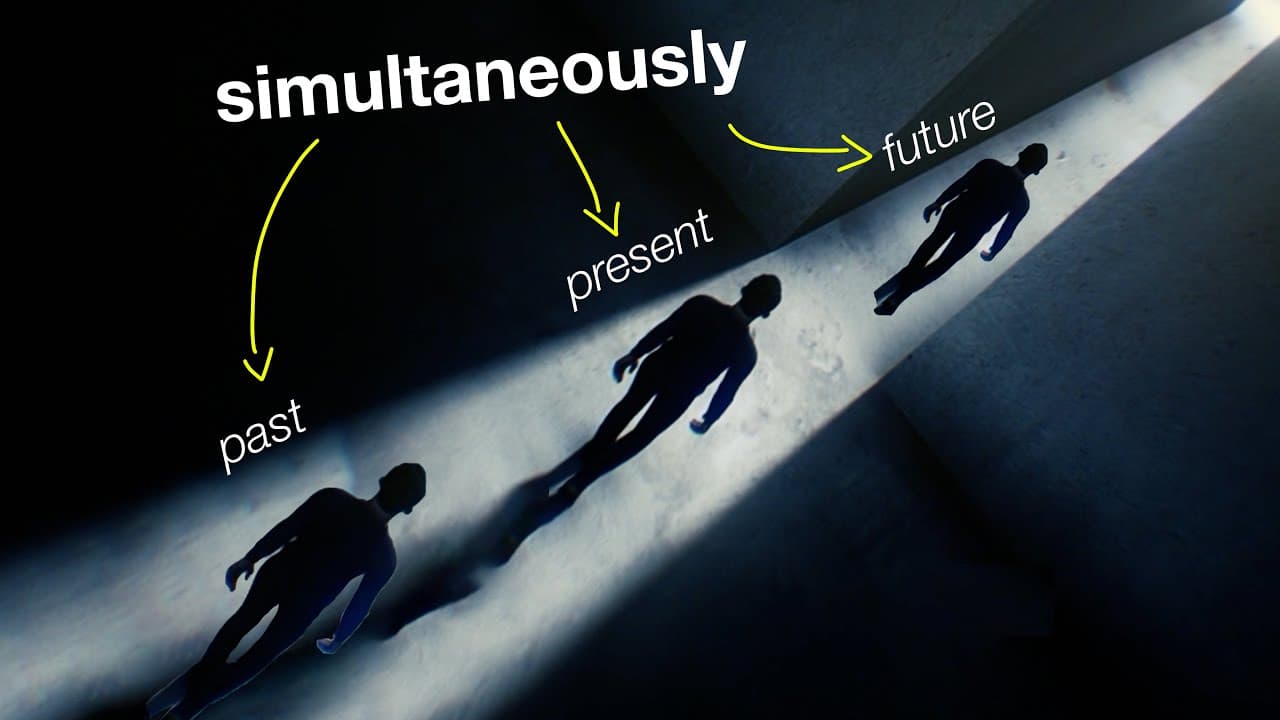
The block universe says time is like space, with past, present, and future all real at once. Our conscious flow through time is a perception, not an external process, and relativity shows that different observers disagree on what is happening now. Free will and branching timelines are debated within this four dimensional structure.
Transcript
in 1955 Albert Einstein wrote a letter to the family of a close friend who had just died he said "The distinction between past present and future is only a stubborn illusion." Decades earlier his own equations had revealed that time doesn't behave the way we think it should it bends it stretches and it depends on how you move two people in differen... Read More
Key Insights
- Time is not a simple flow but an arrangement where past, present, and future exist together in a four dimensional spacetime.
- Relativity introduces a relative now, meaning different observers have valid but conflicting perceptions of what is happening at the same moment.
- The Andromeda paradox shows that motion alters the slice of spacetime each observer experiences, leading to disagreements about distant events.
- The block universe implies that every event is already part of the structure, and we navigate a preexisting landscape rather than create it in real time.
- Time distortions from motion and gravity are real, measurable effects used in technologies like GPS to correct positions.
- Consciousness scans moments sequentially, while the entire spacetime fabric contains all moments simultaneously.
- Some interpretations of quantum mechanics, such as many worlds, describe branching timelines where multiple versions of events exist within spacetime.
- The debate on free will ranges from libertarian to hard determinism, questioning whether choice can be real if futures already exist in the block structure.
- More videos from this channel:
- More from this channel: Be Inspired
Install to Summarize YouTube Videos and Get Transcripts
Explore YouTube Video Summarizer or Get YouTube Transcript Extractor
Questions & Answers
Q: What is the block universe and why does it matter?
The block universe is the idea that time is a four dimensional structure in which past, present, and future all exist together. This matters because it challenges everyday intuition that time flows and that only the present is real. If time is laid out like space, the future could already be part of reality, influencing how we think about causality, decision making, and the nature of free will. The concept also explains why motion and gravity create real time distortions that are measurable and essential for technologies like GPS.
Q: How does relativity affect our sense of now?
Relativity shows simultaneity is relative, meaning different observers can disagree on what the present moment is for distant events. This means there is no single universal now that applies everywhere in the universe. The result is that our experience of time is a subjective slice through a much larger four dimensional structure, and each observer’s slice can be valid yet incompatible with another’s.
Q: What is the Andromeda paradox and what does it illustrate?
The Andromeda paradox arises when you consider observing Andromeda while moving. If you and a friend are in different states of motion, the events you see on Andromeda can be days apart due to your different frames of reference. This illustrates how motion changes the perception of time and highlights that there can be disagreement about what is happening now in distant regions of the universe, challenging a single universal present.
Q: Do all possible events exist in the block universe?
Yes, within the block universe, every event that could occur is encoded in the four dimensional spacetime. This includes past events, present moments, and future possibilities. The structure acts like a map where all trajectories exist, and our consciousness experiences only one path at a time as we move through it. This does not imply static fate, but rather a landscape of all potential histories present in reality.
Q: How does the block universe relate to free will?
Free will is debated in the context of a block universe where futures exist structurally. Libertarian free will argues that we could have acted differently, yet if the future is already part of spacetime, choosing differently may be constrained by prior conditions. Determinism suggests all actions are predetermined by causes, while some interpretations of physics propose branching timelines where multiple outcomes exist but our experience follows a single path, shaping our sense of agency.
Q: What role does consciousness play in our experience of time?
Consciousness appears to move through time one moment after another while the spacetime fabric contains all moments. This subjective sequence creates the sense of flow, but it does not imply time itself flows. The brain aligns with a moving attention along a preexisting spacetime structure, producing a continuous experience from a series of discrete, real moments.
Q: What are timeline fractals and branching paths in this view?
Timeline fractals describe how a single moment can lead to multiple possibilities that each form their own paths through spacetime. These branches can reconnect or diverge, influenced by choices, randomness, and external events. This view suggests a dense network of possibilities embedded in the four dimensional structure, where our decisions reveal one path while others remain part of the landscape.
Q: How does this theory address the idea of déjà vu or precognition?
From this perspective, déjà vu and precognition can be understood as experiences arising from the complex geometry of spacetime where memories, impressions, or potential futures echo in the present. Since all moments exist within the block universe, the mind may encounter patterns that feel forewarned or familiar, reflecting deeper connections across the spacetime fabric rather than supernatural foresight.
Summary & Key Takeaways
-
The block universe treats time as a four dimensional structure where all moments exist together, and our experience of time is a moving spotlight rather than a true flow.
-
Relativity demonstrates that simultaneity is relative, causing observers in different frames to disagree on the present, which challenges the idea of a universal now.
-
Branching timelines and the role of free will are discussed within interpretations like many worlds and determinism, framed by the idea that all possibilities exist within spacetime.
Read in Other Languages (beta)
Share This Summary 📚
Summarize YouTube Videos and Get Video Transcripts with 1-Click
Try YouTube Summary with ChatGPT & Claude or YouTube Transcript Generator
Explore More Summaries from Be Inspired 📚
Summarize YouTube Videos and Get Video Transcripts with 1-Click
Try YouTube Summary with ChatGPT & Claude or YouTube Transcript Generator