What Is Analytic Idealism and Is Reality Mental?
TL;DR
Consciousness, not matter, is presented as the foundation of reality, while matter is described as the outward appearance of mental activity. Analytic idealism uses a dashboard metaphor to argue that perception gives living beings representations rather than direct access to reality, and it explains separate organisms as dissociated centers within one universal field of consciousness.
Transcript
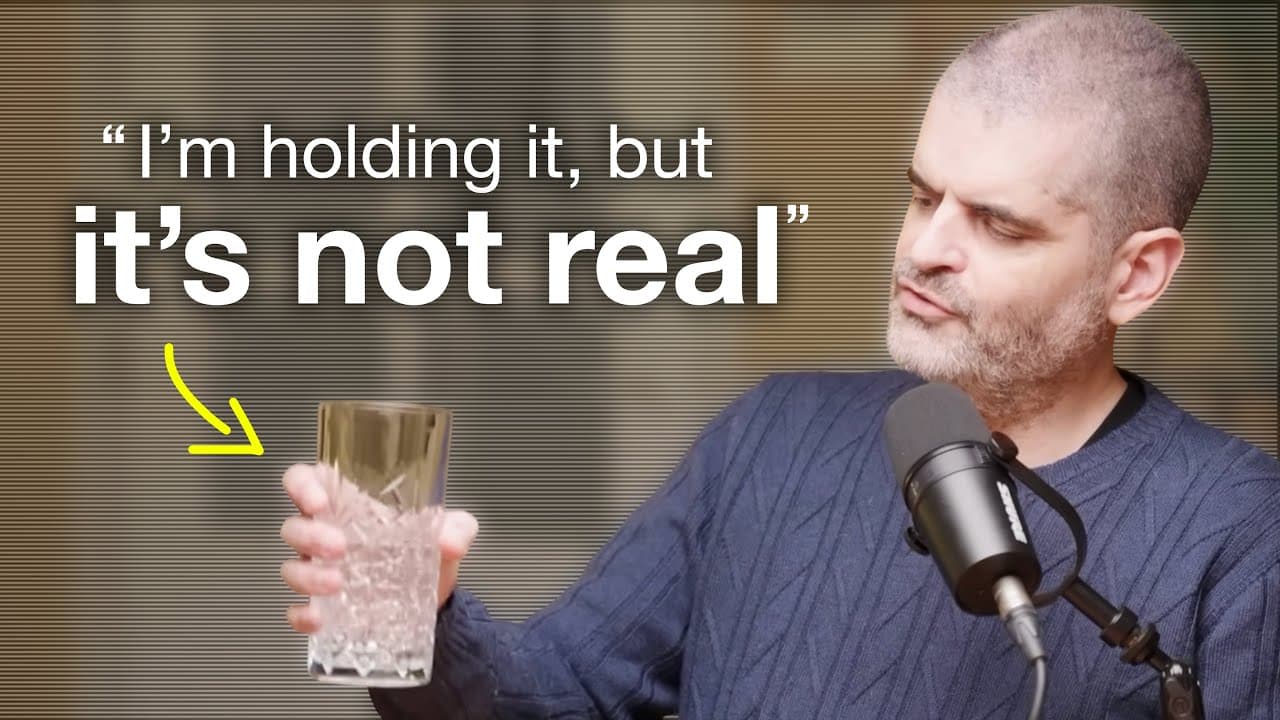
When there are no living beings looking around, there is no matter. Matter is always in all cases without exception without a single exception. Matter is always what mind looks like. You know if I hold this glass and feel its solidity and weight these are mental qualities. Solidity and weight are qualities in my conscious states. God is not this ma... Read More
Key Insights
- Analytic idealism is the view that everything is inherently mental, with consciousness serving as the basic foundation of reality. It challenges the assumption that matter exists as a fundamentally independent substance and that conscious experience is merely produced by physical processes.
- Matter is described as a dashboard representation rather than the underlying reality itself. Just as airplane instruments represent conditions in the sky, sensory qualities and physical forms represent deeper processes that living beings encounter through their perceptual interfaces.
- Perception is an organized stream of processed impressions, including shapes, colors, sounds, textures, solidity, and weight. Because everything known about the world arrives within conscious experience, the framework questions whether observers ever access an independent physical reality directly.
- The brain is presented as what a person's mental activity looks like from an outside perspective. Thoughts, memories, emotions, desires, hunger, colors, and tastes are experienced internally, while the same processes appear externally to other observers as tissue, neurons, and brain activity.
- Matter is treated as the appearance of consciousness rather than its source. The material world consequently becomes a secondary representation of processes that are mental at their core, with physical form arising when those processes are observed across a boundary.
- Appearances require a boundary between an observer and what is observed. An outside view can arise only when there is a distinction between inside and outside, so division and perspective are necessary conditions for mental activity to appear as physical structure.
- Dissociation is proposed as the mechanism that produces apparently separate living organisms within one universal mind. Each organism functions as a localized center of experience, while the mental reality outside those localized centers is described as mind at large.
- Computational irreducibility is used to argue that exact future choices cannot be known through a shortcut. The universe must play itself out until a choice is made, so neither individuals nor God can anticipate the precise outcome before the relevant process unfolds.
Install to Summarize YouTube Videos and Get Transcripts
Explore YouTube Video Summarizer or Get YouTube Transcript Extractor
Questions & Answers
Q: What is analytic idealism?
Analytic idealism is the view that reality is fundamentally mental rather than physical. It proposes that consciousness is primary and that matter is how mental activity appears when observed from an outside perspective. Instead of asking people to accept the claim through belief, the framework begins with the observation that all knowledge, including knowledge of objects, arrives through conscious sensation and experience.
Q: How does the dashboard metaphor explain perception?
The dashboard metaphor compares a living being's perceptual system to an airplane instrument panel. The panel displays representations created from measurements of the sky and clouds, but those readings are not the sky itself. Similarly, shapes, colors, sounds, and textures are presented within awareness as organized readings of a deeper reality rather than as direct access to that reality.
Q: Does matter exist when no living beings are observing it?
Under the account presented, matter does not exist without living beings because matter is defined as a dashboard representation that requires a perceptual dashboard. The deeper reality represented by matter does continue to exist, just as the sky remains when no airplane is displaying instrument readings. The claim therefore denies unobserved matter, not the persistence of the underlying reality.
Q: Does the brain generate consciousness in analytic idealism?
The brain is not presented as a generator that produces consciousness from matter. It is described as the external appearance of mental activity when another observer views that activity across a boundary. From inside, the process consists of thoughts, memories, emotions, desires, sensations, and imagination. From outside, the same process appears as a physical brain, neurons, and measurable activity.
Q: Why does matter feel solid if reality is mental?
Solidity and weight are described as qualities within conscious states. Holding a glass produces stable experiences of resistance, heaviness, coolness, and transparency, but those experienced qualities do not prove that matter is fundamentally independent of mind. In analytic idealism, the glass remains a shared and structured representation of a deeper mental dynamic, which explains why its appearance can be consistent.
Q: How does dissociation create separate conscious beings?
Dissociation is proposed as the process through which one universal field of consciousness forms localized centers of experience. These centers appear to be separate minds associated with living organisms, although they remain rooted in the same field. The boundary created by dissociation distinguishes inside from outside, allowing internal mental life to appear externally as a body, nervous system, or brain.
Q: Why do mental processes appear as physical objects?
Mental processes appear physical when they are viewed from outside the boundary separating an observer from the observed process. A person's sorrow, hunger, memories, desires, colors, and tastes are directly experienced from within, while another observer sees the associated body and brain. The framework extends this inside and outside relationship beyond nervous systems to matter throughout the wider world.
Q: How does analytic idealism explain free will and prediction?
The discussion rejects the simple libertarian idea that every action could always have been otherwise as probably incoherent. It instead emphasizes computational irreducibility: exact choices cannot be predicted by taking a shortcut through the universe's unfolding process. The only way to know a choice precisely is to let events proceed until the choice is actually made, which limits anticipation for everyone, including God.
Summary & Key Takeaways
-
Analytic idealism begins with the claim that everything is inherently mental. Human knowledge of the physical world arrives through conscious sensations such as light, sound, touch, solidity, and weight. The framework therefore treats matter not as reality's independent foundation, but as a structured representation of deeper mental activity.
-
The dashboard metaphor compares perception to an airplane instrument panel. A dashboard displays measurements of the sky without being the sky itself. Likewise, matter is said to exist as a perceptual representation only when living beings possess the necessary interface, while the deeper reality represented by matter continues independently of observation.
-
The framework describes brains, bodies, and objects as external appearances of mental processes. Separate organisms arise through dissociation within one universal consciousness, producing boundaries between observers and observed phenomena. These boundaries create distinct perspectives and physical appearances while leaving every localized center rooted in the same underlying field of mind.
Read in Other Languages (beta)
Share This Summary 📚
Summarize YouTube Videos and Get Video Transcripts with 1-Click
Try YouTube Summary with ChatGPT & Claude or YouTube Transcript Generator
Explore More Summaries from Be Inspired 📚


Summarize YouTube Videos and Get Video Transcripts with 1-Click
Try YouTube Summary with ChatGPT & Claude or YouTube Transcript Generator