Did CERN Experiments Alter Our Reality?
TL;DR
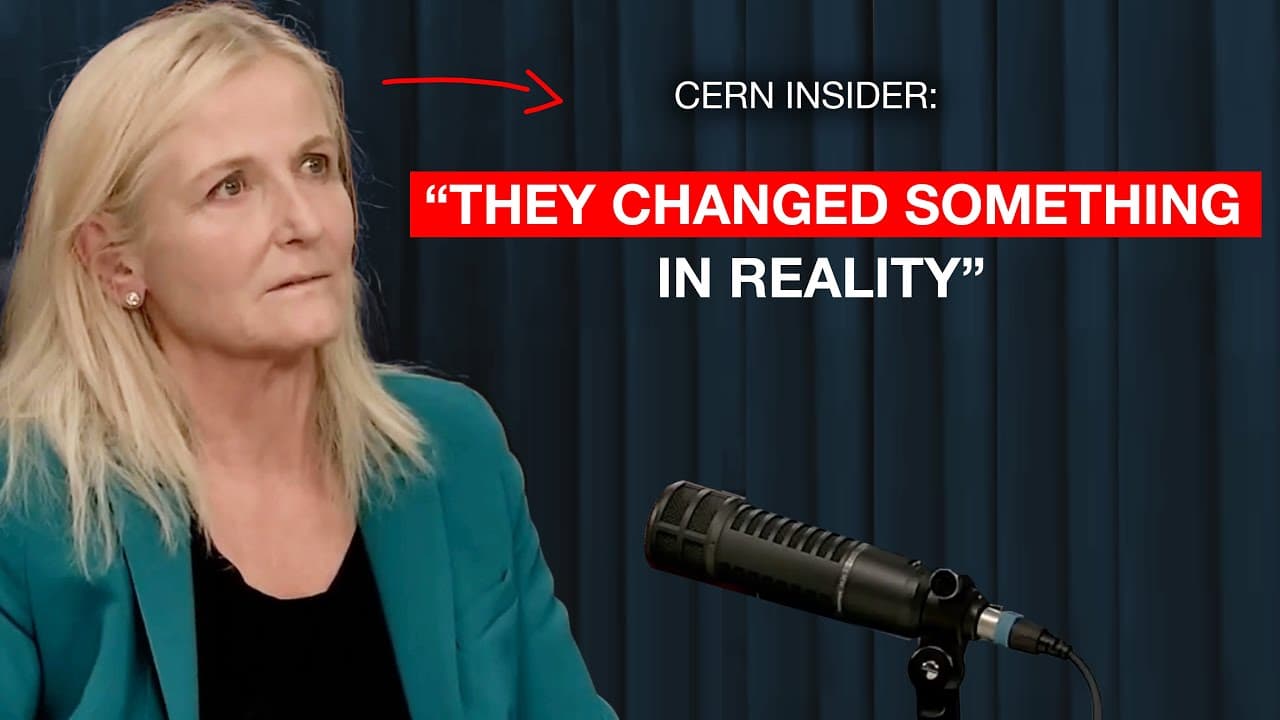
CERN's Large Hadron Collider might have altered reality, as some claim it coincides with the Mandela Effect, where collective memories don't match recorded facts. The video explores if CERN's experiments could have opened dimensions or realities, potentially explaining these memory discrepancies.
Transcript
they had changed something in the reality. They are disclosing that they are doing all this type of research on wormholes, black holes, change of time and space. I mean officially >> yes she's talking about CERN and something strange happened there in November 2009. CERN's director of research Sergio Bertluchi made a very interesting statement. Thi... Read More
Key Insights
- CERN's Large Hadron Collider is a 27 km underground ring where particles are accelerated and collided to study fundamental physics.
- The Mandela Effect describes collective false memories, possibly linked to CERN's experiments, suggesting altered realities.
- CERN's experiments aim to recreate conditions similar to the Big Bang, raising concerns about unknown phenomena like black holes.
- The location of CERN near Geneva may have geological significance, potentially affecting the outcomes of its high-energy experiments.
- CERN's research includes exploring extra dimensions and wormholes, which could hypothetically alter time and space.
- The Mandela Effect examples include misremembered details in popular culture, suggesting possible shifts between parallel realities.
- CERN's experiments have faced legal challenges due to fears of potential catastrophic outcomes, but courts have not intervened.
- Trust in scientific explanations often replaces direct verification, as the public lacks access to raw data and experimental results.
Install to Summarize YouTube Videos and Get Transcripts
Explore YouTube Video Summarizer or Get YouTube Transcript Extractor
Questions & Answers
Q: What is the Mandela Effect?
The Mandela Effect refers to a phenomenon where a large group of people remember an event or detail differently from how it is recorded in reality. It is named after Nelson Mandela, whom many falsely remembered as having died in prison in the 1980s, despite him living until 2013. This phenomenon suggests possible shifts between parallel realities or collective memory errors.
Q: How does the Large Hadron Collider work?
The Large Hadron Collider (LHC) is a massive particle accelerator located near Geneva. It operates by accelerating particles, such as protons, to near the speed of light and then colliding them. These collisions allow scientists to study fundamental particles and forces, recreating conditions similar to those just after the Big Bang, to gain insights into the universe's fundamental structure.
Q: Why is CERN located near Geneva?
CERN is located near Geneva due to Switzerland's political neutrality, stability, and central location in Europe, making it an ideal host for an international scientific organization. Additionally, the area's geological features, such as proximity to the Alps and tectonic stability, may provide a suitable environment for the massive underground installations required for CERN's experiments.
Q: What concerns exist about CERN's experiments?
Concerns about CERN's experiments primarily revolve around the unknown outcomes of high-energy collisions, such as the potential creation of microscopic black holes or other exotic states of matter. These fears have led to legal challenges, though courts have dismissed them due to jurisdictional issues, not safety assessments, leaving some public anxiety about the experiments' implications.
Q: What is the significance of CERN's experiments with extra dimensions?
CERN's experiments with extra dimensions aim to explore theoretical physics concepts that suggest our universe might have more than the four known dimensions (three spatial and one temporal). Discovering or manipulating these dimensions could revolutionize our understanding of reality, potentially explaining phenomena like gravity's relative weakness or the nature of dark matter and energy.
Q: How does the Mandela Effect relate to CERN?
The Mandela Effect is speculated to relate to CERN through the hypothesis that high-energy experiments at the Large Hadron Collider may alter realities or open dimensions, causing collective memory discrepancies. While this idea is largely theoretical and not scientifically proven, the timing of CERN's operations and the rise of Mandela Effect examples fuels public curiosity and debate.
Q: What examples illustrate the Mandela Effect?
Examples of the Mandela Effect include collective false memories such as the Monopoly man having a monocle, the Berenstain Bears being spelled with an 'E' as 'Berenstein,' or Darth Vader's line being remembered as 'Luke, I am your father.' These misremembered details suggest possible shifts between parallel realities or widespread memory errors.
Q: What are some challenges in verifying CERN's research?
Verifying CERN's research is challenging for the general public due to the complex, abstract nature of particle physics, which requires specialized equipment and knowledge. Most people lack access to raw data or the ability to observe phenomena like black holes or subatomic particles, leading to reliance on scientific explanations that cannot be independently confirmed, creating a trust gap.
Summary & Key Takeaways
-
CERN's Large Hadron Collider conducts high-energy experiments to explore fundamental physics, potentially altering reality. Some associate these experiments with the Mandela Effect, where collective memories differ from documented facts, suggesting shifts in parallel realities.
-
The Mandela Effect includes misremembered details in culture, possibly linked to CERN's experiments. CERN's location near Geneva may have geological significance, affecting outcomes. Concerns about unknown phenomena like black holes have led to legal challenges, though courts haven't intervened.
-
CERN researches phenomena like extra dimensions and wormholes, which could impact time and space. Trust in scientific explanations often substitutes for direct verification due to public inaccessibility to raw data. The video's key question is whether CERN's work has altered reality.
Read in Other Languages (beta)
Share This Summary 📚
Summarize YouTube Videos and Get Video Transcripts with 1-Click
Try YouTube Summary with ChatGPT & Claude or YouTube Transcript Generator
Explore More Summaries from Be Inspired 📚
Summarize YouTube Videos and Get Video Transcripts with 1-Click
Try YouTube Summary with ChatGPT & Claude or YouTube Transcript Generator