How to Design High-Converting Landing Pages

TL;DR
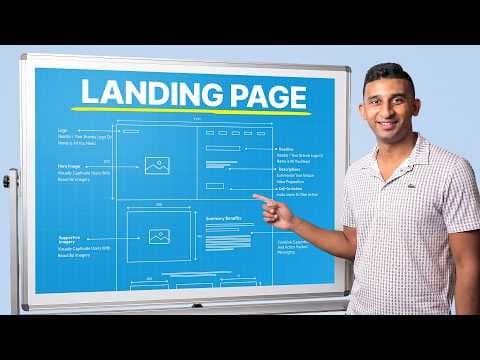
Designing an effective landing page requires continuous optimization and testing. Key elements include a strong value proposition, compelling visuals, and clear CTAs. Avoid copying competitors; instead, focus on your audience's needs. Use data to drive decisions and ensure the design is visually appealing to build trust and credibility.
Transcript
i've designed over 400 landing pages in over 80 niches and through all of that experience I've learned what's actually important when it comes to your landing page so in this video I'll be revealing my top 40 pieces of advice when it comes to designing a killer landing page that'll get you more leads and sales no matter what niche or industry you'r... Read More
Key Insights
- Continuous testing and optimization are essential for landing page success.
- A strong value proposition should be front and center on your landing page.
- Visual appeal significantly impacts brand credibility and conversion rates.
- Design should facilitate easy scanning, using headings and bullet points.
- Images should be purposeful, enhancing the message and not just fillers.
- Proven layouts save time and provide a foundation for further iteration.
- Data analysis is crucial for identifying what works and what doesn't.
- Design should prioritize clarity over cleverness to avoid losing conversions.
Install to Summarize YouTube Videos and Get Transcripts
Explore YouTube Video Summarizer or Get YouTube Transcript Extractor
Questions & Answers
Q: How to optimize a landing page for conversions?
To optimize a landing page for conversions, focus on a strong value proposition, clear and compelling CTAs, and visually appealing design. Use data analysis tools like Microsoft Clarity to understand user behavior and identify areas for improvement. Regularly test different elements and iterate based on results to enhance performance.
Q: What role do images play in landing page design?
Images are crucial in landing page design as they help convey the brand's message quickly and effectively. They should be relevant and aligned with the value proposition, aiding in visual storytelling. Proper use of images can enhance user engagement and contribute to higher conversion rates by making the page more visually appealing.
Q: Why is it important to avoid copying competitors' landing pages?
Copying competitors' landing pages is ineffective because their audience and value proposition differ from yours. Instead, focus on understanding your unique audience's needs and pain points. Design your landing page to address these specifics, ensuring that it resonates with your target market and stands out through differentiation.
Q: How does data influence landing page design decisions?
Data influences landing page design by providing insights into user behavior and preferences. Analyzing data helps identify which elements are working and which need improvement. This information guides design decisions, ensuring that changes are based on actual user interactions, ultimately leading to more effective and higher-converting landing pages.
Q: What is the importance of visual hierarchy in landing page design?
Visual hierarchy is crucial in landing page design as it guides users' attention to the most important elements. By using headings, subheadings, and whitespace strategically, you can make content more digestible and direct users through the page effectively. A well-structured visual hierarchy enhances user experience and boosts conversion rates.
Q: How can AB testing improve landing page performance?
AB testing improves landing page performance by allowing you to test different versions of elements like headlines, images, and CTAs to see which performs better. It helps you understand what resonates with your audience, leading to data-driven decisions that enhance user experience and increase conversion rates over time.
Q: Why should landing pages be designed in Figma before development?
Designing landing pages in Figma before development allows for easy adjustments and feedback during the design phase. It enables quick iterations and ensures that the final design is well-thought-out and optimized for user experience. This approach reduces development time and ensures a pixel-perfect implementation of the design.
Q: What is the significance of mobile-specific design for landing pages?
Mobile-specific design is essential for landing pages because mobile users have different interaction patterns and screen sizes. A tailored design ensures that the page is user-friendly and engaging on mobile devices, with appropriate image sizes and visual hierarchy. This approach improves user experience and conversion rates on mobile platforms.
Summary & Key Takeaways
-
Landing pages are not a one-time effort; they require ongoing testing and optimization to improve conversion rates. A clear value proposition, compelling visuals, and strategic CTAs are critical elements. Avoid copying competitors; focus on understanding your audience's needs and use data to make informed design decisions.
-
Effective landing pages use proven layouts as a starting point and iterate based on collected data. Design should be visually appealing to build trust, and content should be structured for easy scanning. Images play a key role in conveying the message and should be aligned with the brand's value proposition.
-
Data-driven decisions are vital for landing page optimization. Tools like Microsoft Clarity provide insights into user behavior, helping identify areas for improvement. A focus on clarity, rather than cleverness, ensures that the landing page communicates its message effectively, leading to higher conversion rates.
Read in Other Languages (beta)
Share This Summary 📚
Summarize YouTube Videos and Get Video Transcripts with 1-Click
Try YouTube Summary with ChatGPT & Claude or YouTube Transcript Generator
Explore More Summaries from Arsh Sanwarwala | ThrillX 📚




Summarize YouTube Videos and Get Video Transcripts with 1-Click
Try YouTube Summary with ChatGPT & Claude or YouTube Transcript Generator