How to Optimize Landing Pages for Conversions

TL;DR
Prioritize conversion rate optimization by consistently testing the landing page elements most likely to influence visitors, especially the headline and supporting image above the fold. Use statistically valid split tests when traffic permits, or behavioral data and measured page changes when it does not, then apply both winning and losing results to improve messaging, efficiency, and future experiments.
Transcript
Alex Hermoszi is one of the most successful businessmen of our time. And he's exited multiple businesses for over eight figures. And part of the reason he got there is because of his conversion rates on his landing pages and websites. As someone who's built over 400 landing pages in over 80 niches, I was naturally curious to see what he had to say ... Read More
Key Insights
- Conversion rate optimization is a competitive advantage because advertising platforms charge businesses competing for the same attention. A company that converts more of its existing visitors can afford to compete more effectively than one that focuses only on acquiring additional traffic.
- Improving conversion efficiency is an alternative to increasing traffic when a business wants more revenue. A stronger conversion rate extracts more value from the audience already arriving and can amplify revenue and return on investment when additional traffic is later directed to the same page.
- A focused testing cadence is more useful than trying to test many ideas simultaneously. Selecting the hypothesis expected to create the greatest impact helps teams build a consistent optimization habit and makes the resulting evidence easier to interpret and apply.
- Statistical significance is essential for controlled split testing because testing frequency depends on traffic and existing conversion levels. Businesses without enough visitors should not force rapid experiments, but can use a testing calculator to estimate the required duration and sample size.
- Behavioral data is a practical alternative for lower-traffic pages that cannot support frequent traffic-splitting experiments. Teams can identify issues through Microsoft Clarity, make evidence-based changes, and measure performance over time without presenting simultaneous versions to equal visitor groups.
- Conversion knowledge compounds as winning and losing tests reveal what resonates with an audience. A successful hypothesis can inspire related experiments, while an unsuccessful one still provides useful evidence that improves future page design, messaging, and prioritization.
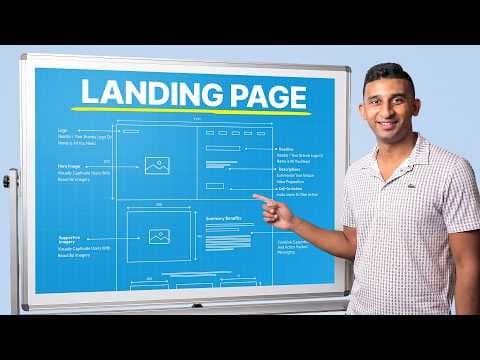
- The above-the-fold section is the highest-priority optimization area because every visitor initially encounters it, while many visitors do not continue scrolling. Headlines and images in this section therefore offer especially strong opportunities to influence understanding, trust, and action.
- A strong headline is a concise value proposition that communicates who the business serves, what it provides, and how the visitor benefits. A strong supporting image reinforces that promise by visually demonstrating the service, result, or type of value being offered.
Install to Summarize YouTube Videos and Get Transcripts
Explore YouTube Video Summarizer or Get YouTube Transcript Extractor
Questions & Answers
Q: How can I improve a landing page conversion rate?
Start by examining the above-the-fold section, since it is the area every visitor initially sees. Confirm that the headline clearly communicates who the offer is for, what the business provides, and how the visitor benefits. Then test meaningful headline variations and supporting images that reinforce the value proposition. Continue measuring results so each experiment informs the next improvement.
Q: Why is conversion rate optimization important as advertising costs rise?
Conversion rate optimization helps a business generate more value from traffic it already pays to acquire. Advertising platforms commonly operate through auctions, so businesses compete for the same audience and acquisition costs can rise. Companies that convert visitors more efficiently can obtain stronger returns from the same traffic, spend more sustainably on advertising, and compete more effectively in their markets.
Q: What landing page elements should be tested first?
The headline and the image directly beneath or near it are strong starting points because they occupy the above-the-fold area. The headline should express the offer, benefit, and differentiator quickly. The image should visually support that message instead of serving as decoration. Testing these prominent elements first can reveal whether visitors immediately understand and trust the page's central promise.
Q: How should a landing page headline communicate value?
A landing page headline should quickly answer three practical visitor questions: who the company is, what it does, and what the visitor gains. The benefit is especially important, such as saving time or money. Once the core promise is clear, a business can test different expressions of the value proposition or different descriptions of the desired end benefit.
Q: What makes an effective landing page hero image?
An effective hero image reinforces the page's main value proposition and helps visitors understand what the company does. It should show relevant work, outcomes, content, or customer value rather than functioning as a generic visual. The transcript's influencer marketing example used client content in a creative collage to demonstrate the agency's ability to create social proof at scale.
Q: How often should a business run landing page tests?
Testing frequency should be determined by available traffic and conversion levels, not by an arbitrary schedule. A high-traffic page may support frequent controlled experiments, while a lower-traffic page may need substantially more time to produce statistically meaningful results. An online testing calculator can estimate the needed sample and duration, helping teams avoid conclusions based on insufficient evidence.
Q: How can low-traffic websites optimize landing pages?
Low-traffic websites can use objective behavioral data instead of relying exclusively on simultaneous split tests. The agency described in the transcript uses Microsoft Clarity to identify visitor behavior and potential page problems, then implements evidence-based changes and measures performance over time. This approach preserves a consistent optimization process when traffic is insufficient for statistically reliable traffic splitting.
Q: How does landing page testing strengthen a business beyond immediate sales?
Landing page testing creates lasting efficiency improvements and collects evidence about what resonates with an audience. Better conversion efficiency can improve the relationship between customer value and acquisition cost, which can support additional investment in advertising and talent. Test results also clarify which messages, trust elements, and benefits matter, giving the business useful information for broader marketing and decision-making.
Summary & Key Takeaways
-
Rising advertising costs make conversion efficiency increasingly important because businesses compete for the same audience through auction-based platforms. Improving a landing page can generate more value from existing traffic, while sending additional visitors to an unoptimized page may simply waste advertising spend. Better conversion rates also amplify returns when traffic later increases.
-
A focused testing process begins with the change most likely to produce a meaningful result. High-traffic businesses can run controlled split tests frequently, while lower-traffic businesses should calculate the sample requirements or use behavioral evidence from tools such as Microsoft Clarity. Consistency matters more than attempting many inconclusive experiments at once.
-
The strongest early opportunities often appear above the fold, particularly in the headline and supporting image. A headline should quickly communicate the offer, audience benefit, and differentiator. The image should reinforce that value proposition. Testing results also reveal which messages resonate, strengthening marketing efficiency and broader business decisions over time.
Read in Other Languages (beta)
Share This Summary 📚
Summarize YouTube Videos and Get Video Transcripts with 1-Click
Try YouTube Summary with ChatGPT & Claude or YouTube Transcript Generator
Explore More Summaries from Arsh Sanwarwala | ThrillX 📚
Summarize YouTube Videos and Get Video Transcripts with 1-Click
Try YouTube Summary with ChatGPT & Claude or YouTube Transcript Generator