How to Build Effective Deep Research Agents
TL;DR
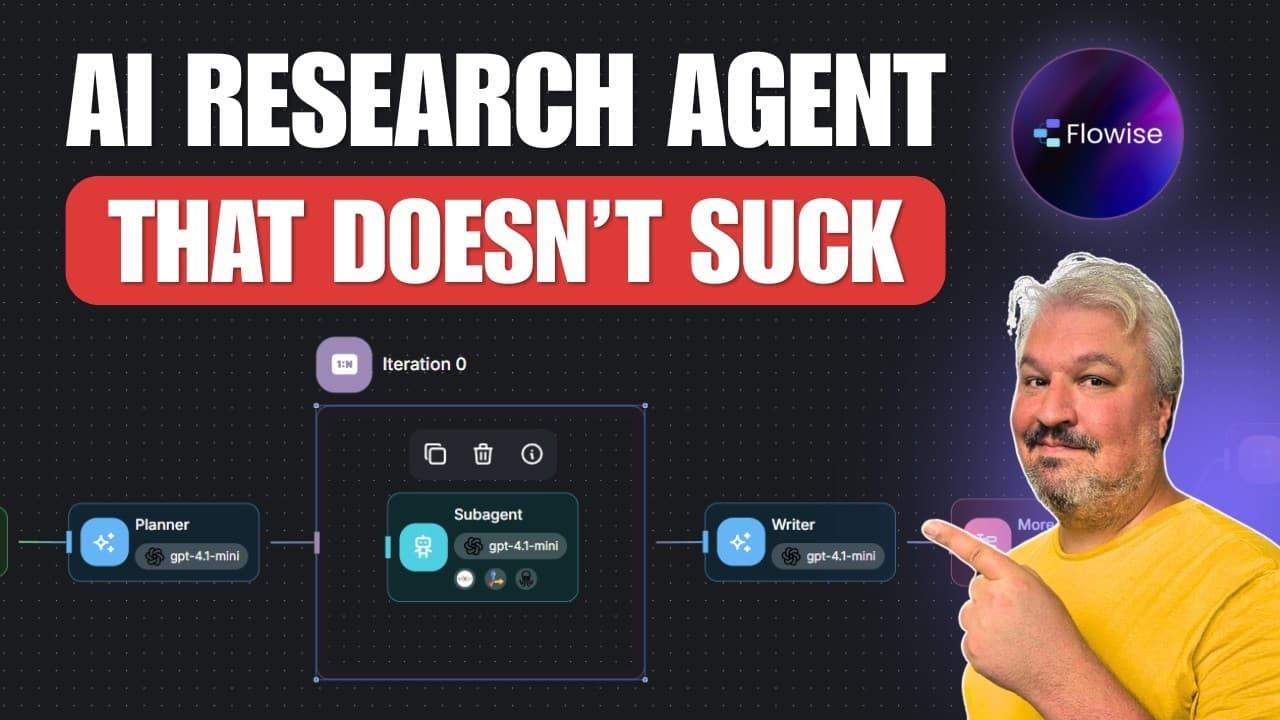
To build an effective deep research agent, use Flowise to create a multi-agent system with a planner orchestrator that spawns specialized subagents for targeted research tasks. Incorporate iteration nodes for processing multiple queries and generate comprehensive reports with citations. Integrate web search tools, web scrapers, and research databases to automate and enhance the research workflow.
Transcript
In this video, I'll show you how to build a deep research agent flow that doesn't suck. A while back, a team member asked me to help research a potential partnership with another company. So, we had to look into things like the company's background and the background of its directors. So, I thought deep research agents would be the perfect candidat... Read More
Key Insights
- Deep research agents use a planner orchestrator to manage subagents with specific tasks.
- The key to effective research is using iteration nodes to process multiple queries simultaneously.
- Subagents are equipped with tools like web search, web scrapers, and research databases for thorough research.
- Flowise allows the creation of a JSON-structured output to define research tasks for subagents.
- Using conditional logic, the system determines when additional research is required for a comprehensive report.
- The planner orchestrator refines and updates the research plan based on initial findings.
- The iteration node consolidates all subagent outputs to provide a comprehensive view of research findings.
- The writer agent compiles subagent findings into a detailed, well-structured report with proper citations.
Install to Summarize YouTube Videos and Get Transcripts
Explore YouTube Video Summarizer or Get YouTube Transcript Extractor
Questions & Answers
Q: How to build a deep research agent using Flowise?
To build a deep research agent using Flowise, create a planner orchestrator to manage subagents with specific tasks. Use iteration nodes to process multiple queries and integrate tools like web search, web scrapers, and research databases. Implement conditional logic to determine when additional research is needed and compile findings into a comprehensive report with a writer agent.
Q: What tools are integrated into the research agent system?
The research agent system integrates tools such as web search APIs, web scrapers, and access to research databases like Archive. These tools allow subagents to perform thorough research and gather detailed information, which is then compiled into comprehensive reports with proper citations.
Q: Why use iteration nodes in building research agents?
Iteration nodes are used to process multiple research queries simultaneously, allowing for efficient management of tasks assigned to subagents. They consolidate outputs from all subagents, providing a comprehensive view of research findings, which enhances the depth and accuracy of the final report generated by the system.
Q: What is the role of the planner orchestrator in the research system?
The planner orchestrator is responsible for managing the overall research process. It formulates the initial research plan, spawns subagents with specific tasks, and refines the research strategy based on initial findings. This orchestrator ensures that the research is thorough and addresses the user's query comprehensively.
Q: How does the system ensure the quality of the research report?
The system uses a condition agent to evaluate if the research findings sufficiently address the user's query. If not, it loops back to the planner orchestrator for additional research. This ensures that the final report is detailed, accurate, and well-sourced, meeting the user's requirements.
Q: What is the function of the writer agent in this system?
The writer agent compiles findings from all subagents into a structured and detailed report. It uses the consolidated output from iteration nodes to create a comprehensive document that includes an abstract, introduction, detailed findings, and citations, ensuring the report is informative and well-organized.
Q: How are subagents created and managed in the system?
Subagents are created by the planner orchestrator, which assigns them specific research tasks. They are equipped with necessary tools like web search and scrapers to perform their tasks. Their outputs are collected and processed by iteration nodes, which are then used by the writer agent to generate the final report.
Q: What is the significance of using JSON-structured outputs in this system?
JSON-structured outputs are used to define the tasks for subagents clearly and consistently. This structure allows the planner orchestrator to communicate specific research tasks to subagents and ensures that the data is organized and easily processed by iteration nodes and the writer agent, facilitating efficient workflow management.
Summary & Key Takeaways
-
The video demonstrates building a deep research agent using Flowise, focusing on creating a planner orchestrator that manages subagents for specific research tasks. The system uses iteration nodes to process multiple queries and generate comprehensive reports.
-
Integrating tools like web search, web scrapers, and research databases enhances the research capabilities of subagents. Conditional logic is implemented to determine when additional research is needed, ensuring detailed and well-sourced reports.
-
The tutorial covers setting up form inputs, flow state variables, and testing the performance of individual subagents. It also explains the use of JSON-structured outputs to define research tasks and the role of the writer agent in report generation.
Read in Other Languages (beta)
Share This Summary 📚
Summarize YouTube Videos and Get Video Transcripts with 1-Click
Try YouTube Summary with ChatGPT & Claude or YouTube Transcript Generator
Explore More Summaries from Leon van Zyl 📚


Summarize YouTube Videos and Get Video Transcripts with 1-Click
Try YouTube Summary with ChatGPT & Claude or YouTube Transcript Generator