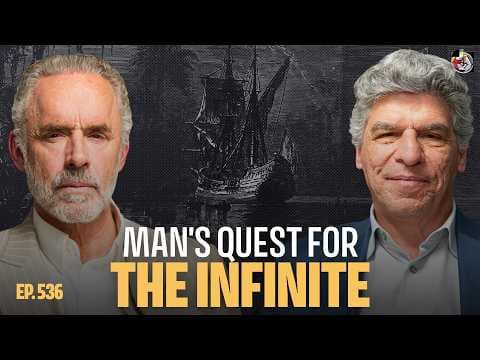
How is God defined as the greatest conceivable being?

TL;DR
God is defined as the greatest conceivable being whose properties include omnipotence, omniscience, and benevolence, yet is ineffable and recedes as one approaches the ultimate concept. The discussion explores how ineffability challenges characterization, outlines three major theological strands, and presents a middle way between strict theism and atheism.
Transcript
well well I wonder just to ask you then at the top of Jacob's Ladder then you take God to be there you take God to be the thing on which all values hang on slash the thing that grounds all of the values to be clear are you happy to to say that to say I believe in the existence of God as the greatest conceivable being let's say well I think it's a i... Read More
Key Insights
- God is positioned at the top of Jacob's Ladder as a conceptual highest.
- Ineffability means God cannot be fully conceived or described.
- The majority of philosophers agree we can say some things about God's essence.
- Three major strands of theology try to define God: revelation, creation, and perfect being.
- The perfect being view asserts God has all great-making properties.
- An overly ineffable God risks losing connection with humanity.
- Exodus and Moses illustrate calling as a forward impulse toward a vocation or goal.
- There exists a middle ground between theism and atheism that accommodates nuance.
Install to Summarize YouTube Videos and Get Transcripts
Explore YouTube Video Summarizer or Get YouTube Transcript Extractor
Questions & Answers
Q: How is God positioned in Jacob's Ladder and what does that imply about his conception?
In the discussion God is placed at the top of Jacob's Ladder as the highest conceivable being, which grounds the pursuit of divine properties while acknowledging that the ultimate being recedes as one approaches it. This framing implies that divine attributes can be approached conceptually, but never fully captured, maintaining a dynamic tension between affirmation and mystery.
Q: What does ineffability mean for describing God, and how do philosophers treat it?
Ineffability means God cannot be fully described or exhaustively known; at most some negative or partial descriptions are allowed, such as what God is not. Philosophers often accept that while full characterization is impossible, positive attributes like omnipotence, omniscience, and benevolence can be meaningfully discussed, though always with limits.
Q: What are the three major strands of theology mentioned, and how do they differ in approach?
The three strands are revelation theology, which infers properties from religious experiences and scripture; creation theology, which looks at God through the world and its order; and perfect being theology, which defines God as the greatest conceivable being with all intrinsic great-making properties. Each uses different methods to infer the divine essence.
Q: What does the perfect being view demand about God’s properties?
The perfect being view demands that God possess all great-making properties such as power, goodness, knowledge, and other intrinsically valuable attributes. If a greater being could be conceived, then that being would be God, so God must be the ultimate exemplar of these properties within the framework of that theory.
Q: Why might an overly ineffable God risk detaching from humanity, according to the talk?
If God is too ineffable, nothing meaningful can be said about the divine in relation to human experience, leading to a drift away from humanity and practical concerns. This can undermine religious practice and the cultural energy that belief systems typically provide, creating a gap between the divine concept and everyday life.
Q: How does the Exodus story relate to the idea of calling and forward movement toward God?
The Exodus narrative is used as an analogy where Moses is compelled to leadership by encountering a burning bush, symbolizing a calling that moves a person forward. This upward movement toward a divine goal can transform one’s perspective and life path, illustrating how spiritual motivation can shape action.
Q: What is the proposed middle ground between theists and atheists in the discussion?
The middle ground suggests that one can be agnostic or hold nuanced Christian views that do not require belief in a perfectly described or historical God event to be meaningful. This solution acknowledges limits on knowledge while still engaging with religious ideas and a sense of the divine.
Q: What role does scripture play in understanding God, according to the speaker?
Scripture is viewed as reflecting the divine in terms of moral truths, symbols, or revelations rather than providing a full empirical or historical account. It can illuminate aspects of the divine, guide ethical behavior, and shape how people experience and relate to God, without claiming complete factual coverage.
Summary & Key Takeaways
-
Summary point 1: The discussion situates God at the top of Jacob's Ladder, representing the pinnacle of conceivable being, yet insists that this top is characterized by ineffability and receding aspects that resist full conceptualization, shaping how believers and philosophers approach divine properties.
-
Summary point 2: Three major theological strands are identified: revelation theology, creation theology, and perfect being theology, each using different sources to infer God’s properties, yet all aiming to describe the divine essence and its relation to the world.
-
Summary point 3: A middle ground is proposed between theism and atheism, suggesting one can hold agnostic or nuanced Christian views that recognize limits on knowing God while still engaging with religious ideas and practices.
Read in Other Languages (beta)
Share This Summary 📚
Summarize YouTube Videos and Get Video Transcripts with 1-Click
Try YouTube Summary with ChatGPT & Claude or YouTube Transcript Generator
Explore More Summaries from Jordan B Peterson 📚
Summarize YouTube Videos and Get Video Transcripts with 1-Click
Try YouTube Summary with ChatGPT & Claude or YouTube Transcript Generator