How to Improve ROAS With Better Facebook Ads
TL;DR
Separate prospecting, retargeting, and existing-customer retention into clear campaign swim lanes so budget increases reach the intended audience. Let a campaign budget optimization structure favor stronger ads instead of forcing equal spend into tests, and expect a temporary performance dip when scaling quickly because new impressions may take several days to convert.
Transcript
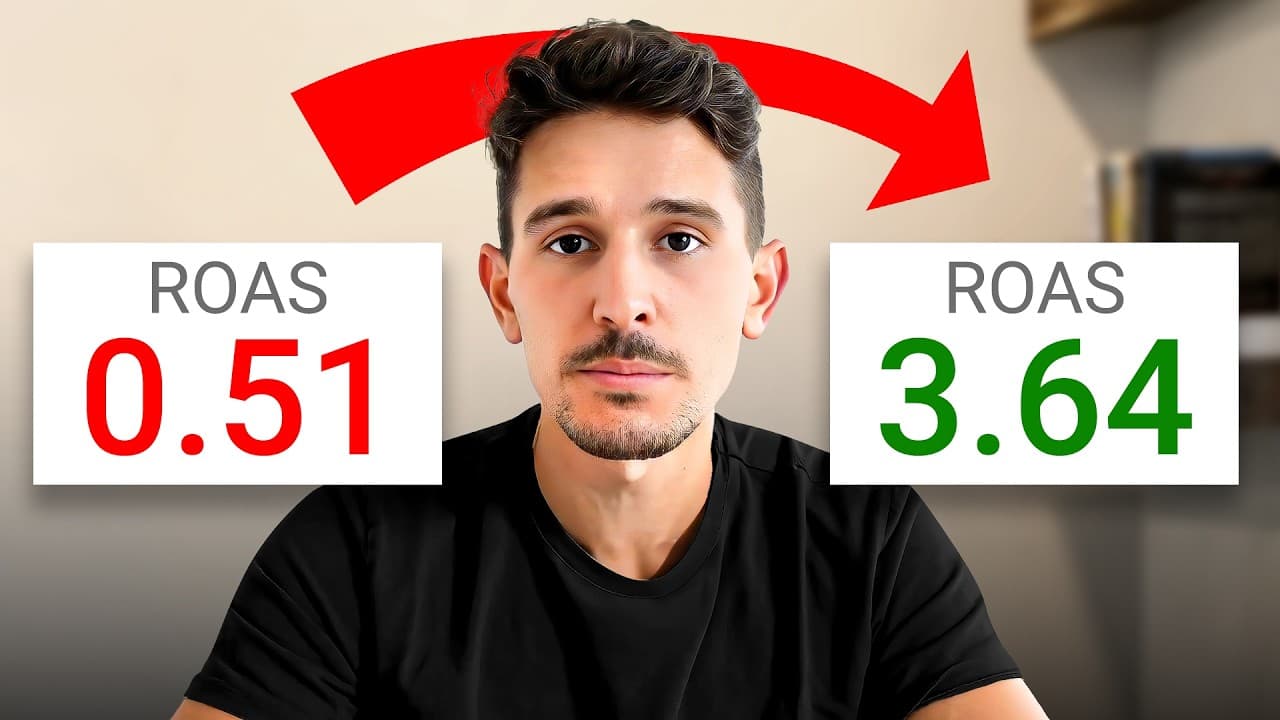
Let's get one thing straight. Facebook ads are completely different for brands that are just starting out versus brands that already have a proven process. And the results that you get are 100% dependent on the actions that you take inside of your ads manager. And you could basically be in one of two places. You could be over here with a very low r... Read More
Key Insights
- Campaign structure is a prerequisite for deliberate Facebook ad scaling because an operator should be able to describe the account's exact setup and strategy. Accounts with one disorganized campaign, dozens of disconnected campaigns, or newly created campaigns for every creative lack a repeatable operating process.
- Swim lanes are clear divisions between prospecting, retargeting, and retention campaigns. Prospecting targets people who have not heard of the brand, retargeting addresses engaged visitors, and retention focuses on existing customers, giving operators direct control over spending for each audience group.
- Facebook is likely to favor retargeting and retention because website visitors and existing customers are more likely to purchase than unfamiliar prospects. That allocation can improve reported efficiency while limiting growth, since expanding a brand requires additional spending that reaches genuinely new customers.
- Audience breakdowns are a practical way to audit how much Facebook spends on new, engaged, and existing audiences. Reviewing these categories can expose unexpectedly high spending on people who already know the brand and show whether a scaling increase is actually funding new-customer acquisition.
- Dedicated testing campaigns can become wasteful when they consume an outsized portion of the daily budget. Giving nearly equal funding to strong and weak ads reduces the amount available for proven performers, although deliberate spending may be justified for expensive creator, influencer, or high-production advertising.
- Campaign budget optimization works by distributing one campaign-level budget across multiple ad sets according to expected performance. Some ad sets and creatives may receive far more money than others, but that uneven allocation is presented as useful competition rather than evidence that every underfunded ad needs forced spending.
- Forced testing can lower aggregate ROAS because its budget must come from ads already receiving spend. If a proven placement produces a 1.5 return while a forced test produces 1.2, shifting money toward the test replaces stronger returns with weaker ones even if the test appears acceptable alone.
- Fast scaling can cause a temporary ROAS decline because new impressions may take 1, 2, 3, or 4 days to convert. Doubling spend makes this delay more visible than a 10 percent increase, but patience can allow conversions to arrive and establish a new baseline at the larger budget.
Install to Summarize YouTube Videos and Get Transcripts
Explore YouTube Video Summarizer or Get YouTube Transcript Extractor
Questions & Answers
Q: How should Facebook ad campaigns be structured to improve ROAS?
Facebook ad campaigns should use clear swim lanes that separate prospecting, retargeting, and retention. Prospecting reaches people unfamiliar with the brand, retargeting reaches engaged visitors, and retention addresses existing customers. This setup lets an operator identify the correct campaign and increase its budget intentionally, rather than allowing audience categories and objectives to remain mixed together in a disorganized account.
Q: What are swim lanes in Facebook advertising?
Swim lanes are distinct campaign categories for prospecting, retargeting, and customer retention. They clarify which people each campaign is intended to reach and make budget changes easier to control. With proper exclusions in place, an operator can raise prospecting spend to pursue new customers without accidentally directing the increase toward website visitors, engaged audiences, or people who have already purchased.
Q: Why can Facebook overspend on retargeting and existing customers?
Facebook can favor retargeting and retention because people who visited the website or already purchased are more likely to buy than prospects who have never heard of the brand. This may make immediate results look efficient, but it can conceal limited new-customer acquisition. Brands seeking growth need to verify that increased spending is actually reaching new audiences rather than repeatedly targeting familiar people.
Q: How can advertisers check whether spending reaches new customers?
Advertisers can open audience breakdowns in their Facebook ad account and examine spending across new, engaged, and existing audiences. These figures show whether the platform is directing an unexpected share of the budget toward people who already know the brand. Combined with separated swim lanes and proper exclusions, the breakdown helps confirm whether a scaling decision is truly expanding prospecting activity.
Q: Why can a dedicated Facebook ad testing campaign reduce ROAS?
A dedicated testing campaign can reduce ROAS when it receives an outsized share of the daily budget and forces similar spending across both strong and weak ads. That money must be taken from campaigns or creatives already producing better results. Deliberate testing can still be appropriate for an expensive creator, influencer, or high-production ad that needs enough delivery for evaluation.
Q: How does campaign budget optimization help ad testing?
Campaign budget optimization lets a campaign distribute a fixed daily budget among multiple ad sets based on where Facebook expects stronger results. New creatives can compete inside that environment without receiving an equal or guaranteed budget. Uneven delivery is intentional: one ad set or a small number of creatives may receive most of the spending because the system considers them better opportunities.
Q: Why does ROAS sometimes fall immediately after doubling ad spend?
ROAS may fall temporarily after a large budget increase because the additional impressions are new and their conversions have not arrived yet. The transcript describes conversion delays ranging from 1 to 4 days. Doubling spend introduces enough new impressions to make that delay visible, whereas a 10 percent increase may create such a small change that the same effect resembles ordinary daily variation.
Q: Should advertisers avoid scaling campaigns during the learning phase?
The recommended approach is to avoid treating the learning phase as a reason for automatically limiting increases to 10 or 15 percent. Strong brands are described as scaling quickly and accepting that performance can decline for 1 or 2 days. If the operator remains patient while new impressions convert, the campaign may establish a new normal at the higher spending level.
Summary & Key Takeaways
-
Low-ROAS accounts often lack a repeatable campaign structure, making it difficult to identify where budgets are going or how to scale deliberately. Clear swim lanes separate prospecting, retargeting, and retention, while audience breakdowns reveal whether Facebook is spending too heavily on engaged visitors and existing customers instead of reaching new prospects.
-
Dedicated testing campaigns can reduce overall returns when they force substantial budgets toward new or weaker ads. A competitive campaign budget optimization structure allows Facebook to distribute money among several ad sets and creatives, concentrating spend where it expects stronger performance while still giving new creative opportunities to compete for delivery.
-
Rapid scaling can produce a short-term ROAS decline because newly purchased impressions need time to convert. The recommended response is patience rather than fear of the learning phase. Once conversions from the new impressions arrive, the account can establish a new performance level at the higher daily budget.
Read in Other Languages (beta)
Share This Summary 📚
Summarize YouTube Videos and Get Video Transcripts with 1-Click
Try YouTube Summary with ChatGPT & Claude or YouTube Transcript Generator
Explore More Summaries from Sam Piliero 📚


Summarize YouTube Videos and Get Video Transcripts with 1-Click
Try YouTube Summary with ChatGPT & Claude or YouTube Transcript Generator