How to Convert a Context-Free Grammar to a PDA | Equivalence of CFG and PDA (Part 1)
TL;DR
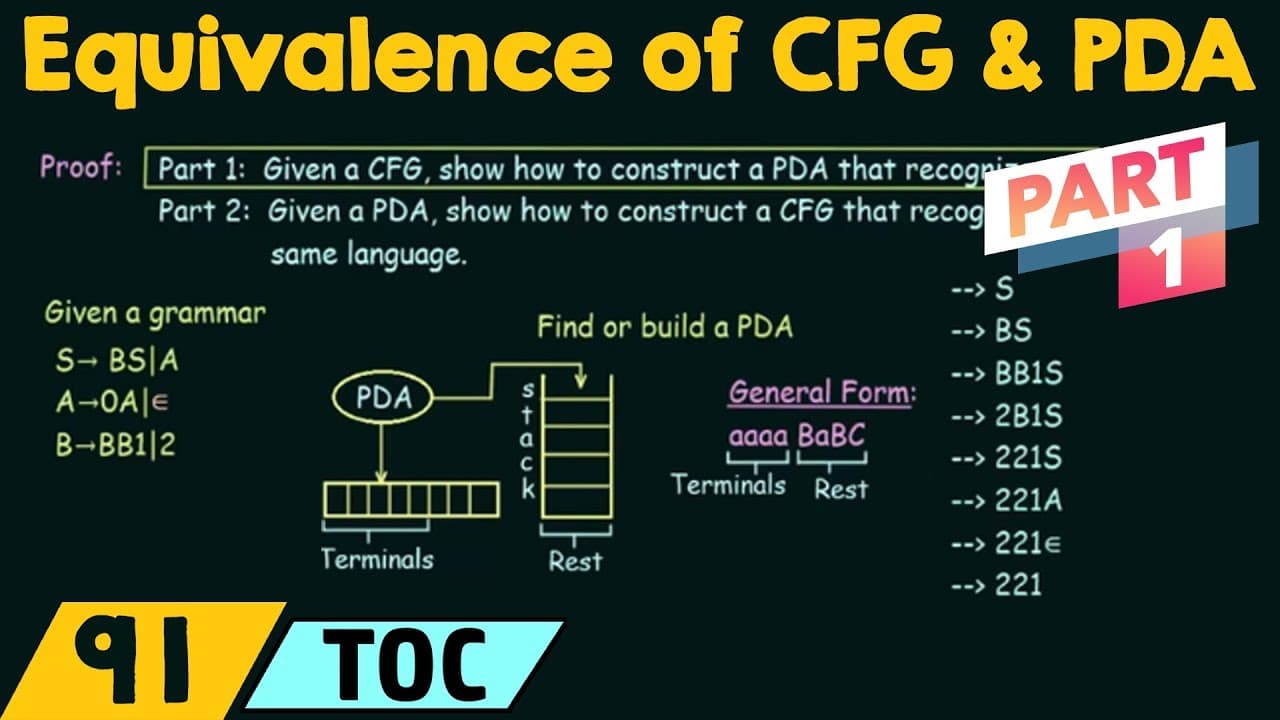
Convert a context-free grammar to a pushdown automaton by having the PDA simulate the grammar’s leftmost derivation while storing unfinished symbols on its stack. When a nonterminal reaches the stack top, replace it with the right-hand side of a matching production; terminals correspond to scanned input, and a bottom marker identifies the stack boundary. Read on to understand each construction step and why it proves one direction of CFG–PDA equivalence.
Transcript
in the last few lectures we have been studying about which done auto matter and we have seen the working of which on automata and we have also seen in detail how push on automata actually works with the help of examples now in this lecture we will be studying about equivalence of context-free grammar and pushed on automata so if you remember when w... Read More
Key Insights
- A language is context-free if and only if some pushdown automaton recognizes it, according to the theorem presented. This means that the languages generated by context-free grammars and those accepted by pushdown automata form the same class.
- The equivalence proof has two directions: converting a context-free grammar into a pushdown automaton, and converting a pushdown automaton into a context-free grammar. Establishing both directions demonstrates that neither formalism recognizes a different class of languages.
- A grammar-to-automaton construction shows how a pushdown automaton can recognize the language generated by a given context-free grammar. The automaton does this by reproducing the grammar’s derivation process through input scanning and stack operations.
- A leftmost derivation always expands the leftmost nonterminal in the current expression. The process continues by selecting productions for that nonterminal until the intended terminal string is obtained and no nonterminal remains to be expanded.
- A left sentential form is any intermediate form obtained during a leftmost derivation. It contains a terminal prefix that may already have been processed and a remaining sequence of terminals and nonterminals whose contribution to the generated string is still being handled.
- The pushdown automaton’s input represents terminal symbols that are being scanned, while its stack stores symbols that remain to be considered. This arrangement lets the automaton track unfinished portions of a grammar derivation as it processes the terminal string.
- A nonterminal at the top of the stack is matched with a grammar production having that nonterminal on its left-hand side. The automaton pops the nonterminal and pushes the corresponding right-hand side, thereby simulating one derivation step.
- A stack-bottom marker identifies the lowest position in the pushdown automaton’s stack. The transcript represents this marker as z followed by a zero or, alternatively, a dollar symbol, so the automaton can recognize when the stored derivation symbols have ended.
Install to Summarize YouTube Videos and Get Transcripts
Explore YouTube Video Summarizer or Get YouTube Transcript Extractor
Questions & Answers
Q: How do you convert a context-free grammar to a pushdown automaton?
Make the pushdown automaton simulate a leftmost derivation of the grammar. Store the symbols still awaiting processing on the stack and treat the processed terminal prefix as scanned input. When a nonterminal is on top, pop it and push the right-hand side of a production whose left-hand side matches that nonterminal.
Q: What does Part 1 of the equivalence proof establish?
Part 1 begins with a context-free grammar and constructs a pushdown automaton that recognizes the same language. The lecture focuses on this CFG-to-PDA direction, while Part 2 performs the reverse construction.
Q: Why are context-free grammars and pushdown automata equivalent?
They are equivalent because the languages generated by context-free grammars and the languages accepted by pushdown automata are the same class. The stated theorem says that a language is context-free if and only if some pushdown automaton recognizes it. Proving both CFG-to-PDA and PDA-to-CFG constructions establishes the equivalence.
Q: What is a leftmost derivation in a context-free grammar?
A leftmost derivation always expands the leftmost nonterminal in the current expression. Productions are repeatedly selected for that nonterminal until the required terminal string is produced and no nonterminal remains.
Q: What is a left sentential form?
A left sentential form is any intermediate form obtained during a leftmost derivation. It may contain a processed terminal prefix followed by terminals and nonterminals that still need to be handled.
Q: What does the PDA stack store during the conversion?
The stack stores the portion of the left sentential form that has not yet been processed. The terminal prefix already handled corresponds to scanned input, while the remaining grammar symbols stay on the stack.
Q: How does a PDA simulate a grammar production?
When the stack top is a nonterminal, the PDA selects a production with that symbol on its left-hand side. It pops the nonterminal and pushes the production’s right-hand side, leaving the symbols beneath it unchanged. This operation simulates one step of the grammar’s derivation.
Q: Why does the PDA use a stack-bottom marker?
The bottom marker identifies the lowest position in the PDA stack and remains beneath the pending derivation symbols. It lets the automaton recognize when it has reached the end of its stored symbols. The marker may be written as z followed by zero or as a dollar symbol.
Summary & Key Takeaways
-
Context-free grammars and pushdown automata describe the same class of languages. The equivalence proof has two directions: constructing a pushdown automaton from a grammar, and constructing a grammar from a pushdown automaton. The lesson focuses on the direction that begins with a context-free grammar and produces an equivalent automaton.
-
The construction uses leftmost derivation, which repeatedly expands the leftmost nonterminal in the current expression. Every intermediate expression produced during this process is called a left sentential form. The already processed terminal prefix corresponds to scanned input, while the symbols still awaiting processing are represented inside the pushdown automaton’s stack.
-
When the stack top is a nonterminal with a matching grammar production, the automaton pops that nonterminal and pushes the production’s right-hand side. Other symbols already stored beneath it remain unchanged. A special bottom marker identifies the stack boundary, helping the automaton determine when it has reached the end of its stored symbols.
Read in Other Languages (beta)
Share This Summary 📚
Summarize YouTube Videos and Get Video Transcripts with 1-Click
Try YouTube Summary with ChatGPT & Claude or YouTube Transcript Generator
Explore More Summaries from Neso Academy 📚




Summarize YouTube Videos and Get Video Transcripts with 1-Click
Try YouTube Summary with ChatGPT & Claude or YouTube Transcript Generator