How to Secure Local AI Agents Like OpenClaw
TL;DR
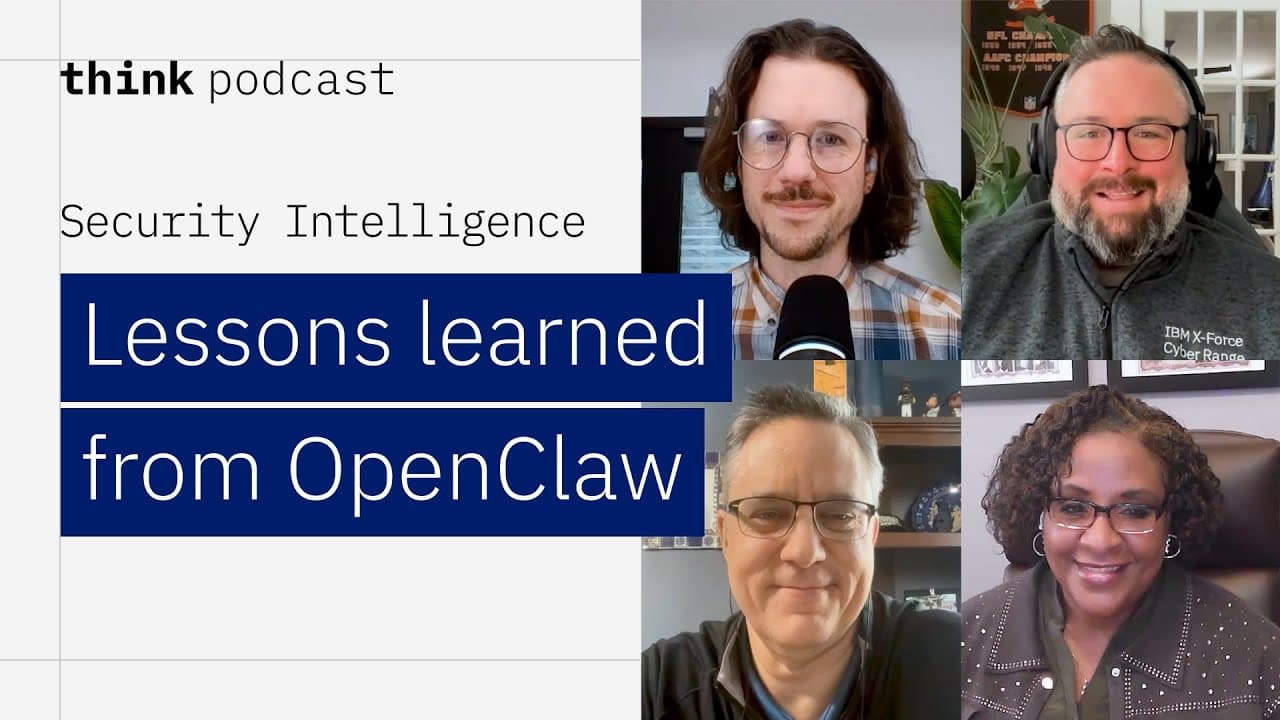
Treat locally installed AI agents as highly privileged accounts, not ordinary apps. Limit their permissions, verify configurations, prevent public internet exposure, and monitor access to corporate data, secrets, email, and calendars. OpenClaw and Moltbook illustrate how misconfigured databases, exposed API keys, and malicious downloadable skills can turn useful automation into an insider-like security threat.
Transcript
Our agents, AI agents, the most helpful insider threat. Of course they are. All that and more on Security Intelligence. Hello and welcome to Security Intelligence, IBM's weekly cyber security podcast, where our expert panelists turn the biggest industry news stories into practical takeaways you can use. I'm your host, Matt Kazinski, and I have rece... Read More
Key Insights
- AI agents are highly privileged systems because useful automation requires access to data, applications, and actions. An agent that handles email, calendars, or administrative work can become an insider-like threat when its permissions are excessive, its configuration is weak, or an attacker compromises it.
- OpenClaw creates a distinct attack surface because end users can install it locally without necessarily understanding enterprise security practices. Its convenience can encourage users to grant broad access, while the complexity of agent configuration makes secure deployment harder than installing a conventional application.
- Moltbook’s database was reportedly exposed through a misconfiguration that left agent API keys, claim tokens, verification codes, and owner relationships unprotected. This example shows how insecure supporting infrastructure can undermine an agent ecosystem even when users believe they are interacting with trusted tools.
- Malicious agent skills can spread through trust between automated systems. Research described in the episode demonstrated that agents could upload harmful skills and trick other agents into downloading them, turning a feature intended to expand capabilities into a potential compromise channel.
- Least-privilege design is essential for local AI agents because one broadly authorized agent can provide access to many connected resources. In an enterprise environment, sensitive capabilities would more likely be divided among multiple agents or accounts with separate, limited permissions instead of being concentrated in one system.
- Shadow IT increases agent risk when employees install local tools on personal computers and connect them to corporate information. An agent operating outside approved controls may gain access to work data without the organization having adequate visibility into its permissions, configuration, updates, or behavior.
- Agent-driven email can weaken accountability because a compromised or abused agent may send replies using the owner’s access. The episode notes that this can undermine the ability to establish whether the person actually sent a message, creating a challenge for non-repudiation and incident investigation.
- Security communication must describe agent permissions in concrete terms because benefit-focused marketing can obscure the risks. Users may react differently when told that software needs passwords and broad system access than when the same permissions are framed merely as requirements for helpful AI automation.
Install to Summarize YouTube Videos and Get Transcripts
Explore YouTube Video Summarizer or Get YouTube Transcript Extractor
Questions & Answers
Q: How should organizations secure locally installed AI agents?
Organizations should treat locally installed AI agents as sensitive, highly privileged accounts rather than ordinary applications. They should restrict each agent to the data and actions required for its task, divide broad capabilities among multiple agents where appropriate, prevent unauthenticated public internet access, verify configurations, protect secrets, and monitor whether employees connect unapproved agents to corporate information.
Q: Why are local AI agents attractive targets for information stealers?
Local AI agents are attractive targets because they may hold or reach passwords, API keys, email, calendars, configuration data, and other valuable information needed to perform automated tasks. Users are also encouraged to grant them extensive access for convenience. A single compromise can therefore give an attacker an easy route to multiple resources instead of requiring separate compromises.
Q: What security problem was found in the Moltbook database?
A security researcher found that the database supporting Moltbook was misconfigured and exposed sensitive agent information without protection at an accessible URL. The exposed material reportedly included secret API keys, claim tokens, verification codes, and relationships between agents and their owners. The incident illustrates how one infrastructure error can expose an entire connected agent ecosystem.
Q: How can malicious skills compromise AI agents?
Malicious skills can exploit the mechanism agents use to add capabilities. The research discussed in the episode demonstrated that agents could upload harmful skills and then trick other agents into downloading them. Because those agents may already possess extensive permissions and trusted access, an installed malicious skill could quietly abuse connected systems, data, or credentials.
Q: Why should AI agent permissions be divided among multiple accounts?
Dividing permissions reduces the damage that one compromised agent can cause. The panel explains that an enterprise would likely separate access among multiple agents or system accounts, each responsible for a narrower task. Giving one locally installed agent access to everything creates a large failure domain, where a single configuration error, malicious skill, or compromise can affect many resources.
Q: How do local AI agents create shadow IT risks?
Local AI agents create shadow IT risks when employees install them without organizational approval or security oversight. An employee might use a personal computer for work and allow an agent to access corporate data. The organization may then lack visibility into the agent’s permissions, authentication, configuration, updates, and actions, even though sensitive business information is within reach.
Q: How can an AI agent affect email accountability?
An AI agent that can read and reply to email acts through the owner’s authorized account. If the agent is compromised or abused, it may send messages that appear to come from the person. The episode argues that this can weaken non-repudiation, because investigators may have difficulty determining whether the owner intentionally sent a message or the agent acted improperly.
Q: What should users understand before installing OpenClaw?
Users should understand that OpenClaw is not simply another convenient application. To automate personal and administrative tasks, it may require extensive access to email, calendars, data, credentials, and system functions. Users should examine authentication, internet exposure, permissions, configuration, patching claims, and access to work information before deciding whether its benefits justify the security risks.
Summary & Key Takeaways
-
OpenClaw demonstrates why locally run AI agents create a significant attack surface. To automate email, calendars, and administrative work, an agent may receive extensive permissions and sensitive data access. If its configuration, authentication, or supporting infrastructure is insecure, one compromise can expose secrets and enable access across a user’s environment.
-
Moltbook’s supporting database was reportedly misconfigured, leaving agent API keys, claim tokens, verification codes, and owner relationships unprotected at an accessible URL. Researchers also demonstrated that agents could upload malicious skills and persuade other agents to download them, creating a path for compromised capabilities to spread between trusted automated systems.
-
Organizations should manage agents like sensitive, highly permissioned accounts. They should divide access among multiple agents where appropriate, constrain permissions, monitor shadow IT, and clearly explain risks to users. The episode also identifies wider cybersecurity signal problems involving AI-generated bug bounty submissions, possible changes to NIST vulnerability enrichment, and vibe-coded malware failures.
Read in Other Languages (beta)
Share This Summary 📚
Summarize YouTube Videos and Get Video Transcripts with 1-Click
Try YouTube Summary with ChatGPT & Claude or YouTube Transcript Generator
Explore More Summaries from IBM Technology 📚



Summarize YouTube Videos and Get Video Transcripts with 1-Click
Try YouTube Summary with ChatGPT & Claude or YouTube Transcript Generator