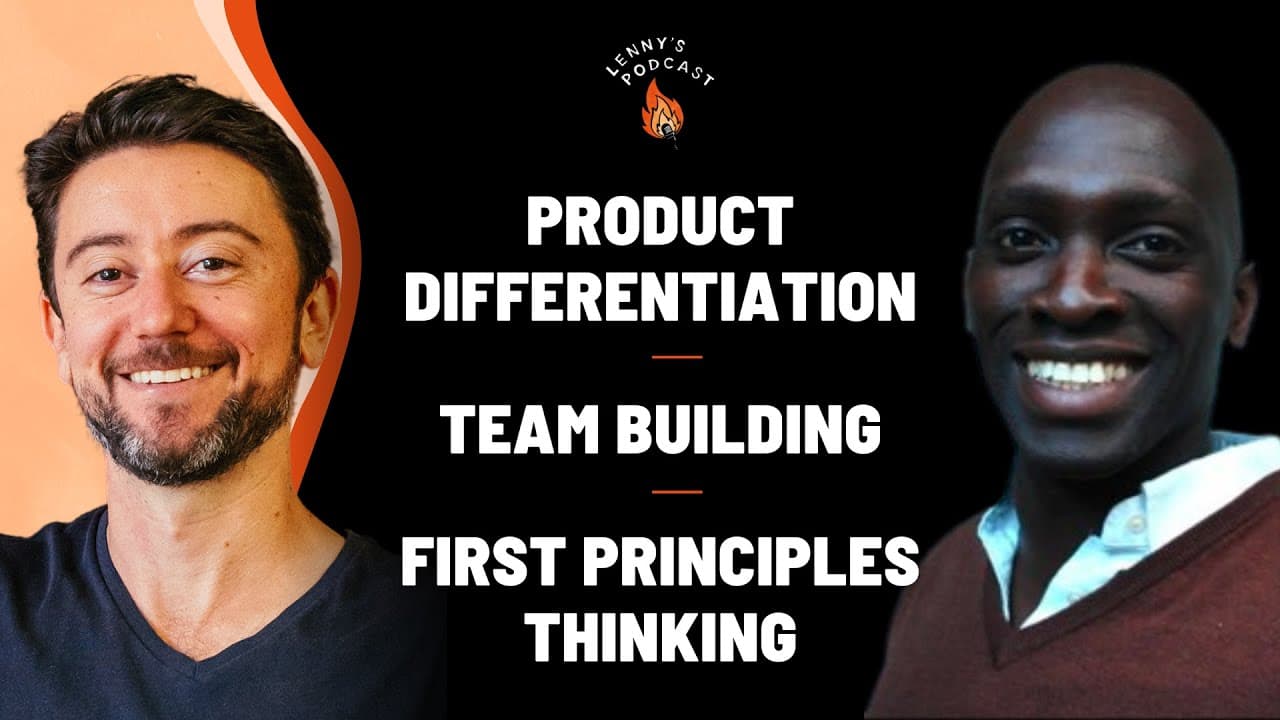
Ayo Omojola on product differentiation and first principles
TL;DR
Ayo explains that true product success comes from a combination of differentiation, rigorous problem solving, and building small, focused teams. He emphasizes customer needs, deep design, and first principles thinking as core tools for scaling both fintech and health tech products. He also shares hiring, leadership, and problem deep-diving approaches for founders.
Transcript
cash app as a team we really cared about what we could do that was different and better than what else existed in Market being different is not enough because very easy to build a thing that's different from what exists today because you just have to look at what existed and build something else being better is not enough because it's also easy to ... Read More
Key Insights
- Differentiation alone is not enough; it must solve a real, usable user need.
- The most successful consumer products balance user value with strong design and focused execution.
- Small, autonomous teams can move faster and maintain deep customer empathy in larger organizations.
- A customer-centric approach requires prioritizing consumer needs over other trade-offs.
- First principles thinking helps deconstruct problems into fundamental constraints for better solutions.
- Hiring and leadership practices shape product culture as much as technical capability does.
- Design depth and user experience can be a lasting differentiator beyond features.
- Crucial to connect people in your network to what they need, enabling productive frictionless interactions.
- More videos from this channel:
- More from this channel: Lenny's Podcast
Install to Summarize YouTube Videos and Get Transcripts
Explore YouTube Video Summarizer or Get YouTube Transcript Extractor
Questions & Answers
Q: Ayo, how do you balance being different with being better in a way that actually matters to users?
Differentiation must translate into meaningful user value, not just novelty. We focus on a concrete user problem and test early with real users to learn which differences reduce effort, increase speed, or improve outcomes. It is the convergence of meaningful value, usability, and reliable delivery that makes a difference, not cleverness alone.
Q: What is your approach to building a startup within a startup, and why does that work?
A startup within a startup needs a tight, autonomous charter, clear success metrics, and enough freedom to experiment. The key is to reduce friction with the parent organization while preserving speed and ownership. Teams must own outcomes, not just outputs, and leadership should shield them from conflicting priorities.
Q: How important is team size in achieving product goals, and what should founders optimize for?
Smaller, highly focused teams often outperform larger groups due to clearer decision rights, faster iteration, and stronger alignment with user needs. The optimization should be for speed, clarity, and concentration on high-impact priorities, while maintaining diverse perspectives to avoid blind spots.
Q: What role does design depth play in product differentiation?
Design depth matters because it shapes how users experience the product, from aesthetics to interaction flow and recovery from errors. A deeply considered design reduces cognitive load, increases trust, and lowers barriers to adoption. It’s about delivering consistent, delightful experiences that users notice and remember.
Q: How do you apply first principles thinking in product development?
Start by identifying the fundamental constraints and assumptions behind a problem. Break the system into its basic components, question each assumption, and reconstruct a solution from the ground up. This helps avoid copying existing patterns and fosters innovations that truly address core needs.
Q: What advice do you have for health tech founders navigating regulation and user needs?
Health tech founders should map user journeys with empathy, prioritize patient safety, and design compliance into the product from the start. Engage clinicians early, build auditable data practices, and simplify regulatory pathways by focusing on transparent risk management and measurable outcomes that matter to users and providers alike.
Q: How can leaders foster genuine problem deep-diving within their teams?
Leaders should encourage structured problem analysis, questions that challenge assumptions, and time-boxed where-abouts to avoid analysis paralysis. Create spaces to surface hard questions, reward rigorous experimentation, and align incentives with learning rather than just delivering features.
Q: What is the single most important mindset shift for founders according to your experience?
Treat entrepreneurship as a disciplined practice of learning under uncertainty. Embrace rigorous inquiry, tolerate ambiguity, and constantly test hypotheses against real user feedback. This mindset turns risk into an opportunity to uncover durable but flexible strategies that sustain product value over time.
Summary & Key Takeaways
-
Ayo emphasizes that differentiation must matter to the end user, not just be different, and that it must be paired with real value. He argues that small, focused teams can outperform larger groups by maintaining strong customer focus and disciplined prioritization. He also highlights the role of design depth in winning users.
-
He discusses the concept of building a startup within a startup and how agile, autonomous teams can innovate more effectively in larger organizations. He shares how leadership and hiring choices shape product culture, speed, and product outcomes, with a strong emphasis on deep problem solving.
-
He stresses first principles thinking as a practical tool for product leaders, urging founders to question assumptions, map fundamental constraints, and reframe problems to unlock durable competitive advantages. He also provides practical advice for health tech founders navigating complex regulatory and user needs.
Read in Other Languages (beta)
Share This Summary 📚
Summarize YouTube Videos and Get Video Transcripts with 1-Click
Try YouTube Summary with ChatGPT & Claude or YouTube Transcript Generator
Explore More Summaries from Lenny's Podcast 📚

Summarize YouTube Videos and Get Video Transcripts with 1-Click
Try YouTube Summary with ChatGPT & Claude or YouTube Transcript Generator