How to Map AI Concepts Like a Periodic Table
TL;DR
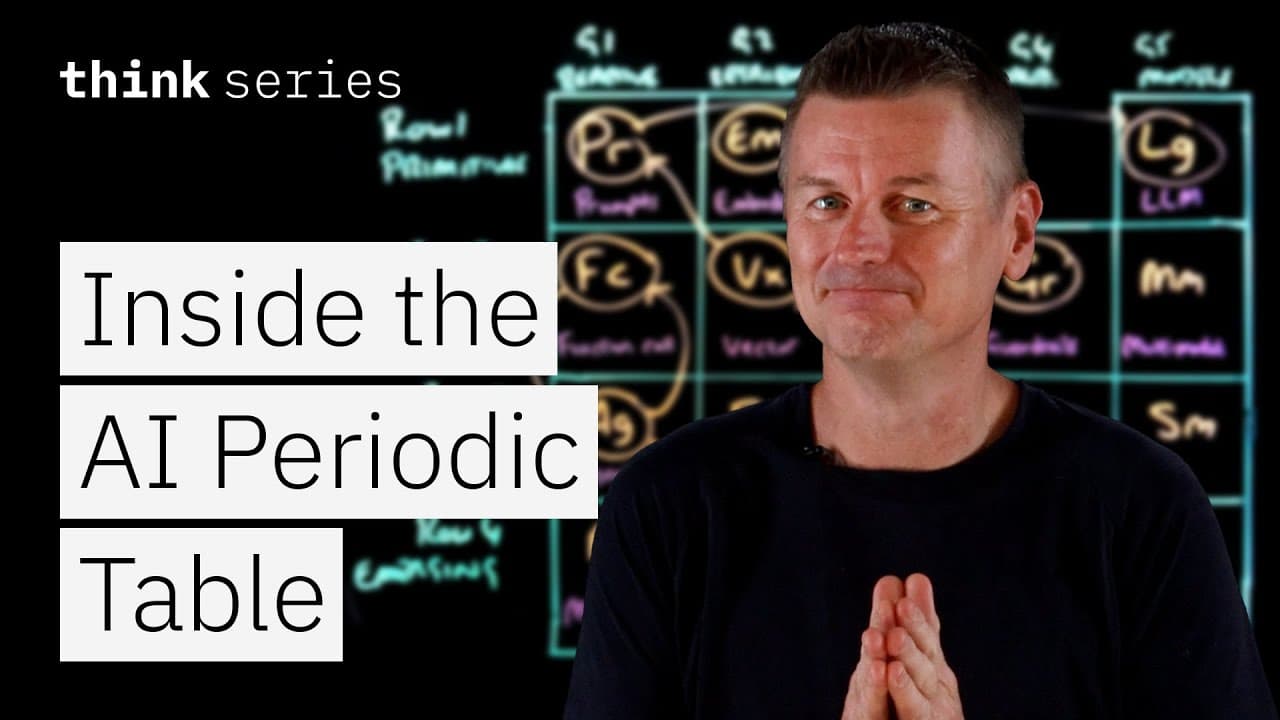
The AI periodic table offers a structured way to understand various AI components like prompts, embeddings, and large language models, organizing them into rows and families similar to the chemical periodic table. By categorizing AI elements, it becomes easier to decode AI architectures and identify how different components interact or what's missing.
Transcript
Does the world of AI feel a bit like this to you? A thousand terms all flying around. Everyone's talking about agents and RAG and embeddings and guardrails, and you're just kind of supposed to know how it all fits together. Well, how about we put a structure to all this chaos? What if we could organize AI like chemistry organizes the elements into ... Read More
Key Insights
- AI periodic table organizes AI elements into a structured framework similar to the chemical periodic table.
- Prompts, embeddings, and large language models are foundational AI primitives in this framework.
- Function calling is a composition element that enables AI models to interact with external tools.
- Agents use think-act-observe loops for autonomy, facilitating goal-driven actions.
- Vector databases store embeddings for semantic search, forming part of the retrieval family.
- Retrieval augmented generation (RAG) combines multiple AI elements for contextual information retrieval.
- Guardrails ensure AI outputs are safe and valid, acting as a validation mechanism.
- Emerging AI concepts like multi-agent systems and synthetic data are rapidly evolving, expanding AI capabilities.
Install to Summarize YouTube Videos and Get Transcripts
Explore YouTube Video Summarizer or Get YouTube Transcript Extractor
Questions & Answers
Q: How does the AI periodic table help in understanding AI systems?
The AI periodic table organizes AI elements into a structured framework, similar to the chemical periodic table, making it easier to understand how different AI components interact. By categorizing elements like prompts, embeddings, and large language models, it provides insights into AI architectures and helps identify missing or over-engineered components.
Q: What are the foundational primitives in the AI periodic table?
The foundational primitives in the AI periodic table include prompts, embeddings, and large language models. These elements are considered atomic and form the basis for building more complex AI systems. They are categorized into specific rows and families, highlighting their role in AI architectures.
Q: How do function calling and agents contribute to AI compositions?
Function calling allows AI models to interact with external tools, making them essential for AI compositions. Agents use think-act-observe loops to achieve autonomy, enabling goal-driven actions. Together, they form part of the reactive family, evolving from control to action to autonomy within the AI periodic table framework.
Q: What role do vector databases play in AI systems?
Vector databases store embeddings for semantic search, making them crucial for AI systems that rely on retrieving and utilizing contextual information. They are part of the retrieval family in the AI periodic table, enabling efficient storage and querying of embeddings to find relevant data.
Q: How does retrieval augmented generation (RAG) work?
Retrieval augmented generation (RAG) combines multiple AI elements, such as embeddings and vector databases, to retrieve relevant context from documents. This context augments prompts, allowing large language models to generate informed answers. RAG orchestrates these components, forming part of the orchestration family in the AI periodic table.
Q: What are guardrails in AI, and why are they important?
Guardrails are mechanisms that ensure AI outputs are safe and valid, preventing undesirable or harmful results. They include runtime safety filters and schema validation, acting as a validation mechanism in the AI periodic table. Guardrails are crucial for maintaining AI reliability and trustworthiness.
Q: What are some emerging concepts in the AI periodic table?
Emerging concepts in the AI periodic table include multi-agent systems and synthetic data. Multi-agent systems involve multiple AIs collaborating to solve complex problems, while synthetic data is generated by AI to train other AI models. These concepts represent rapidly evolving areas that expand AI capabilities.
Q: How can the AI periodic table be used to evaluate AI products?
The AI periodic table can be used to map AI products, identifying the elements they use and their interactions. By analyzing which components are present or missing, it helps evaluate the product's architecture, safety, and efficiency. This framework aids in understanding the underlying structure and potential improvements.
Summary & Key Takeaways
-
The AI periodic table provides a structured way to understand AI components, categorizing elements like prompts, embeddings, and large language models into rows and families. This framework helps decode AI architectures and interactions, offering insights into how AI systems are built and function.
-
Function calling and agents are key elements in AI compositions, enabling models to interact with external tools and achieve autonomy through think-act-observe loops. Vector databases and retrieval augmented generation enhance AI's ability to retrieve and utilize contextual information.
-
Guardrails and emerging concepts like multi-agent systems and synthetic data play vital roles in ensuring AI safety and expanding capabilities. The AI periodic table serves as a guide to categorize and link AI terms, facilitating a deeper understanding of AI systems.
Read in Other Languages (beta)
Share This Summary 📚
Summarize YouTube Videos and Get Video Transcripts with 1-Click
Try YouTube Summary with ChatGPT & Claude or YouTube Transcript Generator
Explore More Summaries from IBM Technology 📚



Summarize YouTube Videos and Get Video Transcripts with 1-Click
Try YouTube Summary with ChatGPT & Claude or YouTube Transcript Generator