How Does Michael Pollan Write Nonfiction Books?
TL;DR
Begin nonfiction with a question, then investigate it through direct experience, conversations, research, and reflection before shaping what you discover into a book. Michael Pollan also distinguishes focused attention from open awareness, treats unusual insights as hypotheses requiring evidence, and uses first-person reporting to guide readers through complex subjects in a friendly, accessible way.
Transcript
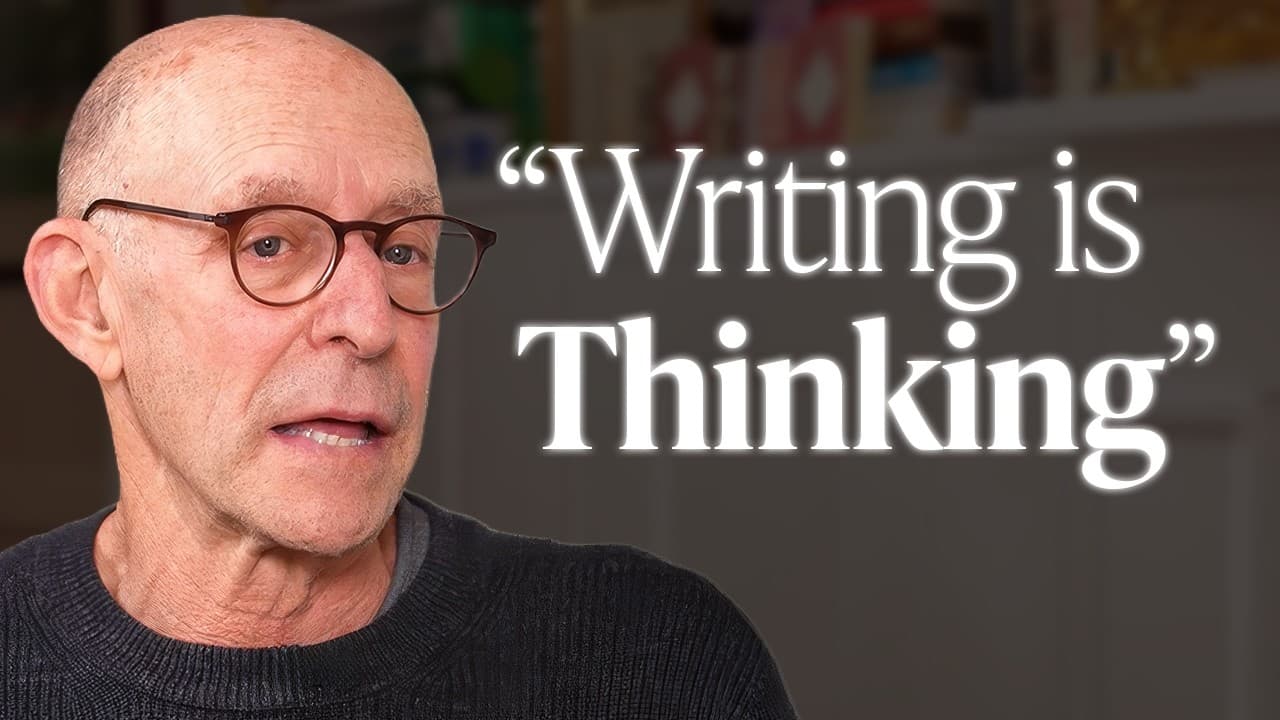
Michael Pollen, one of my all-time favorite non-fiction writers, a guy who's been writing about food and nature and consciousness for decades now. And for him, the writing process begins with a question. He finds something that he's interested in. And he says, "All right, I'm going to go on an adventure. I'm going to experience things. I'm going to... Read More
Key Insights
- Pollan’s nonfiction process is an investigation driven by a question. He approaches a subject as an adventure, gains direct experience, talks with people, learns from what happens, and then organizes those discoveries into a book for readers.
- Pollan’s writing style is conversational and companionable. Rather than presenting himself only as a distant authority, he reports what he experienced and learned in a manner compared to putting an arm around the reader.
- Focused attention is essential for completing demanding writing. Pollan uses the distinction between spotlight consciousness, which narrows attention toward a task, and lantern consciousness, which receives information broadly but makes sustained task completion more difficult.
- Caffeine and nicotine can function as focus aids by narrowing a person’s mental aperture. Pollan also associates caffeine with energy and empowerment, while acknowledging that the resulting sense of power could partly be an illusion.
- Coffee is part of Pollan’s morning writing routine. He begins writing at about 9:30, slowly drinks one cup throughout the morning, and continues until lunch at 1:00 because caffeine makes him feel sharper and more present.
- Alcohol is not part of Pollan’s writing process. He suggests that writers have often used it to unwind after difficult work rather than to produce the work itself, and he questions how many writers genuinely write while drunk.
- Psychedelic insights are not automatically creative or valuable. Pollan says most apparent epiphanies are stupid, banal, or impractical, although some experiences can inspire useful questions or help people visualize problems in unfamiliar ways.
- An extraordinary experience can become useful nonfiction when treated as a hypothesis. After sensing that plants were conscious and returning his gaze, Pollan investigated plant intelligence and consciousness, found scientists working on those questions, and incorporated the inquiry into his book.
Install to Summarize YouTube Videos and Get Transcripts
Explore YouTube Video Summarizer or Get YouTube Transcript Extractor
Questions & Answers
Q: How does Michael Pollan begin writing a nonfiction book?
Michael Pollan begins with a question about something that genuinely interests him. He then treats the project as an adventure by seeking direct experiences, talking to people, learning about the subject, and following unexpected leads. After gathering this material, he shapes what he discovered into a book that reports both the investigation and its conclusions.
Q: How can direct experience improve nonfiction writing?
Direct experience gives a nonfiction writer events, observations, conversations, and uncertainties that can carry factual material. Pollan’s approach is to enter the world he is investigating instead of relying only on abstract explanation. For his work on meat and the industrial food system, he bought a cow and followed it from birth to slaughter.
Q: What is the difference between spotlight and lantern consciousness?
Spotlight consciousness is the learned adult ability to narrow attention, block distractions, and remain focused on a specific task. Lantern consciousness takes in information from all directions, much like the broad awareness associated with young children. Pollan says writing requires the spotlight mode because sustained concentration is necessary for getting work done.
Q: Does coffee make Michael Pollan more productive as a writer?
Coffee supports Pollan’s writing routine by helping him feel sharper, more present, and mentally capable of working. He begins around 9:30 and stretches one cup across the morning until lunch at 1:00. He describes caffeine as indispensable to his writing, while recognizing that regular use quickly turns its effects into a maintained baseline.
Q: Should writers stop drinking coffee to improve creativity?
Pollan does not urge most people to stop drinking coffee. He temporarily abstained to observe what would happen and found that returning to caffeine made its powerful effects especially noticeable. He suggests that a break of even one or two weeks can reveal a person’s dependence, but he presents abstinence as an experiment rather than a general rule.
Q: Does alcohol help writers produce better work?
Pollan does not connect alcohol with his own work and doubts that many writers truly write while drunk. He suggests that writers who drink may use alcohol to unwind after a difficult or emotionally tangled day of writing. In his account, alcohol is more closely associated with recovery from work than with focused literary production.
Q: Do psychedelics reliably produce creative insights?
Psychedelics do not reliably generate useful creative insights. Pollan says that most apparent epiphanies are stupid, banal, or difficult to apply, even when they feel powerful at the time. Some experiences may still open a productive line of inquiry or help visualize a problem, but inspiration must be examined rather than automatically trusted.
Q: How should a writer evaluate an insight from a psychedelic experience?
A writer can treat the insight as a hypothesis and look for other forms of evidence that might support or challenge it. Pollan followed this approach after experiencing plants as conscious, cautious, benevolent, and responsive to his gaze. He researched plant intelligence and consciousness, found scientists studying these possibilities, and used that investigation in his book.
Summary & Key Takeaways
-
Michael Pollan’s nonfiction process begins with genuine curiosity rather than a predetermined conclusion. He selects a question, enters the relevant world, gathers experiences, speaks with people, studies the subject, and returns with material for a book. His conversational style presents the resulting discoveries as a friendly report from an intellectual adventure.
-
Pollan associates productive writing with focused attention. He describes caffeine and nicotine as substances that can narrow awareness into a spotlight, while caffeine also supplies a feeling of mental energy. He personally stretches one cup of coffee across his morning writing period, although he distinguishes caffeine’s effects from coffee and tea’s broader properties.
-
Psychedelic experiences may suggest creative directions, but Pollan argues that most apparent epiphanies are banal or unusable. His experience of plants seeming conscious became valuable only after he treated it as a hypothesis and investigated relevant scientific work. The broader lesson is to test inspiration through research instead of accepting it automatically.
Read in Other Languages (beta)
Share This Summary 📚
Summarize YouTube Videos and Get Video Transcripts with 1-Click
Try YouTube Summary with ChatGPT & Claude or YouTube Transcript Generator
Explore More Summaries from David Perell 📚

Summarize YouTube Videos and Get Video Transcripts with 1-Click
Try YouTube Summary with ChatGPT & Claude or YouTube Transcript Generator