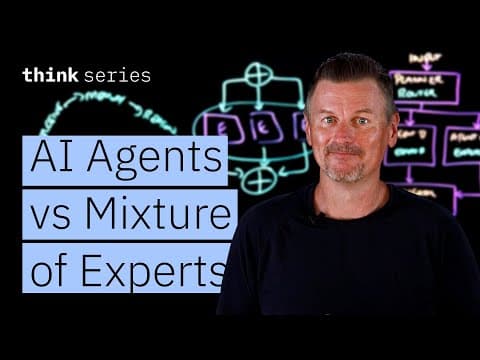
How Do Generative AI and Agentic AI Differ?
TL;DR
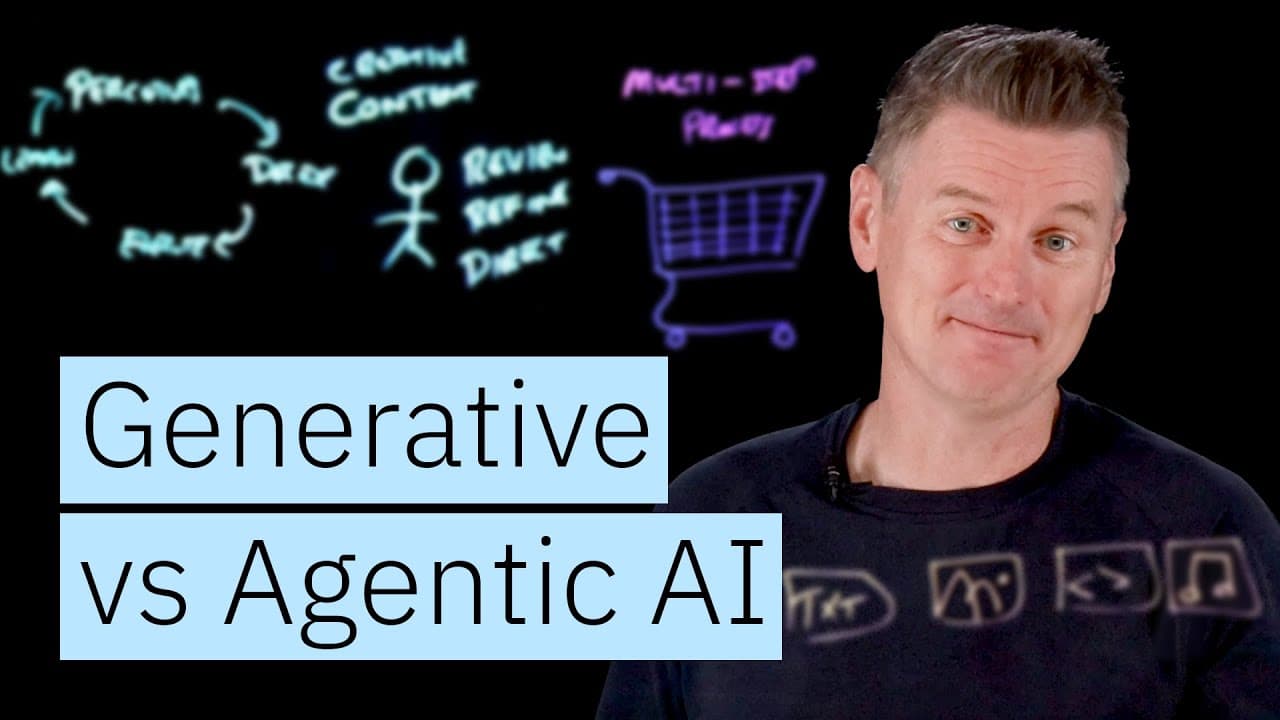
Generative AI reacts to prompts by producing content, while agentic AI proactively pursues goals through repeated perception, decision, execution, and learning. Generative models can serve as the cognitive engine inside agents, helping them divide complex tasks into logical steps, choose actions, and operate with minimal human intervention while requesting input when needed.
Transcript
What's the difference between generative AI and agentic AI? Well, they're two distinct approaches to artificial intelligence. And I think we're all familiar with generative AI, things like chat bots and image generators and the like. And they are really fundamentally reactive systems. They wait for you to do something, specifically they wait for yo... Read More
Key Insights
- Generative AI is a reactive system that waits for a user prompt before producing content. It uses patterns learned during training to generate outputs such as text, images, code, or audio, but it does not independently continue the task after completing that generation.
- Generative AI works through sophisticated pattern matching across statistical relationships in training data. Depending on the system, those relationships may exist between words, pixels, or waves, allowing the model to predict what should come next after receiving a prompt.
- Human direction is central to generative AI workflows because the system generates possibilities rather than managing the complete process. A creator reviews each output, checks whether it meets the intended goal, refines it when necessary, and determines what the AI should do next.
- Agentic AI is a proactive approach that turns an initial prompt into a goal pursued through a series of actions. It can manage ongoing, multistep work with minimal human intervention and seek additional input only when that input becomes necessary.
- The agentic AI lifecycle consists of perceiving an environment, deciding on an action, executing that action, and learning from the output. Repeating this cycle enables an agent to adapt its next step according to what happened during the previous one.
- Large language models are a shared foundation for chatbots and many agentic systems. In generative applications they produce language, while in agents they can provide the reasoning capability needed to examine problems, form plans, and select actions.
- Chain of thought reasoning is presented as a process for dividing a complex task into smaller logical steps. An agent can generate an internal dialogue that identifies requirements, sequences research, checks relevant conditions, and prepares actions before executing them.
- Intelligent AI collaboration is likely to combine generative and agentic capabilities rather than rely exclusively on either approach. Such systems could recognize when to generate and compare possible options, then determine when to commit to a course of action and execute it.
Install to Summarize YouTube Videos and Get Transcripts
Explore YouTube Video Summarizer or Get YouTube Transcript Extractor
Questions & Answers
Q: What is the difference between generative AI and agentic AI?
Generative AI is reactive: it waits for a prompt and creates content based on patterns learned during training. Its work ends after producing the requested text, image, code, or audio unless a person gives another instruction. Agentic AI is proactive: it uses an initial prompt to pursue a goal through multiple actions, repeating a cycle of perception, decision, execution, and learning with minimal human intervention.
Q: How does generative AI create text, images, code, or audio?
Generative AI creates content by using statistical relationships learned from massive datasets. It identifies patterns between elements such as words, pixels, or waves and predicts what should come next in response to a prompt. The resulting output may be text, an image, a piece of code, or audio. The system generates the content but does not independently take further steps after completing it.
Q: Why does generative AI require continued human direction?
Generative AI requires continued human direction because it produces possibilities rather than controlling an entire workflow. A human reviews the generated content, checks whether it matches the intended result, refines it when it does not, and provides the next instruction. For example, a creator might separately request script feedback, thumbnail concepts, and background music while evaluating the output at every stage.
Q: How does an agentic AI system complete a multistep task?
An agentic AI system begins with a prompt that defines a goal, then moves through a repeated lifecycle. It perceives the relevant environment, decides which action to take, executes that action, and learns from the output. The new information informs the next cycle. This process lets the system manage connected steps with minimal intervention while asking the user for input when necessary.
Q: What tasks are suitable for agentic AI systems?
Agentic AI is suited to work that requires ongoing management and multiple connected steps. A personal shopping agent, for example, could search across platforms for product availability, monitor price fluctuations, handle checkout, and coordinate delivery. Instead of waiting for separate prompts at every stage, it pursues the purchasing goal largely by itself and requests human input only when needed.
Q: How do large language models support agentic AI?
Large language models can provide the reasoning engine that powers an agentic system. The agent uses the model's generative capabilities to think through a problem, break the goal into smaller logical steps, and decide what action should follow. In this arrangement, generative AI acts as the cognitive engine for decision-making, while the broader agent system carries out actions and evaluates their results.
Q: How can agentic AI use reasoning to organize a conference?
An agent organizing a conference could first identify requirements such as event size, duration, and budget. It could then research venues matching those parameters and check the availability of suitable options. By generating an internal dialogue, the agent explores the problem space, establishes a logical sequence of smaller tasks, and prepares decisions before taking the actions needed to advance the plan.
Q: How might generative AI and agentic AI work together?
Generative and agentic capabilities can work together as parts of an intelligent collaborator. Generative AI can explore possibilities, create content, and support reasoning about a problem. Agentic behavior can then select a course of action, execute it, observe the result, and continue toward the goal. This combination allows a system to recognize when it should consider options and when it should commit to action.
Summary & Key Takeaways
-
Generative AI systems wait for prompts and produce outputs such as text, images, code, or audio. They use statistical relationships learned from massive datasets to predict appropriate content. Their work normally ends after generation, so a person must review the result, refine the request, and direct every subsequent stage of the process.
-
Agentic AI systems use an initial prompt to pursue goals through multiple actions. An agent perceives its environment, decides what to do, executes an action, and learns from the resulting output. This cycle can continue with minimal human intervention, making agents suitable for ongoing management and complex, multistep processes such as shopping.
-
Large language models connect generative and agentic approaches. They power chatbots and can provide the reasoning engine used by agents to break complicated goals into smaller logical steps. Future AI collaborators may combine generation for exploring possible options with agentic behavior for selecting and carrying out an appropriate course of action.
Read in Other Languages (beta)
Share This Summary 📚
Summarize YouTube Videos and Get Video Transcripts with 1-Click
Try YouTube Summary with ChatGPT & Claude or YouTube Transcript Generator
Explore More Summaries from IBM Technology 📚
Summarize YouTube Videos and Get Video Transcripts with 1-Click
Try YouTube Summary with ChatGPT & Claude or YouTube Transcript Generator