How to build 1000+ SEO pages with AI tools
TL;DR
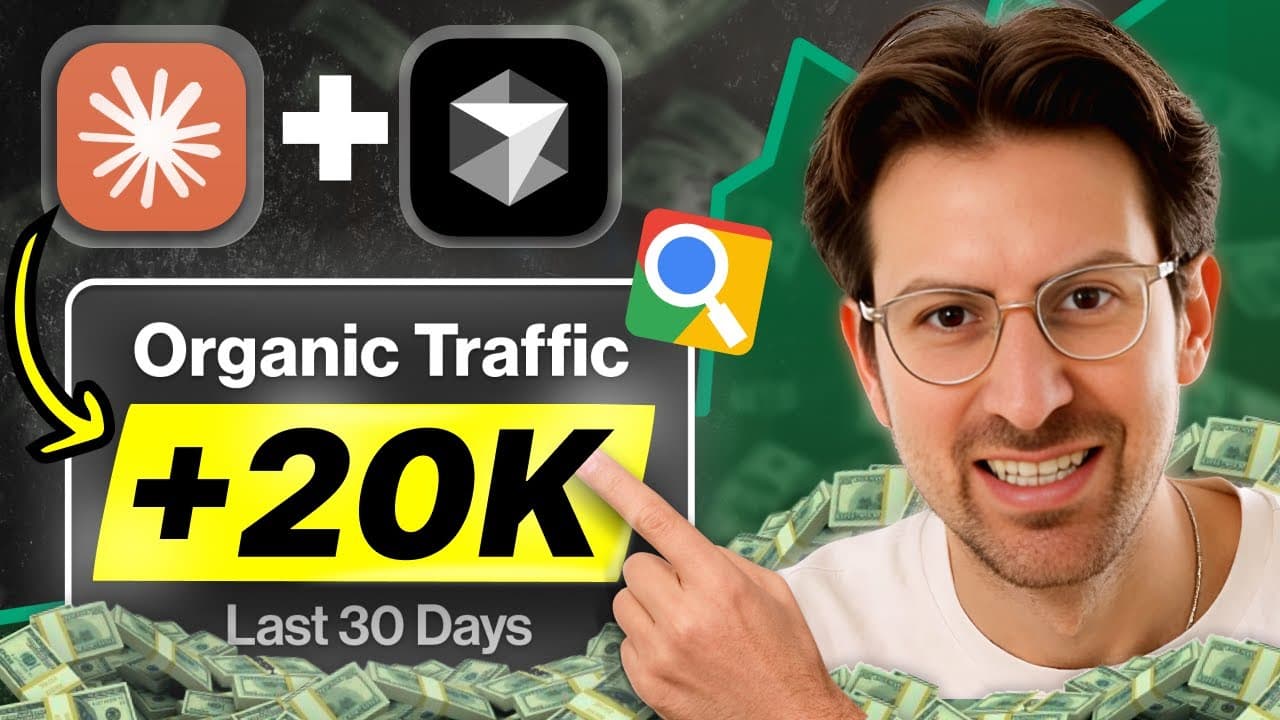
AI tools Cursor and Claude Code enable a non technical marketer to generate thousands of programmatic SEO pages. The workflow starts with MCP aided research using FireCrawl and Perplexity, then Claude Code executes the plan and Versell deploys the pages, illustrating a scalable approach to SEO without traditional coding.
Transcript
anyone could become a developer with AI there's a bunch of tools that you can cobble together with Cursor Claude and a few others and we go through how a non-technical person uh in 3 weeks is now building apps that are getting thousands of visits every single month i think a lot of people have avoided Cursor because it's pretty daunting but the ups... Read More
Key Insights
- Cursor agent enables natural language control over the development environment, letting users execute tasks within a single interface.
- MCPs like FireCrawl and Perplexity act as reusable research and data gathering components that feed the page creation process.
- Claude Code provides code execution capabilities that translate research results into working pages and live deployments.
- Versell is used to host and optimize the produced pages, ensuring fast performance and easy deployment from the AI environment.
- The approach is designed for non technical marketers to automate SEO workflows without deep coding knowledge.
- The content emphasizes a workflow that ties together research, content generation, and deployment into a single repeatable process.
- The strategy aims to generate thousands of pages by templating and automating repetitive SEO tasks.
- The video suggests that emerging AI tools are blurring the line between marketing and development roles.
- More videos from this channel:
- More from this channel: Greg Isenberg
Install to Summarize YouTube Videos and Get Transcripts
Explore YouTube Video Summarizer or Get YouTube Transcript Extractor
Questions & Answers
Q: What is the basic setup for building programmatic SEO pages with AI tools?
The basic setup uses Cursor with an agent, Claude Code for execution, and MCPs such as FireCrawl to gather data from target sites. The workflow starts by planning within Cursor, then running Claude Code to turn the research into a working page, followed by deployment through Versell. This creates a repeatable pipeline that scales content production.
Q: How do MCPs contribute to the workflow?
MCPs, or Model Control Protocols, act as modular research and data gathering components. They can scrape data from websites like Vibearketer, summarize findings, and prepare structured inputs for Claude Code. This modular approach allows the user to swap or add MCPs for different data sources without rewriting the entire workflow.
Q: What role does Claude Code play in building the pages?
Claude Code is used to interpret the research data and implement the plan by generating the necessary code and content for the pages. It handles planning, coding, and iterative edits, providing a logical, task driven flow. This helps convert raw research into a live, well formed page ready for deployment.
Q: Why is FireCrawl mentioned as important for this workflow?
FireCrawl is highlighted as a powerful scraper used to collect site data and produce a comprehensive summary document. It provides the essential data foundation that Claude Code and other tools rely on to draft and assemble the programmatic SEO pages. The efficient data gathering accelerates the entire process.
Q: What is the deployment method used in this approach?
Deployment is done via Versell, a hosting and optimization platform. The workflow includes installing and using Claude Code to prepare the page, then deploying through Versell to ensure speed and reliability. This keeps the process contained within the AI toolchain and minimizes manual deployment steps.
Q: How does the workflow address non technical marketers?
The workflow is designed so non technical marketers can orchestrate AI tools to build SEO content. It uses natural language prompts, MCPs, and code execution within Claude Code, removing the need for deep programming knowledge. The approach empowers marketers to manage data, plan, implement, and deploy pages end to end.
Q: What is the practical outcome demonstrated in the video?
The practical outcome is a live, keyword focused page template for AI tool comparisons that can be replicated for many keywords. It demonstrates the end to end process from research to live deployment and shows how scaling to thousands of pages is possible by reusing templates and automation.
Q: What are the time and cost considerations highlighted?
The video discusses time savings from automating SEO workflows and the cost of Claude Code, along with other tools. It emphasizes reducing manual coding and development resources while maintaining scalable output. Exact numbers are not provided, but the focus is on efficiency and scalability.
Summary & Key Takeaways
-
The video demonstrates a non technical marketer using Cursor, Claude Code, and MCPs to automate page creation, research, and deployment, aiming to generate thousands of SEO pages for traffic growth. The process combines web scraping, planning, coding, and hosting to illustrate a scalable workflow. It emphasizes practical steps over theory.
-
The workflow centers on KC using FireCrawl to gather site data, Claude Code to craft and implement pages, and Versell for deployment, highlighting how integrated AI tools can replace manual development work in SEO tasks.
-
The content showcases a repeatable method for building multiple keyword focused pages, including keyword research, content generation, page templating, and deployment, designed to scale marketing programs while reducing reliance on traditional development resources.
Read in Other Languages (beta)
Share This Summary 📚
Summarize YouTube Videos and Get Video Transcripts with 1-Click
Try YouTube Summary with ChatGPT & Claude or YouTube Transcript Generator
Explore More Summaries from Greg Isenberg 📚




Summarize YouTube Videos and Get Video Transcripts with 1-Click
Try YouTube Summary with ChatGPT & Claude or YouTube Transcript Generator