How to mimic a large team with AI tools for small businesses
TL;DR
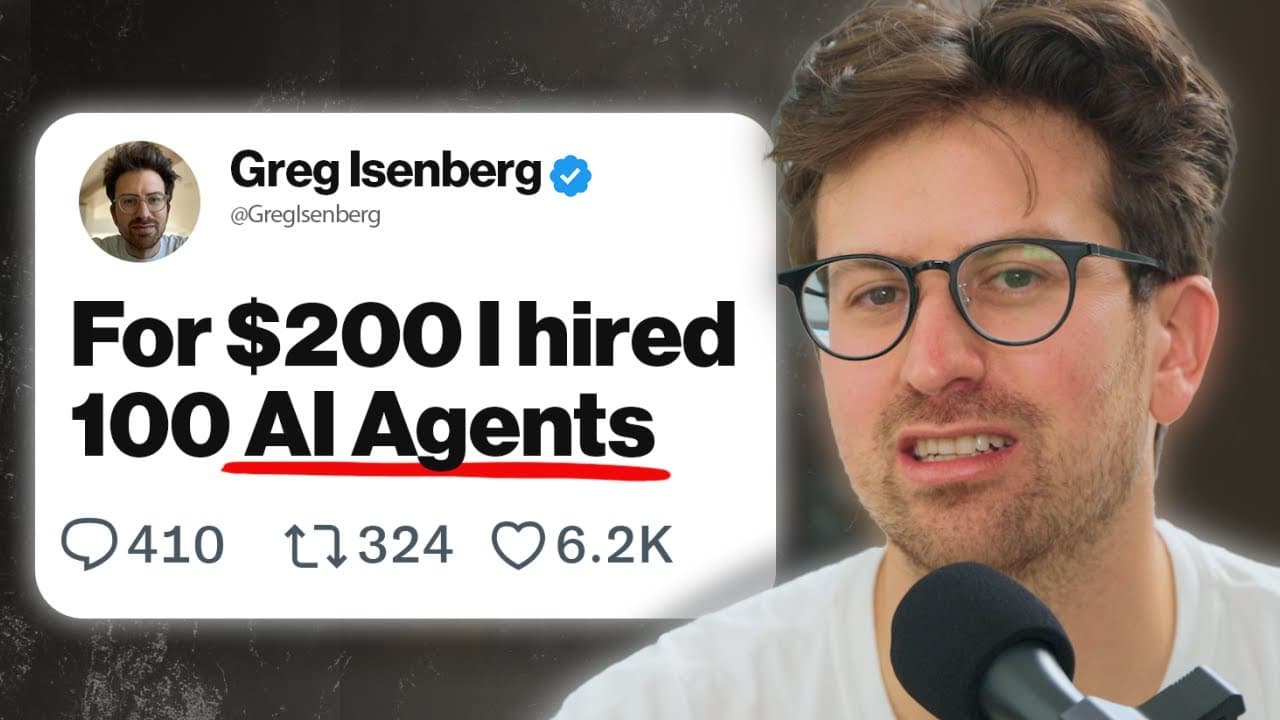
AI tools can scale a one person operation into the output of a much larger team by handling research, content creation, and ads. Founders should first master tools like ChatGPT Pro before delegating, because affordable AI can dramatically boost productivity, with examples of Pro at 200 dollars a month and NoteBook LM combined costs around 320 dollars.
Transcript
okay you know I've been on your podcast you've been talking about AI stuff and I've been kind of like yeah it's interesting but also I'm not using it that much i think since 03 came out it's completely changed my entire like perception of what AI can do for my company or like my clients companies and I'm actually kind of like getting a bit worried ... Read More
Key Insights
- AI tools like ChatGPT Pro can multiply a one person operation into the output of a larger team. The key is to set up and optimize the AI workflow so inputs become high quality outputs.
- Founders should personally learn AI tools before delegating to others, ensuring they can map repetitive tasks and automate them effectively across marketing, research, and content creation.
- There is an arbitrage opportunity in AI costs versus value, with tools costing hundreds of dollars per month delivering productivity equivalent to many people.
- Content research, ad generation, and workflow automation are core areas where AI can replace manual, time consuming processes and accelerate growth.
- Building an audience is foundational for iterative product and messaging testing, leveraging AI to generate ideas and content at scale while watching for algorithmic signals.
- The human editor remains important for taste, judgment, and quality control, guiding AI outputs toward business goals and brand voice.
- AI tools are evolving rapidly, and staying current on the best combos of GPT models, Claude, Notebook LM and others is crucial for maximizing ROI.
- The future of AI costs suggests a tradeoff between capabilities and price, encouraging founders to optimize tool stacks rather than default to traditional hiring.
- More videos from this channel:
- More from this channel: Greg Isenberg
Install to Summarize YouTube Videos and Get Transcripts
Explore YouTube Video Summarizer or Get YouTube Transcript Extractor
Questions & Answers
Q: What is the main benefit of using AI tools for a one person business?
The main benefit is increasing output without adding headcount. By using AI for research, content creation, and ads, a single founder can achieve the workload of a much larger team. This requires setting up repeatable AI workflows and monitoring outputs for quality, but the productivity gains can be substantial and cost effective.
Q: Why should a founder learn AI tools before delegating to the team?
Learning AI tools first ensures the founder maps repetitive tasks accurately and automates them effectively. When the founder understands how the tools work, they can design processes that produce consistent results, set realistic expectations, and guide the team. This hands on knowledge also helps in auditing AI outputs for quality and alignment with business goals.
Q: How can AI change content creation and audience building for a small business?
AI can generate content ideas, draft scripts or posts, and optimize messaging for different platforms. By consistently producing content and testing variations, a founder can accelerate audience growth, test positioning, and gather feedback quickly. The result is faster learning about what resonates with customers and higher engagement.
Q: What does the transcript say about tool costs and productivity?
The transcript mentions paying around 200 dollars a month for ChatGPT Pro, 100 dollars for Claude Max, and 20 dollars for Notebook LM, totaling approximately 320 dollars per month. This combination is framed as delivering the productivity equivalent of many hundreds of people, highlighting a strong cost efficiency advantage.
Q: What is the role of the human editor when using AI in business operations?
The human editor provides taste, intuition, and strategic judgment that AI lacks. They review AI outputs, refine messaging, ensure alignment with brand voice, and make final decisions. This collaboration ensures outputs are not only efficient but also polished, credible, and appropriate for the target audience.
Q: What is meant by the idea of ‘audience first’ in an AI enabled workflow?
Audience first means creating content and experiments designed to learn what resonates with real people. AI helps generate ideas and test them at scale, but success depends on measuring engagement, iterating based on feedback, and refining the approach to better meet audience needs.
Q: How does AI enable scaling without hiring more people according to the discussion?
AI enables scaling by automating repetitive tasks, improving research, ad creation, and workflow processes. By leveraging tools like ChatGPT Pro and other AI platforms, a founder can achieve higher output with the same team, and only hire when there is a clear gap that requires human specialization.
Q: What should startups consider when choosing an AI tool stack?
Startups should assess the balance between capability and cost, choosing tools that fit their specific workflows such as research, content generation, and automation. It is important to stay updated on tool developments, test combinations, and ensure the stack aligns with the company’s goals and brand voice.
Summary & Key Takeaways
-
AI tools dramatically increase productivity by enabling small teams to outperform larger ones through automation and smarter workflows. Founders should personally master these tools to map repetitive tasks and maximize output. The cost efficiency of AI tools makes it feasible to scale without immediate hires.
-
Audience building and content strategy are central to leveraging AI, with the algorithm insights and content ideas generated by AI playing a key role in growth. The emphasis is on practical, hands-on use of tools to drive real business outcomes.
-
The discussion highlights an ongoing shift in how businesses operate, focusing on tool literacy, practical workflows, and the economics of AI to stay competitive. The central message is to embrace AI as a tool that expands capacity rather than a threat to jobs.
Read in Other Languages (beta)
Share This Summary 📚
Summarize YouTube Videos and Get Video Transcripts with 1-Click
Try YouTube Summary with ChatGPT & Claude or YouTube Transcript Generator
Explore More Summaries from Greg Isenberg 📚





Summarize YouTube Videos and Get Video Transcripts with 1-Click
Try YouTube Summary with ChatGPT & Claude or YouTube Transcript Generator