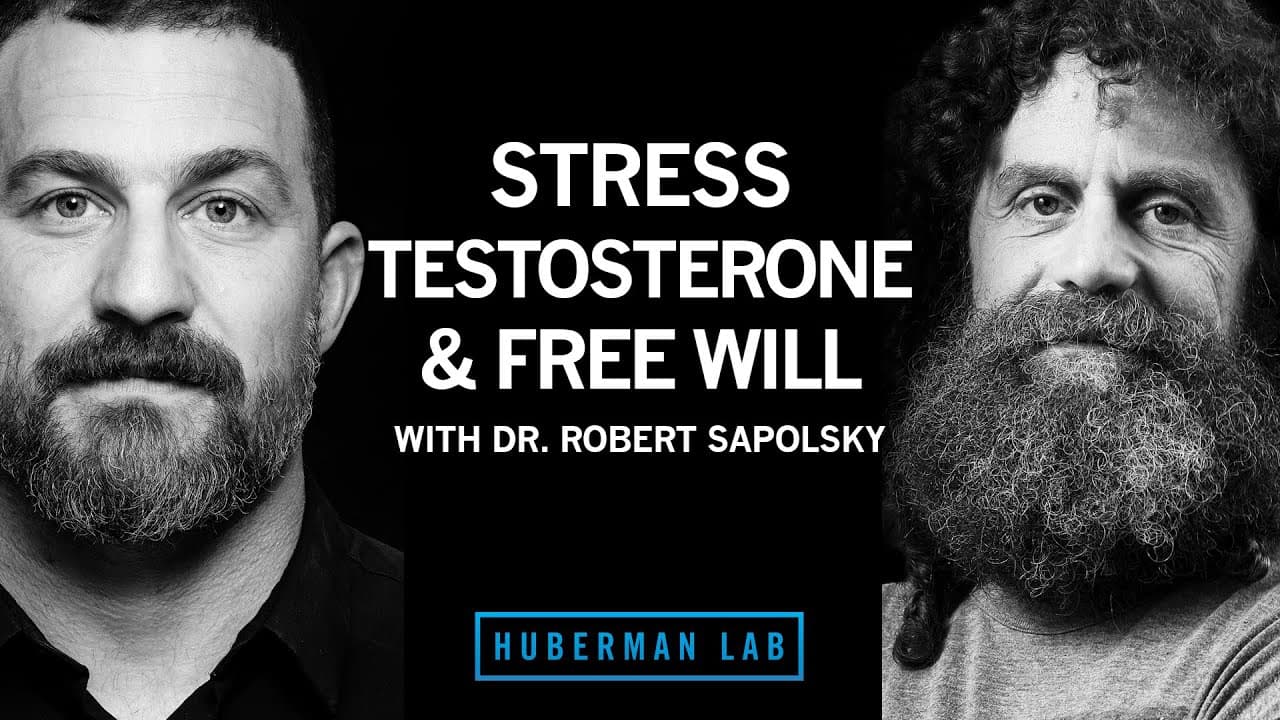
What Role Do Stress, Testosterone, and Free Will Play in Behavior?
TL;DR
Stress influences behavior significantly by altering cognition and emotional responses, while testosterone amplifies existing patterns of aggression and motivation without directly causing them. Both hormones operate within a complex interplay of context, individual differences, and social factors, making personalized stress management strategies essential for effective coping.
Transcript
- [Andrew Huberman] Welcome to the Huberman Lab Podcast where we discuss science and science-based tools for everyday life. - I'm Andrew Huberman, and I'm a Professor of Neurobiology and Ophthalmology at Stanford School of Medicine. Today I have the pleasure of introducing Dr. Robert Sapolsky. Dr. Sapolsky is a Professor of Biology and Neurosurgery... Read More
Key Insights
- ❓ Testosterone amplifies preexisting patterns of aggression and motivation, but it does not directly cause aggression or other behaviors.
- 🧡 Estrogen has a range of protective effects on cognition and cardiovascular health, but optimal effects depend on physiological levels and context.
- 🧑🏭 Stress mitigation requires finding techniques that work individually, focusing on controllable factors, predictability, and effective outlets for frustration.
- 💨 Perception and cognitive flexibility play a significant role in stress response, enabling individuals to interpret stressors in a way that minimizes their impact.
- ❓ Social support, when meaningful and appropriately provided, contributes to stress management and overall well-being.
- 🖐️ The prefrontal cortex plays a crucial role in interpreting circumstances, facilitating cognitive flexibility, and influencing stress responses.
- 🎙️ More videos with Robert Sapolsky:
Install to Summarize YouTube Videos and Get Transcripts
Explore YouTube Video Summarizer or Get YouTube Transcript Extractor
Questions & Answers
Q: How does testosterone affect human behavior?
Testosterone does not directly cause aggression. Instead, it lowers the threshold for aggression and amplifies preexisting patterns of aggression. Testosterone levels in individuals vary, and its effects depend on social circumstances and individual traits.
Q: What is the role of estrogen in stress and health?
Estrogen has a range of beneficial effects on cognition, neurogenesis, glucose and oxygen delivery, and protection against dementia and cardiovascular disease. However, the effectiveness of estrogen replacement therapy depends on timing, type, and ratio with other hormones.
Q: How can individuals mitigate stress effectively?
Stress management techniques differ for each person. It is essential to find strategies that work best for individual needs, such as exercise, mindfulness, gratitude, or any activity that provides a sense of control and predictability. It is crucial to prioritize personal well-being and choose techniques that resonate positively.
Q: How can individuals support others in stress management?
Providing social support involves being attentive, empathetic, and reciprocating support rather than demanding it. However, it is essential to ensure that support is meaningful and appropriate to the individual's needs, as different people respond differently to various types of support.
Summary & Key Takeaways
-
Dr. Robert Sapolsky delves into the impact of stress, hormones, and control on human behavior and biology.
-
He highlights the importance of factors like sense of control, predictability, outlets for frustration, and social support in stress management.
-
Individual differences play a significant role in stress response, making personalized stress mitigation strategies crucial.
-
Context and perception can significantly affect the outcomes of stressors, emphasizing the role of cognition and interpretation in stress management.
Read in Other Languages (beta)
Share This Summary 📚
Summarize YouTube Videos and Get Video Transcripts with 1-Click
Try YouTube Summary with ChatGPT & Claude or YouTube Transcript Generator
Explore More Summaries from Andrew Huberman 📚

Summarize YouTube Videos and Get Video Transcripts with 1-Click
Try YouTube Summary with ChatGPT & Claude or YouTube Transcript Generator