How to Overcome Fear and Trauma with Neuroscience
TL;DR
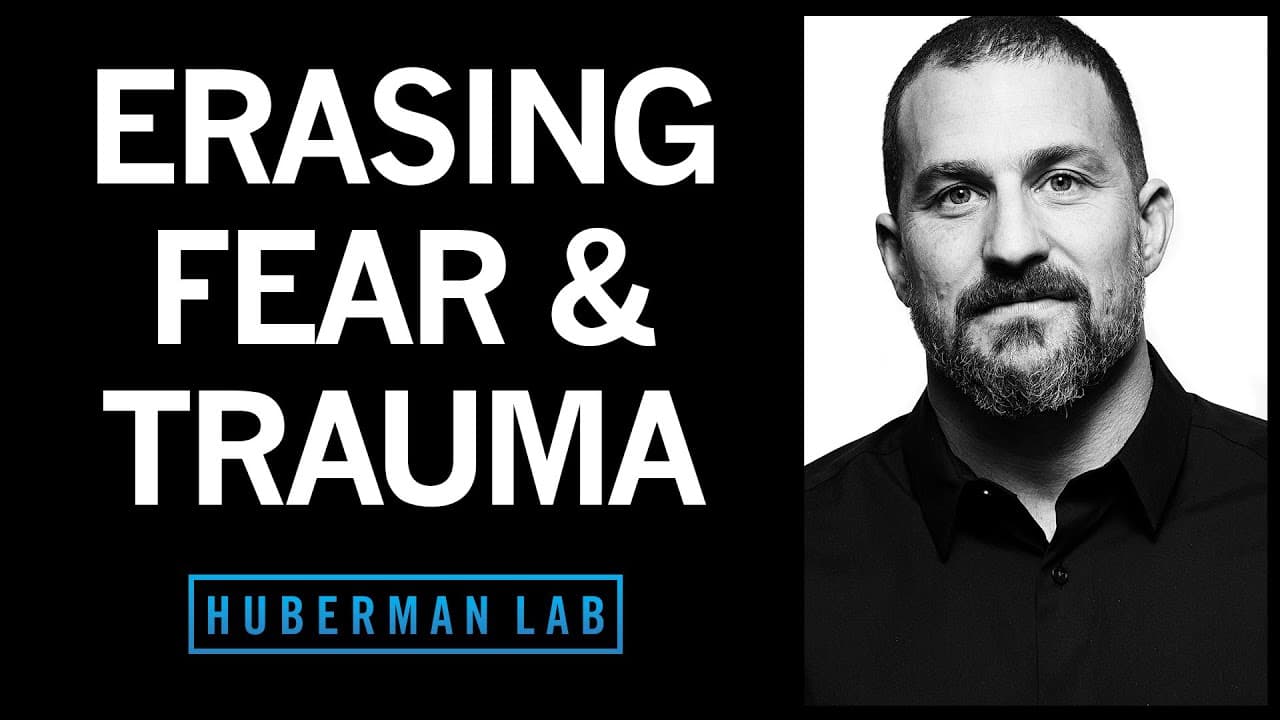
To overcome fear and trauma, understand that fear involves a threat reflex activated by the amygdala, leading to physiological responses. The HPA axis releases stress hormones like cortisol that influence these reactions. Techniques such as behavioral therapy can help extinguish fear memories and replace them with positive associations, utilizing top-down processing from the prefrontal cortex to regain control.
Transcript
- [Andrew Huberman] Welcome to the Huberman Lab Podcast, where we discuss science and science-based tools for everyday life. [bright music] - I'm Andrew Huberman, and I'm a professor of neurobiology and ophthalmology at Stanford School of Medicine. Today, we're going to talk about the Neuroscience of fear. We are also going to talk about trauma and... Read More
Key Insights
- 😨 Fear involves a threat reflex that activates the amygdala, leading to physiological and cognitive responses associated with fear.
- 😨 The HPA axis plays a role in the stress response, and stress and anxiety are often present in fear and trauma.
- 😨 The top-down processing from the prefrontal cortex allows individuals to override reflexive fear responses.
- 😨 Fear memories can be formed through classical conditioning, where a conditioned stimulus becomes associated with a fear response.
- 😨 Behavioral therapies involving the retelling of traumatic or fearful events help in extinguishing the fear response and replacing it with new positive associations.
Install to Summarize YouTube Videos and Get Transcripts
Explore YouTube Video Summarizer or Get YouTube Transcript Extractor
Questions & Answers
Q: How does stress relate to fear?
Stress is a physiological response that often accompanies fear, but fear can exist without stress. Stress activates the sympathetic nervous system, while fear involves the threat reflex and can result in anxiety.
Q: What is the connection between the amygdala and fear?
The amygdala is a key component of the threat reflex and plays a crucial role in the fear response. It receives information from memory and sensory systems and activates various brain areas involved in freezing, pain management, and arousal.
Q: How does fear become associated with certain memories or stimuli?
Fear is learned through classical conditioning, where an initially neutral stimulus is paired with an unconditioned stimulus that elicits an innate fear response. Over time, the conditioned stimulus alone can trigger fear.
Q: How do behavioral therapies help in overcoming fear?
Behavioral therapies like prolonged exposure therapy, cognitive processing therapy, and cognitive-behavioral therapy help in reducing fear and trauma by gradually exposing individuals to their fears and replacing negative associations with positive experiences.
Summary & Key Takeaways
-
The podcast discusses the biology of fear and trauma, explaining the neural circuits involved in the fear response and how fear can turn into trauma.
-
It explores the concept of autonomic arousal and the HPA axis, which releases stress hormones like cortisol and adrenaline.
-
The podcast highlights the importance of the amygdala in the threat reflex and the role of the prefrontal cortex in top-down processing to override the fear response.
Read in Other Languages (beta)
Share This Summary 📚
Summarize YouTube Videos and Get Video Transcripts with 1-Click
Try YouTube Summary with ChatGPT & Claude or YouTube Transcript Generator
Explore More Summaries from Andrew Huberman 📚



Summarize YouTube Videos and Get Video Transcripts with 1-Click
Try YouTube Summary with ChatGPT & Claude or YouTube Transcript Generator