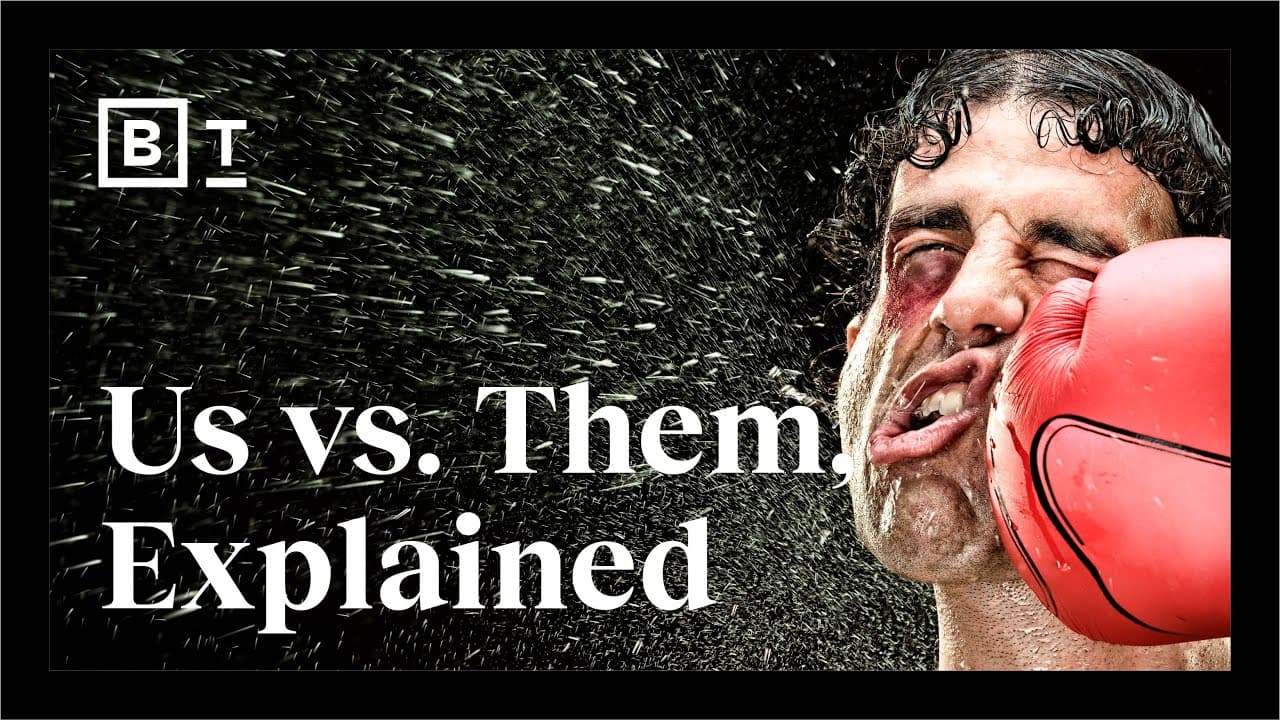
What Causes the 'Us vs. Them' Mentality in Humans?
TL;DR
Humans are naturally inclined to categorize others as 'us' or 'them,' favoring in-group members and often discriminating against out-group individuals. This bias is partly driven by oxytocin, which promotes positive social behaviors within groups but can worsen treatment of those outside one’s group. Overcoming this innate tribalism requires recognizing our assumptions and embracing diverse group identities.
Transcript
Our brain evolved to take what is meaningless to make it meaningful. Everything you do right now is grounded in your assumptions. Not sometimes, but all the time. We are kind of hardwired to figure out the intentions of other people. We turn the world into us's and thems. And we don't like the thems very much and are often really awful to them. Tha... Read More
Key Insights
- 👥 Humans have a natural tendency to divide the world into "us" and "them," resulting in biased treatment towards out-group members.
- 👥 Oxytocin, often associated with positive social behaviors, can also enhance in-group favoritism and worsen treatment towards out-group members.
- 🖐️ Perceptions of typicality play a role in our impressions of others, and it is influenced by both facial features and cultural factors.
- 🤪 Loyalty to a tribe is highly valued, and going against the tribe is seen as a serious offense.
- 😵 Overcoming tribalism requires embracing cross-cutting group identities and acknowledging the influence of assumptions in our perceptions.
- 😃 Humans are skilled at quickly picking up on social cues, such as eye gaze and facial expressions, but it is challenging to accurately judge character solely based on facial features.
- 🎙️ More videos with Robert Sapolsky:
Install to Summarize YouTube Videos and Get Transcripts
Explore YouTube Video Summarizer or Get YouTube Transcript Extractor
Questions & Answers
Q: How does oxytocin affect our behavior towards in-group and out-group members?
Oxytocin enhances our positive behaviors towards in-group members, such as trust and empathy. However, it also makes us more aggressive and less cooperative towards out-group members.
Q: Can our perceptions of typicality be influenced by cultural factors?
Yes, typicality is not only based on facial features but also influenced by cultural factors. People tend to perceive faces that are closer to the typical features in their social environment as more trustworthy.
Q: Why is loyalty to a tribe considered crucial, and what happens if one betrays the tribe?
Loyalty is essential within tribes, and betraying the tribe's trust is considered the most serious offense. Betrayal can lead to social punishment, ridicule, or even ex-communication.
Q: How can we overcome the negative effects of tribalism?
One approach is to develop cross-cutting group identities, where individuals identify with multiple groups that neutralize each other. This helps prevent the polarization and entrenchment of two opposing tribes.
Summary & Key Takeaways
-
Humans are hardwired to distinguish between "us" and "them" and often treat the "thems" poorly.
-
Oxytocin, often referred to as the "love hormone," enhances in-group favoritism but worsens the treatment of out-group members.
-
The perception of typicality plays a role in our impressions of others, and it is culturally specific and influenced by our natural environment.
Read in Other Languages (beta)
Share This Summary 📚
Summarize YouTube Videos and Get Video Transcripts with 1-Click
Try YouTube Summary with ChatGPT & Claude or YouTube Transcript Generator
Explore More Summaries from Big Think 📚

Summarize YouTube Videos and Get Video Transcripts with 1-Click
Try YouTube Summary with ChatGPT & Claude or YouTube Transcript Generator