How to Stop Polite Habits That Weaken Respect
TL;DR
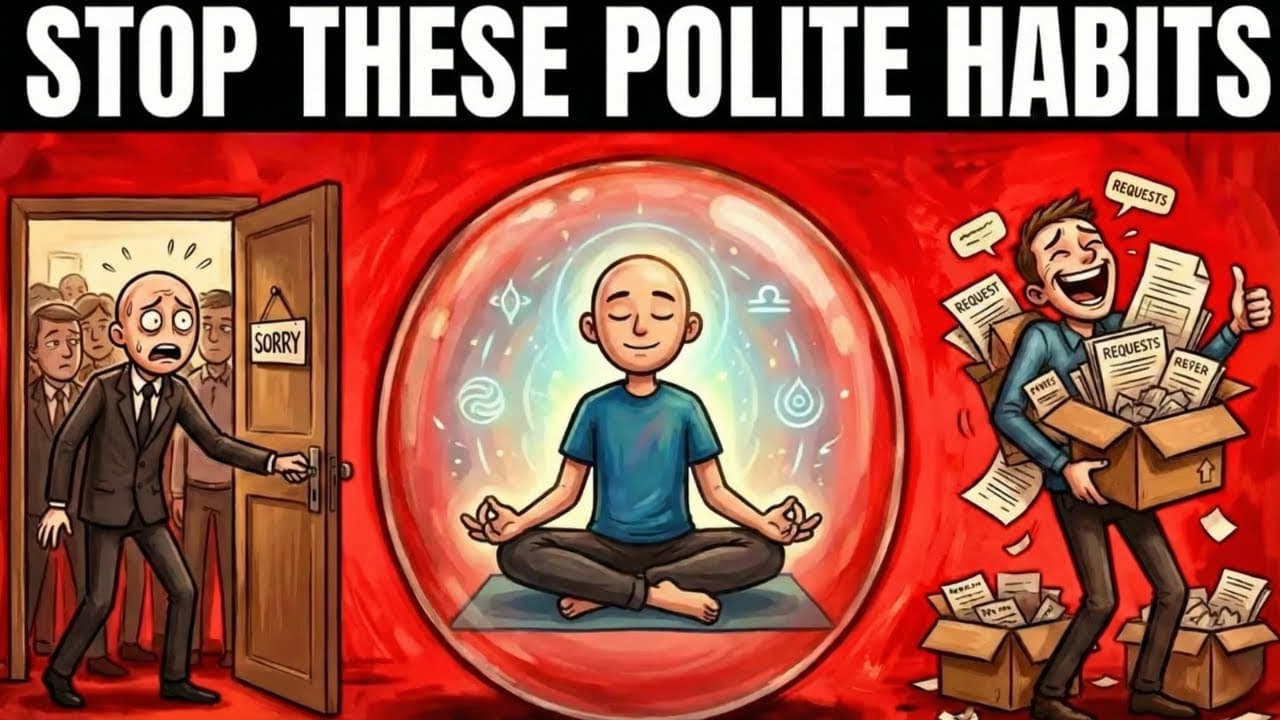
Reserve apologies for situations where you actually caused harm, keep your expression aligned with the moment, and decline requests without extensive justification. Replace unnecessary apologies with gratitude, remove nervous smiles during disrespect, stop after one brief reason for saying no, and use confident checks for understanding instead of asking, “Does that make sense?”
Transcript
You have been lied to since the day you were born. You were told that if you were polite, the world would be kind to you. You were taught that if you made yourself small, soft, and agreeable, you would be safe. You were trained to believe that nice is a virtue and that accommodating is a strength. But look around you. Look at your life right now. W... Read More
Key Insights
- Excessive politeness is presented as a signal that personal needs are secondary, time is cheap, and boundaries can be negotiated. The proposed goal is not becoming rude, but removing submissive behaviors while communicating needs and decisions with greater clarity.
- The apology reflex reduces the value of sincere apologies when “sorry” is repeatedly used for harmless actions, questions, delays, or circumstances outside personal control. The transcript recommends reserving apologies for occasions when someone has actually been harmed.
- Gratitude can replace an unnecessary apology without abandoning courtesy. Saying “Thank you for your patience” instead of “Sorry I’m late” recognizes the listener positively, while “Thank you for making time” avoids framing a reasonable request as an improper burden.
- A nervous smile during criticism or disrespect creates a mismatch between facial expression and actual emotion. The transcript argues that this incongruence can appear untrustworthy while also signaling that rude behavior has been accepted or rewarded.
- A calm, neutral expression can answer rudeness without either smiling or reacting angrily. The recommended response is to relax the face, maintain direct eye contact, and allow silence to remain instead of immediately relieving the other person’s discomfort.
- Overexplaining a refusal turns a decision into a negotiation because every detailed reason gives the other person something to challenge or solve. The transcript labels the pattern JADE, meaning justify, argue, defend, and explain.
- The executive no consists of a clear refusal followed by no more than one vague reason. Statements such as “I can’t make it,” “I have a prior commitment,” or “My schedule is full” preserve the boundary by ending the explanation.
- The phrase “Does that make sense?” is described as reassurance seeking after an explanation. It can imply either uncertainty about the speaker’s communication or doubt about the listener’s understanding, weakening an otherwise clear plan or instruction.
Install to Summarize YouTube Videos and Get Transcripts
Explore YouTube Video Summarizer or Get YouTube Transcript Extractor
Questions & Answers
Q: How can unnecessary apologies weaken your reputation?
Unnecessary apologies can frame ordinary actions, questions, needs, or circumstances as personal wrongdoing. The transcript describes an apology as an admission of guilt and a social debt. When “sorry” is used for everything, it also loses meaning, so a later apology for a consequential mistake carries less weight. The recommended rule is to apologize when you have actually harmed someone, not merely for taking time or space.
Q: What should you say instead of an unnecessary apology?
Replace the apology with gratitude when another person has shown patience or made time. For example, the transcript recommends “Thank you for your patience” instead of “Sorry I’m late,” and “Thank you for making time” instead of “Sorry to bother you.” This keeps the interaction courteous while avoiding language that portrays your presence, question, or reasonable need as an offense requiring forgiveness.
Q: Why should you stop smiling when someone is disrespectful?
A nervous smile during criticism, an insult, or another disrespectful act can signal that the behavior is acceptable. It may also create visible incongruence because the eyes communicate fear or anger while the mouth communicates friendliness. The transcript argues that this mismatch can make a person appear weak or untrustworthy. A serious situation should instead be met with a serious, emotionally consistent expression.
Q: How should you respond calmly when someone makes a rude comment?
The recommended response is a calm, neutral stare rather than a nervous smile or an angry outburst. Relax the facial muscles, look directly at the person, say nothing, and allow the silence to continue. According to the transcript, this removes the expected emotional reward and leaves the rude person sitting with the discomfort created by their own comment, without turning the exchange into an emotional confrontation.
Q: What is the JADE trap in communication?
JADE refers to justify, argue, defend, and explain. It describes the habit of giving a long defense after declining a request, missing a deadline, or setting another boundary. The transcript presents this as a response learned when a simple no was previously treated as insufficient. In adult interactions, the extra details can communicate guilt and invite the listener to challenge each reason rather than accept the decision.
Q: How do you say no without overexplaining?
Use what the transcript calls the executive no: state the refusal, provide at most one vague reason, and then stop talking. Suitable examples include “I can’t make it,” “I have a prior commitment,” and “My schedule is full.” Avoid detailed reasons because another person can propose solutions to each detail, changing a settled boundary into an open negotiation that appears to require their approval.
Q: Why is asking “Does that make sense?” discouraged?
The phrase is discouraged because its subtext can undermine both participants. It may suggest that the speaker doubts their own ability to communicate coherently, or that the listener may lack the ability to understand a basic explanation. The transcript describes it as assurance seeking, meaning the speaker appears to be requesting validation after presenting an idea, plan, or instruction rather than assuming the explanation was clear.
Q: Which seven polite habits does the video identify?
The description lists seven habits: the apology reflex, the submission smile, the JADE trap involving overexplaining, the “Does that make sense?” habit, the yes addiction, the “just” virus, and the self-roast ritual. The supplied transcript provides detailed explanations and corrections for the first three habits and begins explaining the fourth. It names the final three in the description without providing their detailed treatment in the supplied text.
Summary & Key Takeaways
-
The central argument is that excessive politeness can communicate submission instead of professionalism. Repeatedly apologizing, smiling through disrespect, overexplaining boundaries, and seeking reassurance can make needs appear secondary and boundaries negotiable. The proposed alternative is not hostility, but direct, emotionally congruent communication that preserves genuine courtesy while avoiding unnecessary self-lowering behavior.
-
Unnecessary apologies are described as admissions of guilt for debts that do not exist. The recommended adjustment is to apologize only after causing actual harm and otherwise use gratitude, silence, or a direct statement. “Thank you for your patience” and “Thank you for making time” recognize the other person without portraying ordinary needs as offenses.
-
Nervous smiling and excessive explanation are presented as anxiety-driven responses to tension. A serious or disrespectful moment calls for a calm, matching expression rather than a false smile. Similarly, a refusal should include no more than one vague reason before stopping. Clear explanations should end with a confident invitation for questions, not reassurance seeking.
Read in Other Languages (beta)
Share This Summary 📚
Summarize YouTube Videos and Get Video Transcripts with 1-Click
Try YouTube Summary with ChatGPT & Claude or YouTube Transcript Generator
Explore More Summaries from Mindplicit 📚




Summarize YouTube Videos and Get Video Transcripts with 1-Click
Try YouTube Summary with ChatGPT & Claude or YouTube Transcript Generator