How to Handle Willfully Ignorant People
TL;DR
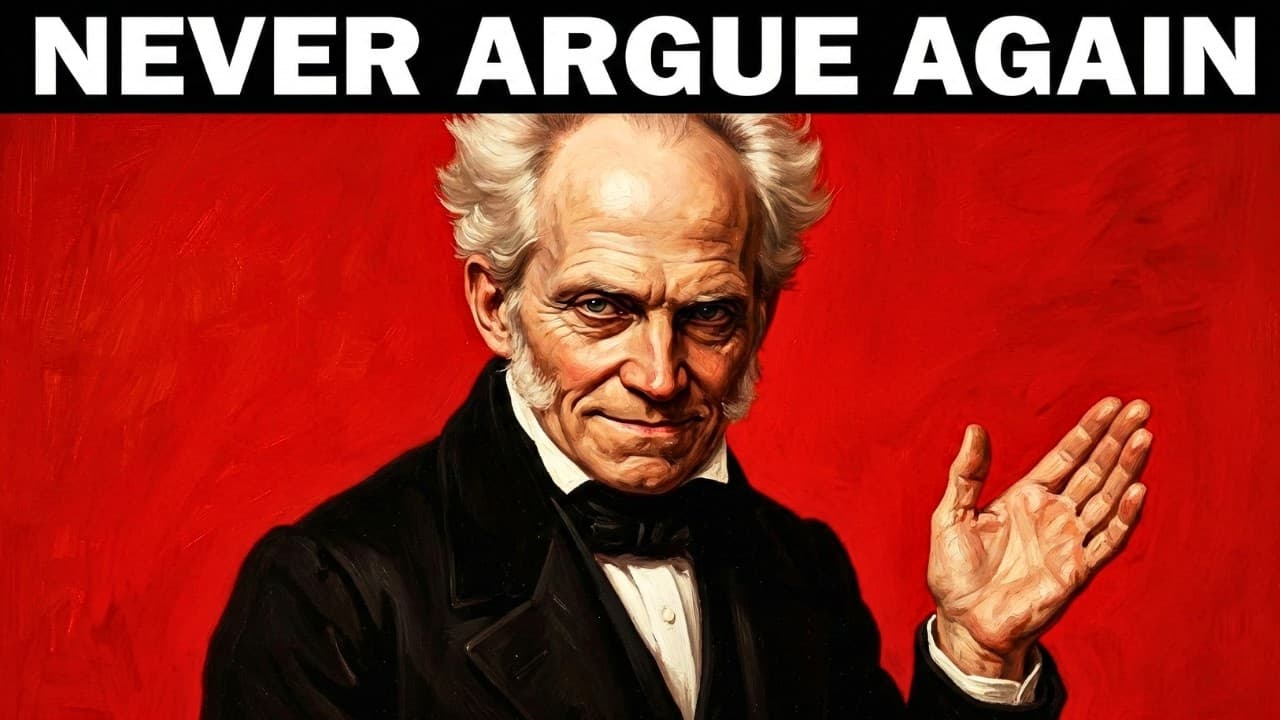
Protect your mental energy by refusing to treat every irrational claim as an invitation to debate. Use strategic detachment, brief neutral responses, or extend a flawed premise to its absurd conclusion, while abandoning the need to receive acknowledgment. When an ignorant person holds power, avoid displaying intelligence in ways that intensify insecurity and make you appear threatening.
Transcript
You are surrounded by fools and it is exhausting. You think your intelligence is your greatest asset. It is actually your biggest vulnerability. The modern world tells you to educate the ignorant, to use logic to find common ground. Arthur Schopenhau knew the brutal truth. Logic is defenseless against stupidity. Explaining your mind to a fool is no... Read More
Key Insights
- The intelligence trap is the belief that everyone values truth and will update a worldview after receiving clear evidence. This assumption projects an intelligent person's reasoning process onto someone who may be defending status, identity, or ego instead of examining the issue.
- Willful ignorance is presented as an active defense mechanism rather than a simple absence of knowledge. When correction threatens the ego, a person may double down on an incorrect position, making additional evidence ineffective and increasing the emotional and cognitive cost of the exchange.
- System 1 is described as fast, emotional, and instinctive, while System 2 is slow, deliberate, and logical. Conflict arises when one person offers nuance and evidence but the other reacts through immediate feelings, fixed opinions, and instinctive resistance.
- Argument gives an irrational person friction, attention, and a sense of importance. Every detailed rebuttal can legitimize the disputed claim by signaling that it deserves time and anger, allowing the less thoughtful participant to prevail through refusal and endurance rather than superior reasoning.
- Reductio ad absurdum works by accepting a premise and extending it to an untenable conclusion. The transcript's modern-art example turns the claim that painting is effortless into a proposal to quit work, make canvases immediately, and become wealthy, exposing the missing nuance.
- The need to be recognized as correct is itself a source of vulnerability. Abandoning the demand for concession prevents another person's approval or provocation from controlling one's emotional state and makes it easier to preserve energy when correction serves no practical purpose.
- Psychological quarantine is a method of remaining physically present while staying intellectually detached. A polite avatar uses short, agreeable statements that provide little to attack, allowing unavoidable interactions with managers, clients, neighbors, or relatives without exposing the authentic self to needless conflict.
- Conspicuous intelligence can threaten a mediocre person who holds power because it reflects their insecurity and perceived inadequacy. In such situations, demonstrating brilliance may not establish value, but instead make the intelligent person appear dangerous to someone capable of imposing consequences.
Install to Summarize YouTube Videos and Get Transcripts
Explore YouTube Video Summarizer or Get YouTube Transcript Extractor
Questions & Answers
Q: Why does logic fail against willful ignorance?
Logic fails when the other person is protecting ego, status, or emotional certainty rather than searching for truth. Evidence is then experienced as a threat instead of an opportunity to learn. The person may respond by doubling down, while the reasoner expends increasing effort on facts and nuance. The exchange becomes a contest of resistance and dominance rather than a shared investigation.
Q: What is the intelligence trap in an argument?
The intelligence trap is the assumption that other people use the same truth-seeking process as an analytical thinker. An intelligent person expects well-presented evidence to produce reflection, revision, and agreement. A willfully ignorant opponent may value emotional security or dominance instead. The intelligent participant keeps refining the argument, becomes exhausted, and mistakes the opponent's refusal to reconsider for a failure of explanation.
Q: How can reductio ad absurdum expose a flawed claim?
Reductio ad absurdum exposes a claim by temporarily accepting its premise and extending it to a consequence that reveals its weakness. In the transcript's example, someone says anyone can create a modern-art masterpiece. Instead of debating technique or history, the response proposes quitting work, painting immediately, finding a gallery, and becoming wealthy. The exaggerated conclusion pressures the claimant to introduce the nuance previously denied.
Q: How does strategic detachment protect mental energy?
Strategic detachment removes the expectation that every false statement must be corrected and every opponent must acknowledge the truth. A person can observe the exchange without investing identity, anger, or extensive reasoning in it. By allowing another person to retain an incorrect belief when no useful outcome is available, the intelligent participant preserves attention, emotional stability, creativity, and decision-making capacity.
Q: What is psychological quarantine in difficult conversations?
Psychological quarantine means limiting how much of the authentic self enters an unavoidable interaction. The person remains polite and physically present but uses a conversational avatar that smiles, speaks briefly, and offers neutral acknowledgments such as recognizing another perspective. These responses create little material for attack. The other participant may feel heard or victorious, while the protected person remains intellectually absent and emotionally detached.
Q: Why can arguing with irrational people impair decision-making?
Interactions with highly irrational people create sustained cognitive load. The mind works to predict unpredictable reactions, suppress frustration, and navigate the conversation carefully. Because mental bandwidth is limited, this continuing effort can produce irritability, poor choices, exhaustion, and reduced creativity. The danger is not merely losing an argument, but allowing repeated exposure to consume the intellectual resources needed for more valuable work.
Q: How should you deal with an ignorant person who has power?
When an irrational or insecure person controls pay, promotion, or another important outcome, openly displaying superior intelligence can be interpreted as a threat. The transcript argues that such a person may attack the reminder of their inadequacy instead of learning from it. Survival therefore requires restraint, awareness of the power imbalance, and communication that does not needlessly provoke insecurity merely to demonstrate that one is correct.
Q: What does Schopenhauer's porcupine dilemma suggest about relationships?
The porcupine dilemma presents human relationships as a tension between isolation and painful closeness. Porcupines seek warmth by gathering together, but their quills hurt one another and force them apart. Applied to difficult people, the lesson is to find a sustainable distance. Complete avoidance may be impossible, especially with relatives, managers, clients, and neighbors, but unrestricted intimacy can expose the mind to repeated exhaustion.
Summary & Key Takeaways
-
The intelligence trap is the assumption that other people value truth and will revise their beliefs when shown sufficient evidence. Willfully ignorant people may interpret correction as an ego threat, respond emotionally, and double down. Detailed arguments then consume the reasoner's energy without creating genuine understanding or productive change.
-
Schopenhauer's proposed strategic response is to deny irrational opponents the friction and importance they seek. A person can agree with a faulty premise and extend it toward an absurd conclusion, forcing its weaknesses into view. This approach lets the claim undermine itself without requiring an exhausting exchange of facts and rebuttals.
-
Psychological quarantine protects limited mental bandwidth through distance, detachment, and a polite conversational avatar. Short responses such as acknowledging another perspective provide little material for conflict while keeping the authentic mind disengaged. This becomes especially important around powerful, insecure people who may interpret visible intelligence as a personal threat.
Read in Other Languages (beta)
Share This Summary 📚
Summarize YouTube Videos and Get Video Transcripts with 1-Click
Try YouTube Summary with ChatGPT & Claude or YouTube Transcript Generator
Explore More Summaries from Mindplicit 📚




Summarize YouTube Videos and Get Video Transcripts with 1-Click
Try YouTube Summary with ChatGPT & Claude or YouTube Transcript Generator