Why Do People With Few or No Friends Often Have These 7 Rare Traits?
TL;DR
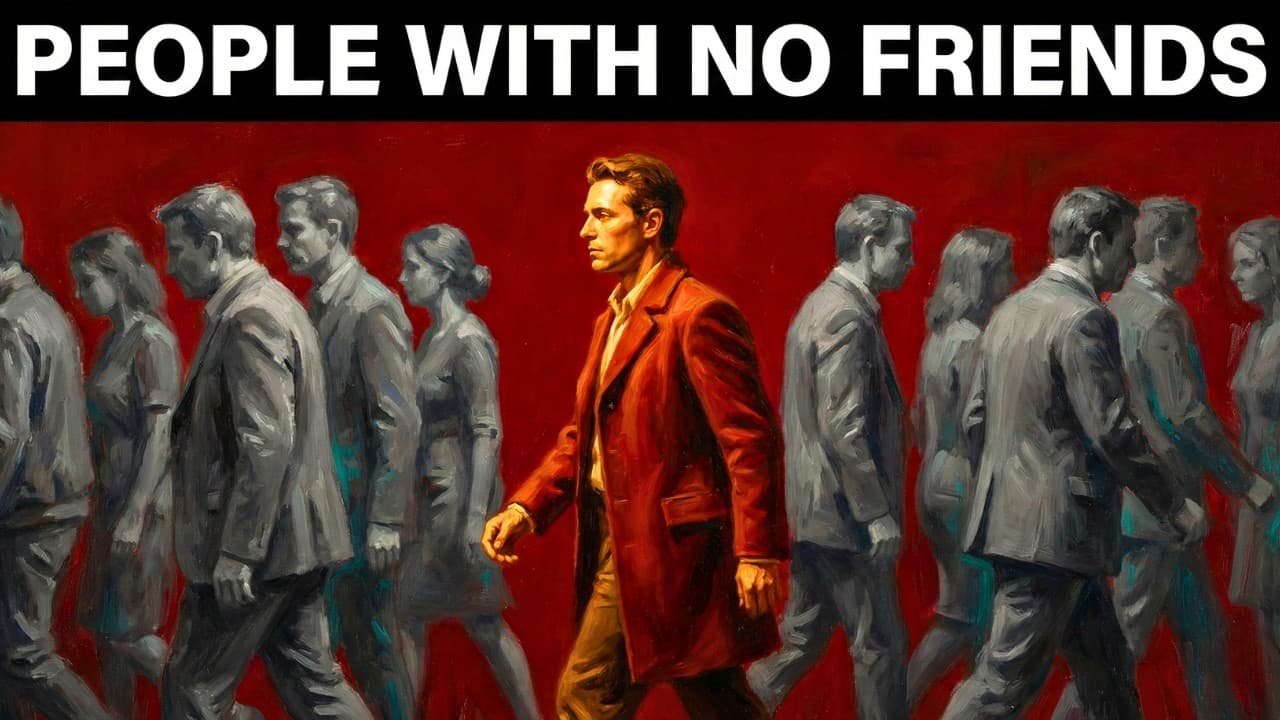
Some people have few or no friends because they prioritize authentic, meaningful relationships over shallow, controlling, or distracting interactions. The material links small social circles to seven traits, including hyperacute pattern recognition, resistance to control, intense creative focus, future orientation, and internal motivation, while emphasizing that solitude does not eliminate the need for connection. Read on to see how each trait may narrow a person’s circle.
Transcript
You check your phone, nothing. You scroll through social media and see groups of people laughing, drinking, connecting, and you feel a cold, heavy weight in your chest. A specific kind of silence. Society tells you this silence is a symptom. It tells you that if you are alone, you are broken, that you are antisocial, that you have failed the fundam... Read More
Key Insights
- The central claim is that solitude can function as protection from artificial relationships rather than evidence that someone is incapable of connection. A small circle may result from rejecting perceived dishonesty, shallow interaction, conformity, and demands that compete with personally meaningful work.
- Hyperacute pattern recognition is described as evaluating behavior instead of accepting reassuring words at face value. People with this trait allegedly monitor microexpressions, changes in tone, and delayed responses, making social gatherings feel like dense streams of information rather than uncomplicated entertainment.
- Thin slicing is presented as the ability to detect patterns from narrow windows of experience. The material connects this process to noticing possible contradictions between compliments and facial expressions or between verbal agreement and vocal pitch, although it offers these examples as psychological interpretation.
- Intolerance for social entropy is described as resistance to conversation that merely recycles familiar topics, complaints, or gossip. People with a high need for cognition are portrayed as preferring ideas, future possibilities, consciousness, strategy, and mortality over exchanges they consider shallow or repetitive.
- The autoimmune response to control is described as refusing arbitrary authority and group conformity. Such individuals are portrayed as requiring logic and proof before supporting a person or belief, which can make them incompatible with friendship circles built around loyalty, hierarchy, or shared hostility.
- The architect's obsession is described as an intense commitment to building a business, art, philosophy, physique, or improved self. Because attention is treated as finite, repeated refusals of parties, drinks, and casual gatherings can eventually reduce invitations and shrink a person's social circle.
- Rare connection is presented as the answer to the concern that humans still need relationships. The material distinguishes between increasing the quantity of social contact and finding a smaller number of connections capable of supporting authenticity, depth, autonomy, and demanding personal goals.
- The seven-trait framework combines pattern recognition, rejection of shallow interaction, resistance to control, focused creation, unconscious mirroring, temporal displacement, and an autotelic personality. Together, these traits are used to explain why internally driven, future-oriented people might experience or choose prolonged isolation.
- Related book: Thinking, Fast and Slow
- Export your Kindle highlights to Glasp: How to Download Highlights and Notes from Kindle
Install to Summarize YouTube Videos and Get Transcripts
Explore YouTube Video Summarizer or Get YouTube Transcript Extractor
Questions & Answers
Q: Why do some people have few or no friends?
The material argues that some people have small social circles because they reject relationships that feel artificial, shallow, controlling, or distracting. Their attention to behavior, preference for deep conversation, resistance to conformity, and dedication to meaningful work can make compatible relationships harder to find. It presents this as selectivity rather than automatic proof that someone cannot connect.
Q: What are the seven rare traits associated with having few friends?
The seven traits are hyperacute pattern recognition, intolerance for social entropy, an autoimmune response to control, the architect’s obsession, the unconscious mirror, temporal displacement, and the autotelic personality. The framework connects them with detecting inconsistencies, rejecting shallow interaction, protecting autonomy, pursuing demanding work, reflecting others back to themselves, focusing on the future, and relying on internal motivation.
Q: How can hyperacute pattern recognition affect friendships?
The material describes hyperacute pattern recognition as focusing on whether people’s behavior matches their words. A person may track microexpressions, tonal shifts, and timing delays, interpreting inconsistencies as envy, deception, or social performance. Constant observation can make gatherings exhausting and perceived inauthenticity difficult to overlook.
Q: What does intolerance for social entropy mean?
Intolerance for social entropy is the material’s term for rejecting conversation experienced as repetitive noise. Examples include routine discussion of weather, sports, employers, celebrity gossip, and familiar complaints. People with this tendency prefer ideas, strategy, consciousness, death, or the future and may choose silence when conversations lack that depth.
Q: Why can small talk feel draining to some people?
Small talk can feel draining when someone has a high need for cognition and prefers mentally demanding subjects. The material portrays attention and mental energy as finite resources, so repetitive or shallow exchanges can seem wasteful. This preference may lead a person to remain silent or withdraw from groups.
Q: How can resistance to control shrink a social circle?
Resistance to control can cause friction with groups that expect conformity, shared opinions, or unquestioned loyalty. The material says autonomous people demand logic and proof rather than following popularity, trends, or arbitrary authority. Groups may respond by treating them as difficult or excluding them.
Q: Why can intense focus cause friendships to fade?
The architect’s obsession describes intense dedication to building a business, art, philosophy, physique, or improved future self. Because attention is limited, repeatedly declining drinks, parties, and casual gatherings protects time for that work. The tradeoff is that invitations may stop and friendships may fade.
Q: Does having few friends mean someone does not need connection?
No. The material acknowledges that humans still need connection and warns that celebrating solitude can become a coping story. Its proposed answer is rare, meaningful connection rather than simply more interaction, relationships that support authenticity, depth, autonomy, and demanding personal goals.
Summary & Key Takeaways
-
The material reframes solitude as a possible defense against artificial relationships rather than proof of social failure. It says some people closely compare words with behavior, notice subtle interpersonal signals, and withdraw when they perceive envy, deception, conformity, or performance. Their smaller circles are presented as the cost of demanding authenticity.
-
A strong need for cognition is presented as another reason for social withdrawal. Shallow conversation, gossip, and repetitive complaints are described as mentally draining, while discussions about ideas, consciousness, strategy, death, and the future feel worthwhile. The resulting silence is framed as deliberate conservation of limited attention and energy.
-
The remaining traits center on autonomy, creation, interpersonal impact, future orientation, and internal motivation. The material argues that resistance to group control and intense dedication to building something can reduce invitations and friendships. It concludes that people still need connection, but highly selective individuals may need rare, meaningful connection rather than more interaction.
Read in Other Languages (beta)
Share This Summary 📚
Summarize YouTube Videos and Get Video Transcripts with 1-Click
Try YouTube Summary with ChatGPT & Claude or YouTube Transcript Generator
Explore More Summaries from Mindplicit 📚





Summarize YouTube Videos and Get Video Transcripts with 1-Click
Try YouTube Summary with ChatGPT & Claude or YouTube Transcript Generator