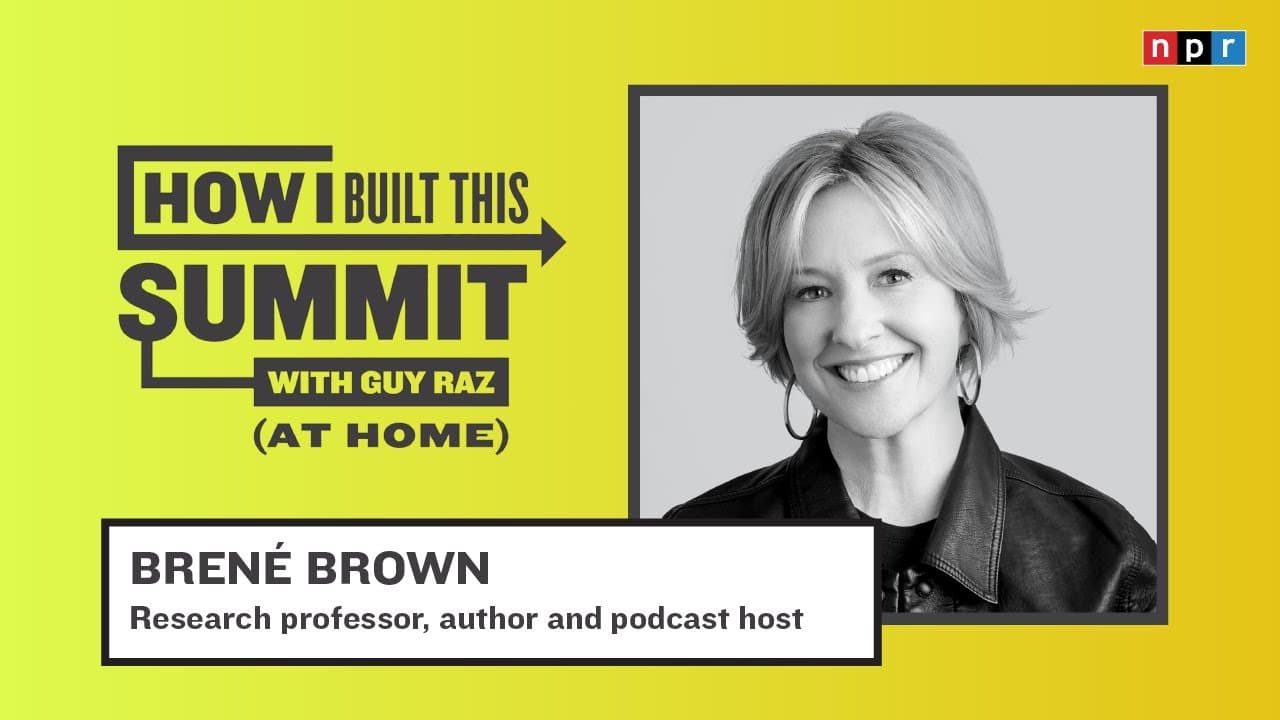
Brené Brown Talks Leading with Vulnerability | How I Built This with Guy Raz | NPR
TL;DR
Vulnerability is essential to courageous leadership because courage always involves uncertainty, risk, or emotional exposure. Leaders improve trust, psychological safety, and performance by examining the fears behind their protective armor, valuing people, connecting daily work to a greater purpose, and creating conditions where honesty does not carry interpersonal punishment.
Transcript
hello welcome back everyone uh obviously we're gonna dive back into our conversation on leadership this time with somebody who has really built a career around helping leaders get better at what they do um i think if we were on stage right now at the yearbook buena center in san francisco people would be screaming and just like wow my god that woul... Read More
Key Insights
- Vulnerability is the experience of uncertainty, risk, and emotional exposure. Brown says this definition is driven by research that had crossed 500,000 pieces of data, distinguishing vulnerability from the common belief that it is simply weakness.
- Courage is impossible without vulnerability because every genuinely courageous act requires uncertainty, risk, or emotional exposure. Brown says a person’s capacity for vulnerability can therefore serve as a practical measure of that person’s capacity for courage.
- Emotional armor is a form of self-protection driven by fear. Brown recommends beginning leadership development by asking what the fear is and examining the protective behavior it creates, rather than merely demanding that someone display more courage.
- Psychological safety is central to high-performing teams. Brown cites Google’s Project Aristotle as finding psychological safety, trust, and vulnerability to be the leading variable among the company’s highest-performing teams, rather than happiness or how much teammates liked one another.
- Sustainable performance depends on treating people as valuable. Brown contrasts trust, strategic decision-making, and consistent performance with a repeated hire-and-fire approach that causes personal harm and fails to produce predictably strong results.
- Meaning strengthens people’s engagement with work. Brown says people function well when they feel trusted and valued and understand how their everyday responsibilities connect to something greater than the individual tasks they perform.
- Recovery exposed Brown’s strategies for avoiding vulnerability. Drinking, overworking, smoking, emotional eating, and involvement in family issues all offered ways to escape or control feelings of uncertainty, emotional exposure, and being at risk.
- Pattern seeking gave Brown a sense of predictive control in uncomfortable environments. As a child who felt different from her family and surroundings, she tried to understand how people’s thoughts and emotions would shape their behavior.
Install to Summarize YouTube Videos and Get Transcripts
Explore YouTube Video Summarizer or Get YouTube Transcript Extractor
Questions & Answers
Q: What is vulnerability in leadership?
Vulnerability in leadership is the experience of uncertainty, risk, and emotional exposure. Brown argues that it should not be confused with weakness. Leaders encounter vulnerability whenever they make an uncertain decision, accept interpersonal risk, speak honestly, or become emotionally exposed. Because courageous leadership necessarily includes those conditions, vulnerability is presented as the path to courage rather than its opposite.
Q: Why does courageous leadership require vulnerability?
Courageous leadership requires vulnerability because no act of courage is free from uncertainty, risk, or emotional exposure. Brown tested this idea by asking special forces members and a professional football team to identify an example of courage that required none of those conditions. Both groups concluded that courage without vulnerability does not exist, either in professional settings or personal life.
Q: How can a leader begin becoming more vulnerable?
A leader can begin by asking what fear is driving self-protection. Brown describes the opposite of courage as armor, meaning behaviors used to avoid uncertainty, risk, or emotional exposure. Identifying the underlying fear helps a person understand why that armor exists. This creates a starting point for developing a greater capacity for vulnerability and, consequently, more courageous leadership.
Q: How does psychological safety affect team performance?
Psychological safety helps create conditions in which people can trust one another and accept the vulnerability involved in contributing honestly. Brown points to Google’s Project Aristotle, which examined its highest-performing teams rather than simply its happiest or most socially compatible teams. She says the research identified psychological safety, trust, and vulnerability as the number one variable associated with those high-performing teams.
Q: Why did leadership move away from repeated hiring and firing?
Brown says the shift is strongly connected to performance, not merely to leaders becoming kinder. A repeated hire-and-fire model creates personal carnage while failing to provide consistent, predictable performance or sound strategic decision-making. Effective organizations recognize that people are their most valuable resource and perform better when they experience trust, value, psychological safety, and a connection to meaningful goals.
Q: What conditions help people perform well at work?
People work effectively when they feel trusted, feel valued, and understand how their daily responsibilities connect to something greater. Brown argues that organizations have nothing without their people, so leadership must consider what allows people to function well. Psychological safety and vulnerability support performance by creating an environment where individuals can participate despite uncertainty, interpersonal risk, or emotional exposure.
Q: How did recovery shape Brené Brown’s understanding of vulnerability?
Recovery forced Brown to confront several behaviors she used to avoid feeling uncertain, exposed, at risk, or out of control. She was advised to stop drinking, overworking, smoking, emotional eating, and becoming involved in family problems, and she began working with a therapist. She later recognized vulnerability as the shared experience she had been trying to outrun or outsmart through those behaviors.
Q: How did Brené Brown’s childhood influence her research interests?
Brown says she felt from an early age that she did not belong or fit within her school, Texas surroundings, or even her loving family. As an introvert without language for that difference, she became a pattern seeker. Understanding the connection among people’s thinking, emotions, and behavior offered predictive control in environments where she otherwise felt uncomfortable or uncertain.
Summary
In this video, Brene Brown discusses the importance of vulnerability in leadership with the host. She talks about her upbringing, her struggles with alcohol, and how she discovered the importance of vulnerability in her own life. She also explains how vulnerability is not a weakness, but a strength, and how it is essential for good leadership. She shares insights on how vulnerability is connected to qualities like courage, trust, and empathy. Finally, she discusses the challenges of leading during the pandemic and the importance of creating a culture of trust and belonging in organizations.
Questions & Answers
Q: Did Brene Brown feel like she didn't belong during her childhood?
Yes, from a very early age, she felt like she didn't fit in or belong. She couldn't figure out where she belonged and who her people were. Despite having a loving family, she knew she was different from them. She began to seek patterns in people's thinking, emotions, and behavior from an early age to have some sense of control in uncomfortable environments.
Q: Did Brene Brown struggle with vulnerability during her teenage years and 20s?
Yes, she struggled with vulnerability during her rebellious teenage years and when she struggled with alcohol in her 20s. She had to let her armor down and face her vulnerabilities when she joined Alcoholics Anonymous and started her journey to sobriety. It was a major turning point in her life and led her to discover the power of vulnerability.
Q: How did Brene Brown become attuned to vulnerability?
Brene Brown became attuned to vulnerability when she attended her first Alcoholics Anonymous meeting. She was told that she had a "poo-poo platter of addictions" and needed to quit drinking, working excessively, emotionally eating, and being involved in family issues. She realized that her addictions were a way to avoid feeling uncertain, at risk, or out of control. She learned to face her vulnerabilities and eventually embraced vulnerability as a way to grow and find strength.
Q: How did Brene Brown come to view vulnerability as a pathway to good leadership?
Brene Brown's view on vulnerability as a pathway to good leadership was shaped through her research on leadership and her work with military personnel and teams at Google. She discovered that vulnerability is the emotion we experience when we are uncertain, at risk, or emotionally exposed. Through her research, she found that the highest-performing teams had a culture of psychological safety and trust, which are rooted in vulnerability. She came to the realization that vulnerability is the key to courage and is essential for true leadership.
Q: How did the transition towards vulnerability as a key leadership characteristic happen?
The transition towards vulnerability as a key leadership characteristic happened primarily due to the focus on performance. Traditional approaches to leadership, such as the "hire fire" mentality of the past, led to inconsistent performance and ineffective decision-making. However, studies like Project Aristotle at Google revealed that psychological safety, trust, and vulnerability were the foundations for high-performing teams. As organizations came to recognize the value of their people and the need for innovation, vulnerability became a key characteristic of effective leadership.
Q: Can vulnerability be hard for leaders who have certain privileges?
Yes, vulnerability can be harder for leaders who have certain privileges. Trauma, discrimination, harassment, and marginalization can make vulnerability more dangerous and difficult for individuals. Leaders have a responsibility to create a culture of belonging and brave spaces where vulnerability is not a privilege for a few, but something that everyone can safely and authentically embrace. It is important to recognize the impact of trauma, privilege, and systemic oppression on an individual's willingness and capacity to be vulnerable.
Q: How can leaders create environments where vulnerability is safe and supported?
Leaders can create environments where vulnerability thrives by placing a priority on representation and diversity. By developing a culture that values and respects all individuals, leaders can foster a sense of belonging and safety. Open and honest communication, care for one another, and creating spaces for vulnerability to be shared are key components. Additionally, leaders must address any culture of armor where vulnerability is avoided or punished, and actively work towards creating a brave space that encourages and supports vulnerability.
Q: Has leading through video platforms like Zoom been challenging for leaders?
Yes, leading through video platforms like Zoom has been incredibly challenging for leaders. The lack of in-person interactions and the limitations of technology have made it difficult to connect and create a sense of trust and psychological safety. Vulnerability is harder to convey through a screen, and leaders have had to find new ways to show care and support for their teams. The pandemic has forced leaders to rethink how they gather, communicate, and lead, and some have been successful by prioritizing their people and their well-being.
Q: Is it important for leaders to be liked by their team?
While being liked is not the primary goal, caring for and connecting with the people we lead is essential. Leaders don't necessarily need to strive to be liked, but they do need to prioritize building relationships and showing genuine affection for their team. When there is care and connection, people are more likely to trust and be inspired by their leader. It's about creating a culture of respect, empathy, and support, where the leader is seen as someone who truly cares about the well-being of their team.
Q: What does Brene Brown struggle with as a leader?
Brene Brown struggles with managing her time and finding uninterrupted periods for creativity and research. As a maker more than a manager, she finds it challenging to balance leadership tasks with the need for focused time to create and innovate. Additionally, she grapples with discernment, making difficult decisions, and finding the right balance between vulnerability and other leadership qualities. However, she has an incredible team and a culture of open and honest feedback, which helps her navigate these challenges and grow as a leader.
Takeaways
Vulnerability is a crucial element in effective leadership. It allows leaders to build trust, establish psychological safety, and create a culture of transparency and innovation. Despite the challenges, leaders should strive to embrace vulnerability and create spaces where it can be safely expressed. It is important for leaders to care for and connect with their team, fostering a sense of belonging and support. Leading with vulnerability is not about being liked, but about building relationships based on respect, empathy, and genuine affection. Even in the fast-paced world of startups, vulnerability should be baked into the leadership ethos from the beginning. Leading through virtual platforms like Zoom can be particularly challenging, but focusing on the well-being of the team and creating opportunities for connection and support can help navigate these difficulties. Overall, vulnerability and leadership go hand in hand, and embracing vulnerability is a pathway to courageous and effective leadership.
Summary & Key Takeaways
-
Brené Brown traces her interest in human behavior to a childhood marked by feeling different and out of place. Pattern seeking became a way to understand connections among thoughts, emotions, and behavior. Her upbringing was loving but tough, with little language for introversion and little tolerance for visible vulnerability.
-
Brown describes sobriety as a confrontation with several ways she avoided uncertainty, risk, and loss of control. After being advised to stop drinking, overworking, smoking, emotional eating, and involvement in family problems, she sought therapy. The experience helped reveal vulnerability as the common feeling she had repeatedly tried to outrun or outsmart.
-
Brown defines vulnerability as uncertainty, risk, and emotional exposure, then connects it directly to courage and effective leadership. She argues that trust, feeling valued, psychological safety, and understanding how daily work serves something greater help people perform. Leaders should begin by identifying the fear and self-protection beneath their emotional armor.
Read in Other Languages (beta)
Share This Summary 📚
Summarize YouTube Videos and Get Video Transcripts with 1-Click
Try YouTube Summary with ChatGPT & Claude or YouTube Transcript Generator
Explore More Summaries from NPR 📚






Summarize YouTube Videos and Get Video Transcripts with 1-Click
Try YouTube Summary with ChatGPT & Claude or YouTube Transcript Generator