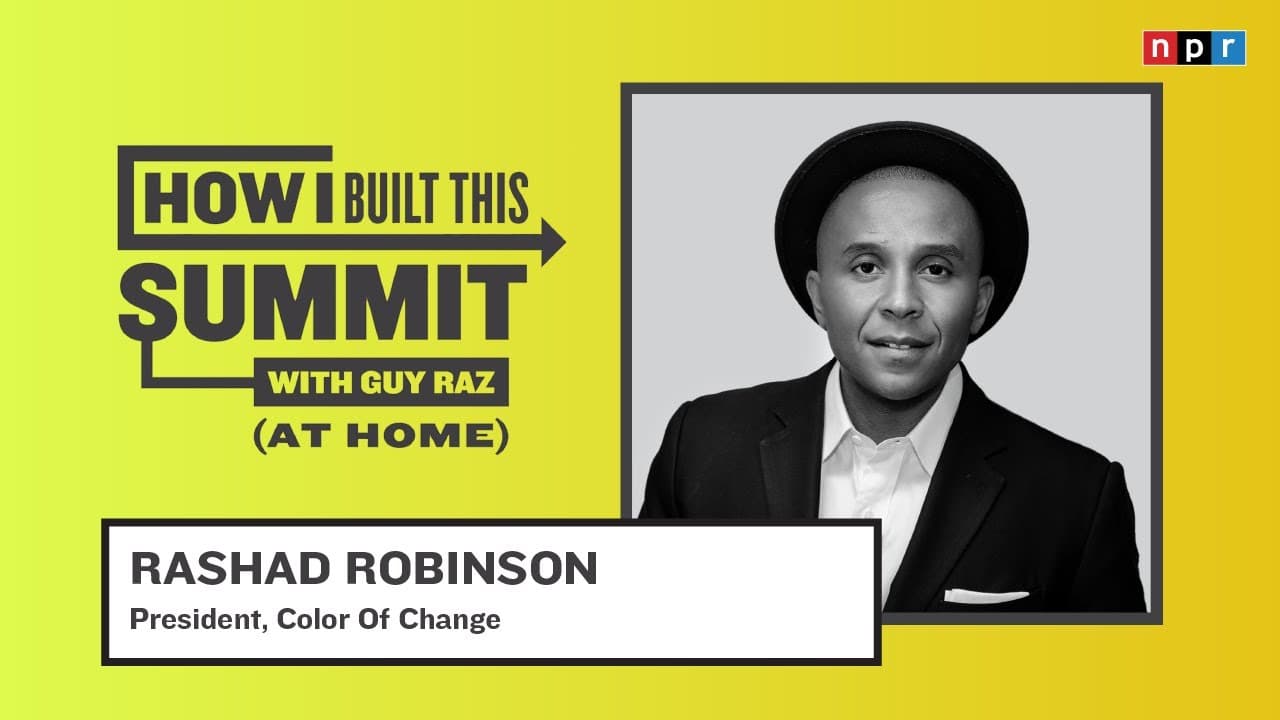
Rashad Robinson Talks Leadership in Activism & Systemic Change | How I Built This with Guy Raz | NPR
TL;DR
Systemic change requires the power to change rules, not merely visibility, awareness, or public praise. Effective activist leadership builds infrastructure that lets people speak for themselves, pursues campaigns with credible leverage, centers aspirations such as Black joy, and measures success by tangible contributions to justice rather than organizational growth or online attention.
Transcript
welcome back that was just amazing um to to experience that um wow i'm sure toby is still kind of reeling um i feel so honored to be here sharing the screen right now with rashad robinson rashad is the president of color change rashad is also our final guest uh this evening and of the summit and what what better way to cap off a day on impact w... Read More
Key Insights
- Power is the ability to change rules, while presence consists of visibility, awareness, retweets, public recognition, and similar signals. Treating presence as if it were power can create a false impression that structural progress has occurred when underlying systems remain unchanged.
- Activist leadership is the work of building vehicles and infrastructure that enable people to be heard for themselves. Robinson rejects the idea that leaders should simply serve as spokespersons for unheard communities, emphasizing collective capacity, participation, and the confidence to confront powerful forces.
- Black joy is the presence of aspiration rather than the absence of pain. Centering it allows advocacy to define what communities are fighting for, not only what they oppose, while recognizing Black contributions to food, culture, politics, innovation, entrepreneurship, the country, and the world.
- Justice is the bottom line for a social activism organization, not money or organizational size. Robinson argues that a rising budget must be questioned if it does not correspond with more campaign victories, making tangible progress a more meaningful standard than conventional growth.
- Impact is measured by both the significance of an outcome and the organization’s relative contribution to it. Color of Change distinguishes momentum achievements from systemic victories, then asks whether its participation merely accompanied the result or supplied a unique, indispensable role.
- Strategic action is based on leverage and a credible theory of change. Color of Change avoids asking members to support campaigns when their petitions or collective action have no plausible path to influencing the target, even when the requested outcome itself is desirable.
- Digital media is capable of distorting perceptions of causation and accomplishment. Sending an email or observing a rapid change does not prove that an organization produced the result, so credible impact claims require evidence showing what role the organization actually played.
- Robinson’s approach to activism is rooted in service and building opportunities where established doors are closed. His family discussed news and the world, while his father’s long experience as a self-employed contractor also shaped Robinson’s orientation toward constructing new avenues for contribution.
Install to Summarize YouTube Videos and Get Transcripts
Explore YouTube Video Summarizer or Get YouTube Transcript Extractor
Questions & Answers
Q: How should activist organizations measure systemic impact?
Activist organizations should measure both the depth of the result and their relative role in producing it. Color of Change places outcomes on a spectrum from momentum achievements, which chip away at structures, to systemic victories, such as changed laws. It also distinguishes results that would have happened anyway from outcomes that required the organization’s unique contribution, supported by evidence rather than assumption.
Q: What is the difference between presence and power in activism?
Presence means visibility, awareness, retweets, public recognition, and similar forms of attention. Power means having the ability to change the rules. Presence can be valuable, but confusing it with power can make people believe that systemic progress has occurred when it has not. Robinson uses this distinction as a central standard for evaluating whether advocacy produces tangible structural change.
Q: What does leadership in activism require?
Leadership in activism requires building vehicles and infrastructure that allow people to speak for themselves, rather than acting only as their spokesperson. Those structures should help participants believe they can challenge powerful forces and win. They should also multiply collective capacity, supporting both changes that can happen immediately and changes that require sustained effort over time.
Q: Why does Rashad Robinson center Black joy in advocacy?
Robinson centers Black joy because advocacy should express aspirations as well as opposition. He defines Black joy not as the absence of pain, but as the presence of aspiration. It highlights what communities are fighting for and recognizes Black contributions to food, culture, politics, innovation, entrepreneurship, the country, and the world, while helping bring people together through relational organizing.
Q: Why is organizational growth insufficient evidence of activist success?
Organizational growth is insufficient because a social activism group exists to advance justice, not simply to increase revenue, budgets, membership, or attention. Robinson argues that if a budget rises without an increase in campaign victories, the organization must question its performance. Growth becomes meaningful only when it strengthens the ability to produce tangible achievements and systemic victories.
Q: How does a theory of change improve an activist campaign?
A theory of change explains how available actions and leverage could realistically produce the desired outcome. Robinson argues that organizations should not ask people to spend time and energy on petitions when there is no plausible reason the target will respond. A clear theory of change therefore connects participation to strategy and concentrates effort on campaigns with a credible path to impact.
Q: How can digital media distort the measurement of social change?
Digital media can make organizations believe that sending an email, circulating a petition, or gaining attention directly caused a subsequent result. Rapid news cycles can similarly make progress appear larger or smaller than it is. Robinson says organizations need receipts showing their actual contribution, especially when claiming that an outcome depended on their participation or unique value.
Q: What shaped Rashad Robinson’s approach to activism and service?
Robinson describes pursuing his purpose by fighting for himself and the people he cares about. He grew up discussing news and world events with his family, became involved in political organizing while young, and later viewed himself as a builder. His approach focuses on creating doors, spaces, movements, and infrastructure when existing avenues for contribution are not open.
Summary
In this video, Rashad Robinson, the president of Color of Change, discusses the importance of black joy and its role in activism. He also talks about his background in activism, the growth of Color of Change, and how he measures impact. Robinson emphasizes the need to change the narrative around racial inequality and structural issues, and the importance of building infrastructure for long-term change.
Questions & Answers
Q: Can you explain what black joy means to Color of Change and its advocacy work?
According to Robinson, black joy is a centerpiece of Color of Change's advocacy and activism work. It is not about the absence of pain, but rather the presence of aspiration. Black joy represents what black people are fighting for, rather than just what they are fighting against. Color of Change aims to bring people together and accomplish big things by centering black joy and focusing on relational organizing.
Q: How does Robinson view leadership in activism?
Robinson believes that leadership in activism is not about being a spokesperson for marginalized communities, but instead about building the infrastructure and vehicles for these communities to be heard. He emphasizes the importance of empowering people to advocate for themselves and creating the necessary resources and support systems for them to challenge powerful forces and achieve change.
Q: How does Color of Change measure its impact?
Color of Change uses a rubric to evaluate its impact, which includes measuring momentum achievements and systemic victories. Momentum achievements refer to actions that chip away at structures, while systemic victories involve actual changes in laws or policies. Color of Change also considers its relative role in the work, distinguishing between campaigns that would have happened without their involvement and ones that couldn't have happened without them.
Q: How does Robinson navigate the emotionally exhausting aspects of his work?
Robinson acknowledges that the work he does can be emotionally draining, particularly when he receives outreach from individuals in deep pain. While he may not always have the resources or ability to address every issue, he finds strength in his network of supportive friends and family. Engaging in activities like cooking and retail therapy also help him cope with the stress. Robinson emphasizes the importance of self-care and community care as essential for sustaining activism.
Q: How does Robinson view progress and the challenges associated with achieving it?
Robinson acknowledges that progress is a tricky term because systems of oppression are durable and can adapt to maintain the status quo. He cautions against mistaking cosmetic victories for actual progress, highlighting the need to challenge underlying systems and structures. Robinson emphasizes the importance of building infrastructure and holding a high standard of change to combat the backlash and forces that impede progress.
Q: How does Robinson approach persuasion in his activism work?
Robinson believes that persuasion is not just about messaging, but also about narrative change and shifting power dynamics. He highlights the power of storytelling and the importance of framing issues in a way that places the responsibility on systems rather than individuals. By making the active voice about the system, people are more likely to question and challenge the underlying structures of racism, inequality, and discrimination.
Q: Can you discuss Robinson's view on hope and its role in activism?
Robinson believes in the power of hope and how it motivates people to fight for a better future. He shares a personal story about his grandfather, who couldn't read or write but still participated in democracy and instilled hope in Robinson. Hope is an essential element in driving change and achieving progress, as it provides the belief that more is possible and that collective efforts can make a difference.
Q: How does Color of Change reimagine the architecture of civil rights movements?
Color of Change's approach involves building momentum, leveraging systemic pivots, and scaling campaigns over time. They focus on creating infrastructure and innovation to respond effectively to various challenges. By channeling energy and responses into movements that drive systemic change, Color of Change aims to go beyond cosmetic victories and focus on achieving tangible progress. The goal is to build sustainable structures and organizations that can withstand opposition and protect the changes made.
Q: How does Robinson view the relationship between progress and backlash?
Robinson acknowledges that progress often comes with backlash. He cites examples such as discriminatory voter ID laws emerging after the election of the first black president. Despite the challenges, he emphasizes the need to recognize progress while being prepared to defend it. This requires building infrastructure, both to achieve progress and to resist the forces that impede change. Robinson underscores the importance of telling stories that highlight progress, while also acknowledging the ongoing work that needs to be done.
Q: How does Robinson find strength to continue his work?
Robinson finds strength in the legacy of his family and the oppressed communities he advocates for. He draws inspiration from the resilience and determination of those who have fought for a better future. Additionally, he relies on his network of friends, family, and colleagues who provide support, advice, and critique. Their encouragement and belief in his leadership sustain him as he navigates the challenges of activism and working towards social change.
Takeaways
Rashad Robinson discusses the significance of centering black joy in activism and the need to focus on what marginalized communities are fighting for. He highlights the importance of building infrastructure and vehicles for people to advocate for themselves, rather than acting as spokespeople. Robinson emphasizes the need to distinguish between cosmetic victories and systemic change and to challenge and change the narrative around racial inequality. He also stresses the role of hope in driving progress and the importance of resilience and community support in sustaining activism. Ultimately, progress requires shifting power dynamics, telling impactful stories, and building infrastructure to achieve long-term change.
Summary & Key Takeaways
-
Rashad Robinson describes activist leadership as building vehicles and infrastructure through which people can speak for themselves, confront powerful forces, and win. He connects this approach to service, purposeful contribution, and his lifelong identity as a builder of spaces, movements, and avenues for victories that once appeared impossible.
-
Color of Change distinguishes presence from power when evaluating impact. Visibility, retweets, public recognition, and cultural celebration can increase awareness without changing underlying rules. Because the organization’s bottom line is justice rather than money, greater budgets or membership matter only when they contribute to more meaningful campaign victories and systemic change.
-
Effective campaigns require strategic action, credible leverage, and a clear theory of change. Color of Change evaluates outcomes from momentum-building achievements to systemic victories, while also examining whether its involvement was incidental or indispensable. This discipline helps the organization direct members’ time and energy toward actions capable of producing tangible results.
Read in Other Languages (beta)
Share This Summary 📚
Summarize YouTube Videos and Get Video Transcripts with 1-Click
Try YouTube Summary with ChatGPT & Claude or YouTube Transcript Generator
Explore More Summaries from NPR 📚






Summarize YouTube Videos and Get Video Transcripts with 1-Click
Try YouTube Summary with ChatGPT & Claude or YouTube Transcript Generator