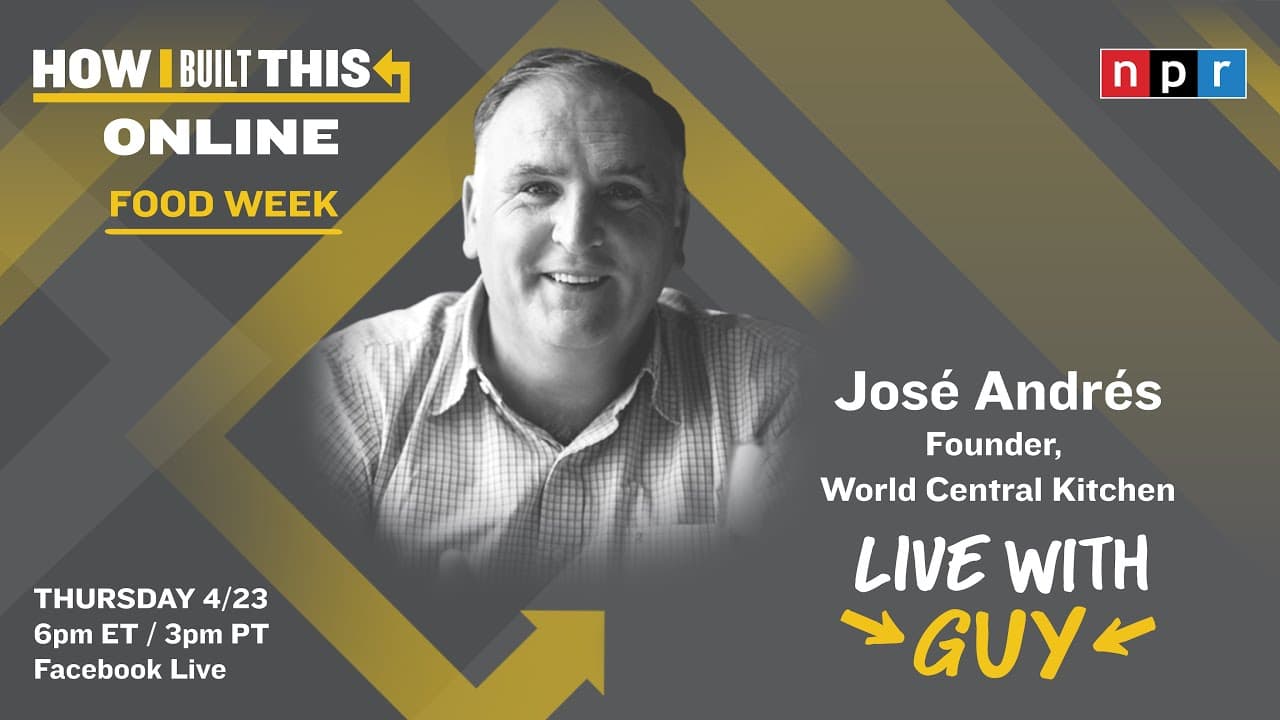
José Andrés Talks Feeding People in a Crisis with Guy Raz | How I Built This | NPR
TL;DR
Crisis food relief works best when local restaurants, chefs, farmers, nonprofits, and public agencies coordinate their existing resources. World Central Kitchen activates kitchens, prepares groceries and ready-to-eat meals, and partners with neighborhood organizations to reach frontline workers, older people, students, families, and others whose usual food systems have been disrupted.
Transcript
hello everybody and welcome to how I built this video edition how are you all doing today we are here as many of you know to talk about how businesses are building resilience and we're taking your questions right now on Facebook on Twitter and on YouTube so please ask away for Jose Andres and this is food week all this week we are talking to incred... Read More
Key Insights
- World Central Kitchen is a crisis-response organization that scales food preparation and distribution according to local needs. Its operations combine culinary expertise, community partnerships, and practical logistics to serve people when disasters or public-health emergencies disrupt normal access to meals.
- Restaurants are valuable relief infrastructure because their chefs, owners, kitchens, suppliers, and workers already know how to produce and distribute food. Andrés argues that these businesses can continue serving their communities during closures by becoming funded participants in emergency meal programs.
- Local partnerships are essential because neighborhood organizations understand which communities are being overlooked. World Central Kitchen works with groups familiar with public housing, schools, shelters, hospitals, and other local settings so that food reaches people whom larger systems may miss.
- Crisis food assistance requires multiple formats because recipients have different circumstances. The organization distributes fresh vegetables, sandwiches, packaged items, reheatable meals, and hot meals, choosing the approach that fits local kitchen capacity, delivery conditions, and household needs.
- Food insecurity can become a humanitarian crisis when health restrictions, restaurant closures, school disruptions, and weakened nonprofit operations occur together. Andrés stresses that economic concerns matter, but people also need reliable access to food while familiar support systems are unavailable.
- Nonprofit capacity is vulnerable during emergencies because organizations may lose funding, volunteers, or operational systems. World Central Kitchen attempts to cover resulting gaps while recognizing that nonprofit groups provide an important public service and remain necessary partners in community relief.
- Farmers and hungry communities can be connected through smarter public support. Andrés calls for mechanisms that purchase available agricultural products, support producers of different sizes, prevent food from being abandoned, and send supplies through food banks, churches, restaurants, and community relief organizations.
- Protecting relief workers is compatible with continuing essential food service. Andrés compares cooks supporting communities with medical workers treating patients, presenting meal preparation and delivery as a practical contribution that culinary professionals can make while following crisis conditions and safety needs.
Install to Summarize YouTube Videos and Get Transcripts
Explore YouTube Video Summarizer or Get YouTube Transcript Extractor
Questions & Answers
Q: How does World Central Kitchen feed people during a crisis?
World Central Kitchen identifies gaps in existing food systems, activates available restaurants or large catering kitchens, and works with local organizations that understand affected neighborhoods. It prepares food in forms suited to each community, including groceries, sandwiches, reheatable dishes, and hot meals. Distribution can support hospitals, older people, homeless communities, students, public-housing residents, frontline workers, and low-income families.
Q: Why are restaurants useful for emergency food relief?
Restaurants already have kitchens, trained cooks, suppliers, operational knowledge, and relationships within their communities. Even when normal dining operations are suspended, those assets can support meal production. José Andrés argues that chefs and restaurant owners know their neighborhoods and can become local relief leaders when funding and coordination allow them to cook for people affected by a crisis.
Q: What kinds of food does World Central Kitchen distribute?
World Central Kitchen uses different food formats rather than imposing a single solution. Its efforts include fresh vegetables that families can take home, sandwiches and produce, meals designed for reheating, and hot prepared dishes. The choice depends on local needs, available kitchen facilities, delivery arrangements, and whether recipients can safely store or warm food themselves.
Q: How do local organizations improve emergency meal distribution?
Local organizations know their neighborhoods, including where vulnerable families, public-housing residents, shelters, schools, and other community services are located. By partnering with these groups, World Central Kitchen can identify gaps that broader systems may overlook. Local knowledge also helps determine the appropriate food format, pickup location, delivery method, and scale of preparation for each community.
Q: Why can a health crisis also become a food crisis?
A health crisis can interrupt several sources of food assistance at once. Restaurants may close, schools may stop providing daily meals, nonprofit groups may lose volunteers or funding, and household incomes may come under pressure. José Andrés warns that these overlapping disruptions can create a humanitarian problem when families cannot reliably obtain food despite supplies and culinary capacity remaining available elsewhere.
Q: How can governments support restaurants during a humanitarian crisis?
Governments can create funding and delivery mechanisms that pay restaurants to prepare meals for communities in need. This approach keeps culinary workers and kitchens active while expanding relief capacity. Andrés argues that public legislation should treat restaurants as part of the solution, directing resources through systems capable of connecting chefs, agricultural producers, nonprofit groups, and affected families.
Q: How can farmers contribute to crisis food assistance?
Farmers can supply products to food banks, restaurants, churches, community organizations, and culinary relief groups when public programs create effective purchasing and distribution channels. Andrés emphasizes supporting smaller producers as well as larger ones. Buying available food can reduce waste in fields while helping communities where families are struggling to obtain enough food during an emergency.
Q: What is José Andrés's main policy argument about hunger relief?
José Andrés argues that hunger should be addressed through a coordinated system in which farmers, restaurants, food banks, nonprofit groups, churches, local governments, and relief organizations all participate. Public funding should reach these networks through practical mechanisms. The goal is to prevent usable food from being wasted while existing kitchens prepare and distribute it to families who need immediate help.
Summary
In this video, the host interviews Jose Andres, a renowned chef and humanitarian, about how he is coping with the crisis and his work with World Central Kitchen. Jose discusses the impact of COVID-19 on the restaurant industry, the role of World Central Kitchen in providing meals, and the need for support and adaptation during these challenging times. He also shares his reasons for being hopeful and how he believes that together, we can create a better future by embracing empathy and working towards the well-being of all.
Questions & Answers
Q: How has COVID-19 changed the restaurant and food industry?
COVID-19 has caused significant disruptions in the restaurant and food industry. Many restaurants have had to shut down, leading to a decline in business and job losses. As a result, the industry will need to adapt to new circumstances, such as implementing safety measures and finding innovative ways to provide food and services. This crisis highlights the need for a food system that ensures the well-being of everyone involved, from farmers to restaurant workers to consumers.
Q: How does World Central Kitchen work and how are meals distributed?
World Central Kitchen operates by partnering with restaurants across America to provide meals to those in need. They have over 500 restaurants involved and are continuously adding new ones. The organization focuses on collaboration with local organizations that have knowledge of the communities they serve. By working together, they are able to ensure a 360-degree response, reaching people in various cities and states. The goal is to not only feed the hungry but also advocate for smart solutions and help farmers and small businesses thrive.
Q: What kind of food is being produced by World Central Kitchen?
World Central Kitchen offers a variety of food options to cater to different needs. In some cases, they provide farmers markets where people can pick up fresh produce for their families. They also distribute pre-packaged sandwiches, vegetables, and other items that can be easily taken home and consumed. Additionally, they serve hot meals that can be heated up later. The specific meals depend on the location and the resources available, but the aim is to provide nutritious and satisfying food to those in need.
Q: How does World Central Kitchen sustain its operations and handle the high demand?
World Central Kitchen relies on a combination of funding from individuals, philanthropies, and big donors to sustain its operations. They have always operated with the mindset of utilizing the funds they have and trusting that more support will come when needed. By continually showing up in emergencies and providing effective solutions, they have built credibility and gained the trust of many donors. However, the demand is constantly increasing, and new sources of funding are required to ensure the organization can continue its work.
Q: What drives your passion for humanitarian work?
Jose Andres attributes his passion for humanitarian work to various factors in his life. He recognizes that he has received a lot from others and believes in the power of giving back. His parents, who were nurses, inspired him to find ways to provide relief and comfort to those in need. Additionally, seeing the impact of small gestures of kindness and experiencing the gratitude of people he has helped has further fueled his passion. He views his work as a way to embody values of empathy, respect, and the belief in the collective strength of communities.
Q: How can individuals help World Central Kitchen or contribute to the cause?
There are several ways individuals can support World Central Kitchen and similar organizations. While volunteering in person may not be feasible for everyone, there are other ways to make a difference. Sharing positive news or videos on social media, retweeting messages, and spreading awareness are simple yet impactful ways to help. Contributing financially, even with small donations, can also make a significant difference. Additionally, supporting local NGOs, making phone calls to check on people, or actively listening to others with respect and empathy are all ways to contribute to the cause.
Q: Are you hopeful for the future, considering the challenges and uncertainties we face?
Despite the challenges and uncertainties, Jose Andres remains hopeful for the future. He believes that by continuously working towards empathy, respect, and understanding, we can create a better world. He emphasizes the importance of embracing diversity of thought and engaging in meaningful conversations with those who have different perspectives. Jose is confident that the American spirit of unity and collaboration will prevail and that we can build an inclusive and prosperous future for everyone.
Takeaways
Jose Andres's work with World Central Kitchen showcases the power of collaboration and the importance of adapting to challenging circumstances. The COVID-19 crisis has had a significant impact on the restaurant industry, but it also presents an opportunity for restaurants to reinvent themselves and contribute to the well-being of their communities. Empathy and respect are key in bringing about positive change, and by focusing on the needs of others, we can build a better future for all. Together, we can overcome adversity and create a more inclusive and compassionate society.
Summary & Key Takeaways
-
World Central Kitchen responds to emergencies by turning available culinary infrastructure into a coordinated food-relief network. Rather than relying on one distribution method, it works with restaurants, chefs, catering facilities, community organizations, and public agencies to prepare meals, provide groceries, identify underserved neighborhoods, and adapt operations to local conditions.
-
During the COVID-19 crisis, José Andrés viewed food insecurity as part of a broader humanitarian emergency. Restaurant closures, reduced nonprofit capacity, interrupted school meals, and pressure on families created gaps that established food-assistance systems could not cover alone. His response emphasized partnerships that connect available kitchens and food with affected communities.
-
Andrés argues that public policy should make restaurants and farmers part of the relief solution. Government support could help purchase food that might otherwise be wasted, sustain local agricultural producers, employ restaurant workers, and expand distribution through food banks, churches, neighborhood groups, and culinary organizations serving people who need immediate assistance.
Read in Other Languages (beta)
Share This Summary 📚
Summarize YouTube Videos and Get Video Transcripts with 1-Click
Try YouTube Summary with ChatGPT & Claude or YouTube Transcript Generator
Explore More Summaries from NPR 📚



Summarize YouTube Videos and Get Video Transcripts with 1-Click
Try YouTube Summary with ChatGPT & Claude or YouTube Transcript Generator