Building Impactful Companies with the Founders of Urban One, Impossible Foods & Khan Academy | NPR
TL;DR
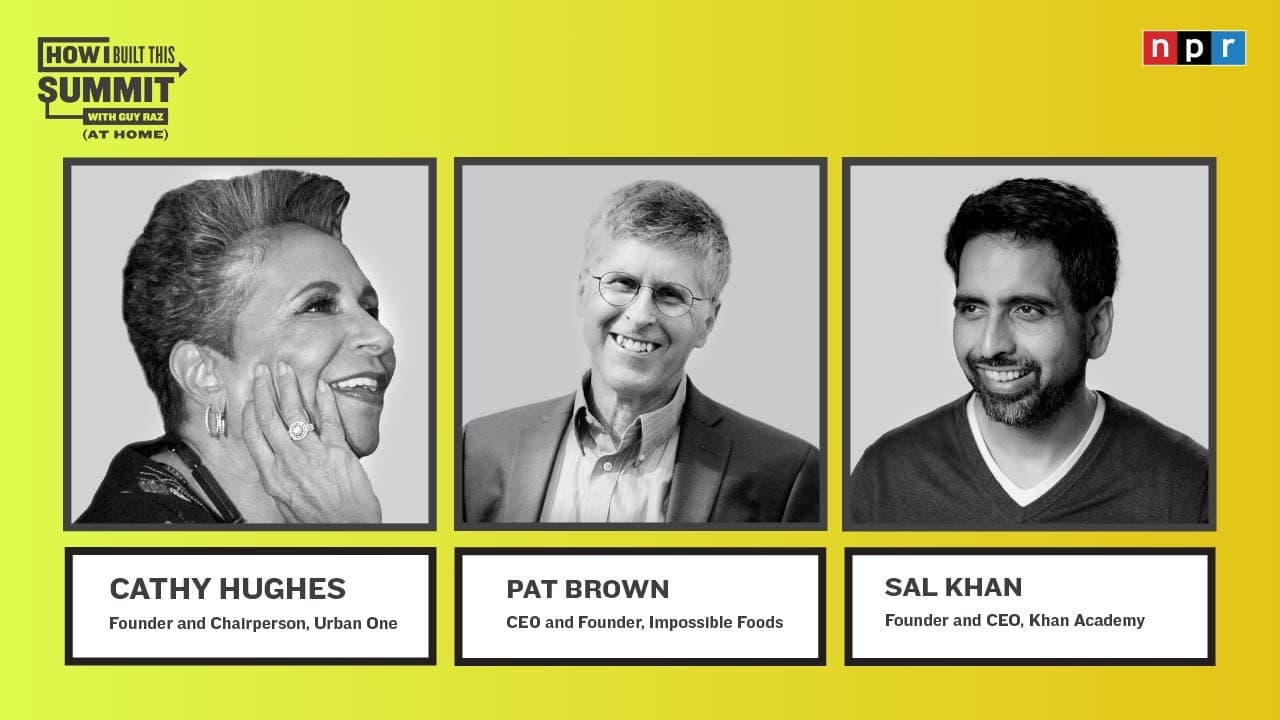
Start with a problem whose solution matters, then build the organization around that purpose. Pat Brown targeted the environmental damage caused by animal agriculture, Sal Khan created free virtual education, and Cathy Hughes built media that addressed an information desert in the African American community. Their experiences show that persistence, experimentation, and close attention to rejected proposals can turn an ambitious mission into a durable institution.
Transcript
hello everyone welcome back uh i am so thrilled to be sitting here uh on stage and screen screen the stage we're all stars of stage and screen with three amazing founders all of whom have been on how i built this uh you if you haven't heard their stories i think you have but you should go back and listen to them multiple times i do myself i refer t... Read More
Key Insights
- Purpose is the starting point for each founder's organization. Pat Brown focused on environmental harm from animal agriculture, Sal Khan pursued broader educational access, and Cathy Hughes sought to distribute important information within the African American community rather than treating impact as a secondary benefit.
- Animal agriculture is described by Pat Brown as a major cause of biodiversity collapse and a significant contributor to climate change. He says fewer than one-third as many wild animals remain as 50 years earlier, and he presents replacing animals in food production as an opportunity for environmental recovery.
- Khan Academy grew from remote family tutoring into a virtual educational institution. Sal Khan began by helping cousins in New Orleans while he lived in Boston, then built videos and software as participation expanded, eventually envisioning an organization unlike the established educational institutions that had preceded it.
- Free access is central to Khan Academy's model. Sal Khan describes educational materials covering mathematics, science, history, English, and languages, while Guy Raz notes that people who can contribute may do so, preserving access for learners regardless of whether they are able to pay.
- Persistence is a process of improving the proposal, not merely repeating it. Cathy Hughes approached 32 banks before receiving financing, and each rejection gave her another opportunity to refine a presentation that eventually became polished enough for her to deliver almost automatically.
- A rejection can provide useful information when the applicant asks why it happened. Hughes learned which objections reflected gaps she could address and which concerned factors outside her control, allowing her to strengthen later presentations and continue searching for the yes that she believed existed.
- Urban One's mission is rooted in addressing an information desert. Hughes wanted African American audiences to receive important news before decisions or events had already passed, while also correcting erroneous beliefs and using public-affairs programming to share information that listeners might not otherwise encounter.
- Impact-driven organizations can begin without an established model or guaranteed funding. Brown did not initially know how to solve his chosen problem, Khan had no clear precedent or assurance that philanthropy would support a virtual nonprofit institution, and Hughes lacked easy access to conventional bank financing.
Install to Summarize YouTube Videos and Get Transcripts
Explore YouTube Video Summarizer or Get YouTube Transcript Extractor
Questions & Answers
Q: How can founders choose a problem worth building a company around?
A founder can begin by asking which important problem they are positioned to help solve, then organize the institution around that answer. Pat Brown used a sabbatical to examine where he could make the greatest contribution and chose the environmental effects of using animals for food. Sal Khan followed a longstanding interest in education, while Cathy Hughes focused on her community's lack of timely information.
Q: Why did Pat Brown leave Stanford to start Impossible Foods?
Pat Brown says he loved his Stanford position and enjoyed the freedom to pursue research based on curiosity. During a sabbatical, however, he asked what major global problem he could help solve. He identified animal use in food production as highly destructive to biodiversity and a major contributor to climate change, so he decided to pursue plant-based meat despite not yet knowing how to accomplish it.
Q: How did Khan Academy grow from tutoring into a nonprofit institution?
Sal Khan first tutored cousins in New Orleans while working at a hedge fund in Boston. As word spread through his family and more relatives requested help, he began developing videos, software, and other educational tools. The growing audience led him to imagine, by 2009, a new kind of virtual institution. He chose a nonprofit model even though he had never worked for one and could not be certain philanthropy would support it.
Q: Why did Sal Khan make Khan Academy free to users?
Sal Khan viewed education as a major way to improve human opportunity and wanted to create an institution centered on impact. His early work began as free tutoring for relatives, and that principle carried into Khan Academy. The platform offers free access to learning resources across subjects including mathematics, science, history, English, and languages, while people who have the means can contribute voluntarily.
Q: How did Cathy Hughes secure financing after repeated bank rejections?
Cathy Hughes kept approaching banks because her father had taught her that a no could mean the person had not yet received the right information. She sought financing from 32 banks before one agreed. Rather than treating every refusal as final, she asked why the proposal had been rejected, incorporated useful feedback, and repeatedly refined her presentation until it became highly polished.
Q: What should entrepreneurs do when investors or banks say no?
Entrepreneurs should ask why the answer was no and determine whether the objection can be addressed. Cathy Hughes found that repeated explanations helped her identify weaknesses in her presentation and prepare stronger responses for later meetings. Some objections were outside her control, including a bank's lack of a broadcasting division, but the overall process made her pitch clearer and strengthened her ability to continue seeking financing.
Q: Why was building a Black media company important to Cathy Hughes?
Cathy Hughes believed the African American community faced an information desert, meaning people often learned important facts only after events or decisions had occurred. Her driving purpose was to distribute and explain information, correct beliefs she considered erroneous, and create public-affairs programming rather than focus only on music. Her Washington, DC, radio station became a place where community and political issues could be discussed.
Q: What common traits connect Urban One, Impossible Foods, and Khan Academy?
All three organizations began with a clearly defined social problem and a founder willing to proceed without certainty. Pat Brown pursued alternatives to animal-based food before knowing exactly how to create them. Sal Khan developed a virtual nonprofit without an established archetype or guaranteed philanthropy. Cathy Hughes continued seeking financing through 32 bank approaches because providing information to her community remained the driving mission.
Summary
In this video, Guy Raz interviews three founders - Kathy Hughes, Pat Brown, and Sal Khan - about the impact their businesses have had. They discuss their motivations, the importance of impact, the challenges they faced, and how they measure impact. They also address the issue of scalability and the need to change the paradigm to support businesses with significant impact.
Questions & Answers
Q: What motivated Pat Brown to start Impossible Foods?
Pat Brown realized the catastrophic impact of using animals for food and saw it as the most destructive technology on Earth. He wanted to address the environmental and health implications of animal agriculture, leading him to start Impossible Foods and engineer meat from plants. He saw the urgent need for a fast response to combat climate change and felt compelled to take action.
Q: How did Sal Khan's fascination with education lead him to start Khan Academy?
Sal Khan had always been fascinated by education and its potential to uplift society. He saw a confluence of technology and opportunity, and with his experience in finance, he started tutoring his relatives online. As the demand grew and word spread, he realized the need to provide free, accessible education to anyone. This led him to start Khan Academy as a nonprofit, with the aim of creating a virtual institution that could serve millions of people worldwide.
Q: What was driving Kathy Hughes to build Urban One?
Kathy Hughes was inspired by her father's teachings about the law of averages and not accepting no as an answer. She faced numerous rejections while trying to secure financing for her first radio station. Her driving force was to distribute and disseminate information to her community, which she saw as being in an information desert. She wanted to correct misinformation and share important knowledge with her audience, particularly tackling health and lifestyle issues that disproportionately affect the African-American community.
Q: How important was it for Kathy Hughes to create a black media company and address the information desert?
Creating a black media company was a driving force for Kathy Hughes. She recognized that the African-American community often found out about things after the fact due to a lack of information. She aimed to be a source of information and correct misconceptions prevalent in her community. Access to important information, such as healthy food alternatives or understanding and analyzing social issues, was crucial for Kathy in empowering her community to make informed decisions.
Q: Pat Brown mentioned that the impact of his product is what motivates him. Can money be a less powerful motivator compared to impact?
Pat Brown believes that making a positive impact on the world is the most powerful motivator. He stated that money is not valuable beyond supporting one's family and meeting basic needs. Making a positive impact and achieving their mission serve as the long-term motivators for most people, driving them to improve the world and maximize their success.
Q: Should entrepreneurs bake impact into their businesses from the beginning?
All three founders agreed that impact should be baked into businesses from the beginning, especially if the goal is to solve a problem and make a meaningful contribution to the world. While some businesses may not have a direct impact, those aimed at solving significant problems should prioritize impact. Business success and mission success can often be perfectly aligned, with market competition being a powerful force to solve pressing issues.
Q: Should entrepreneurs consider making their businesses for-profit or non-profit?
Both for-profit and non-profit structures have their merits, but it depends on the specific goals of the business. For businesses where market forces are aligned with impact, a for-profit model can be suitable. However, for areas like education or healthcare, a non-profit approach may be more beneficial as it aligns with societal values and focuses on serving those in need. It is essential to consider the long-term goals, sustainability, and mission alignment when deciding on the business structure.
Q: How does Kathy Hughes measure the impact of her media company?
Kathy Hughes conducts research to validate and measure the impact of her media company. She believes in avoiding self-proclaimed advocacy and staying in line with her community's wishes. External entities, such as ratings services like Nielsen, play a significant role in validating impact. The challenge lies in the representation of the profit margin and advertising spend with black-owned media. Despite hurdles, Kathy continues to disseminate pertinent information, correct misinformation, and engage with her community to address their needs.
Q: How do Pat Brown and Sal Khan measure impact in their respective businesses?
Pat Brown focuses on the urgency of achieving his mission of replacing animals as a food technology. Impact, in terms of solving the catastrophic environmental consequences of animal agriculture, is crucial to him. He recently published a scientific paper that analyzes the potential impact on climate by phasing out animal agriculture. While impact is important, Pat realizes the need to balance it with consumer demand, making his product an appealing choice that can drive change.
Sal Khan measures impact based on reach, engagement, and efficacy. Khan Academy tracks metrics such as website visits, time spent on the platform, and user growth. They also conduct surveys to gather feedback and stories from users, which provides powerful qualitative measures of impact. While quantifiable data is important, they aim to capture intangible benefits and stories of how Khan Academy has made a meaningful impact on students' lives, bolstering their confidence and educational opportunities.
Q: How can the paradigm be changed to support businesses focused on impact?
The founders believe that it is possible to change the paradigm and support businesses focused on impact. They emphasize the importance of belief and the lower barriers to entry in today's society. By having the right mindset, seeking resources, and staying committed to the underlying problem, there are opportunities for impact-focused businesses to scale and grow. However, it may require entrepreneurs to think differently, challenge existing models, and find creative ways to attract capital and stakeholders who align with their vision.
Q: How can impact-focused businesses that may not attract venture capital still be successful?
The founders believe that it is possible for impact-focused businesses to be successful, even if they don't attract venture capital. They suggest focusing on the underlying problem and finding models that support scalability. There are opportunities to leverage resources and access diverse forms of capital, such as grants, impact investments, or philanthropic support. It may require entrepreneurs to think outside traditional funding models, forge partnerships, and build strong communities around their mission.
Takeaways
The interview highlights the importance of impact in entrepreneurship. All three founders emphasized the significance of making a positive impact on the world as a powerful motivator. They discussed the need to bake impact into businesses from the beginning, aligning market forces with mission success. The founders also emphasized the importance of measuring impact, both quantitatively and qualitatively, to gauge the effectiveness of their businesses. Lastly, the conversation addressed the need to redefine and support businesses focused on impact, challenging the existing paradigm dominated by scalability and profitability. Entrepreneurs were encouraged to think creatively and leverage various resources, including grants and impact investments, to drive positive change.
Summary & Key Takeaways
-
Pat Brown left a Stanford career he loved after asking which important global problem he could help solve. He concluded that using animals for food severely damages biodiversity and contributes to climate change. Although he did not initially know how to create an alternative, he believed the problem was solvable and founded Impossible Foods.
-
Sal Khan's interest in education became practical when he began remotely tutoring relatives in New Orleans while working at a hedge fund in Boston. As demand grew, he developed videos, software, and other tools. By 2009, he imagined Khan Academy as a new virtual institution providing educational resources without requiring users to pay.
-
Cathy Hughes founded Urban One to distribute information within an African American community she described as experiencing an information desert. After 32 bank approaches, she secured financing for her first Washington, DC, radio station. Repeated rejection improved her presentation because she asked decision-makers why they said no and addressed their objections in later pitches.
Read in Other Languages (beta)
Share This Summary 📚
Summarize YouTube Videos and Get Video Transcripts with 1-Click
Try YouTube Summary with ChatGPT & Claude or YouTube Transcript Generator
Explore More Summaries from NPR 📚



Summarize YouTube Videos and Get Video Transcripts with 1-Click
Try YouTube Summary with ChatGPT & Claude or YouTube Transcript Generator