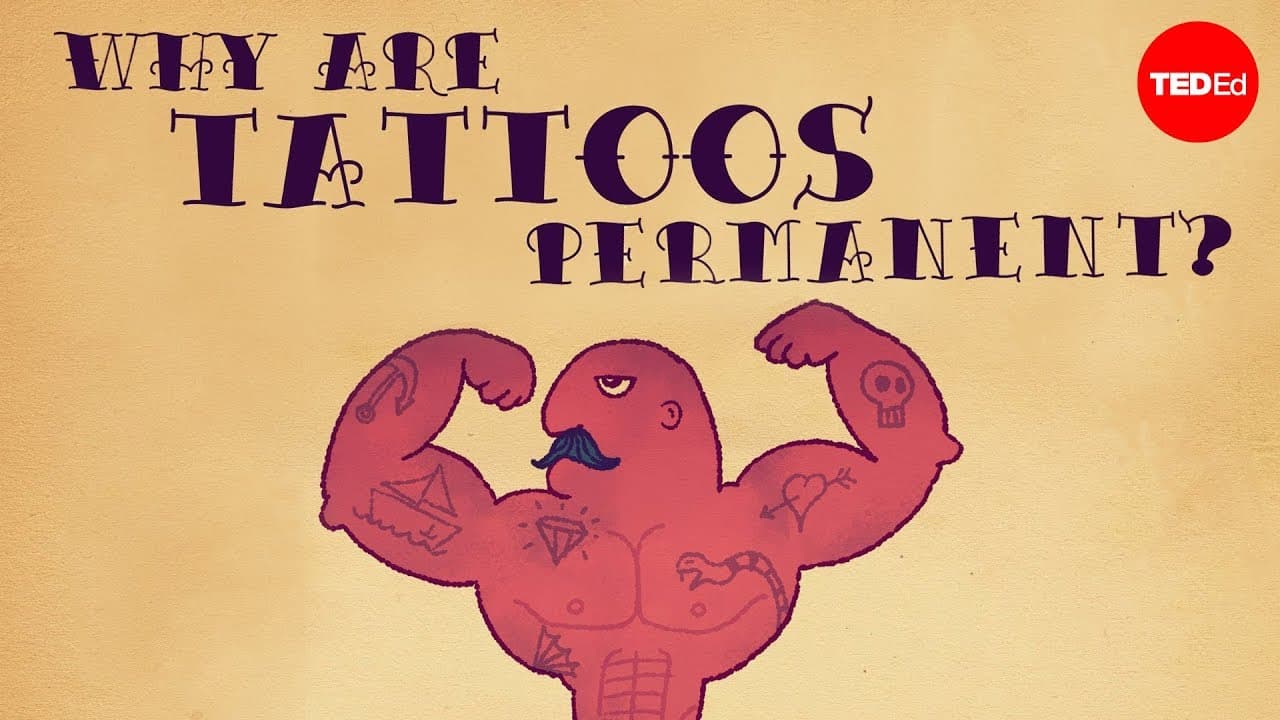
What makes tattoos permanent? - Claudia Aguirre
Transcript
Read and summarize the transcript of this video on Glasp Reader (beta).
Install to Summarize YouTube Videos and Get Transcripts
Explore YouTube Video Summarizer or Get YouTube Transcript Extractor
Summary
Tattooing is an ancient practice that involves getting pigment deeper into the skin than the outermost layer that gets shed. Tattooing machines insert needles loaded with dye into the dermis, causing a wound that triggers the body's inflammatory response. Specialized cells called macrophages attempt to clean up the dye, but some of them carry the pigment into the lymph nodes while others remain in the dermis. The ink particles can also be suspended in the dermal matrix or engulfed by dermal cells. As the damaged epidermal cells heal and shed, the tattoo remains visible. Over time, tattoos may fade naturally as the body breaks down the ink particles, but the dermal cells will keep the ink in place for a person's whole life. However, tattoos can be removed using lasers that break up the ink particles for removal by the macrophages.
Questions & Answers
Q: How does tattooing work?
Tattooing involves getting pigment deeper into the skin, beyond the outermost layer that gets shed. Different cultures throughout history have used various methods to achieve this, but modern tattooing machines insert needles loaded with dye into the skin at a high frequency.
Q: Why don't tattoos flake off with shed skin cells?
Tattooing involves getting the ink deep into the dermis, which is composed of collagen fibers, nerves, glands, blood vessels, and more. The ink remains visible because the dermal cells keep it in place after the damaged epidermal cells heal and shed.
Q: How do tattoos become permanent?
Tattooing causes a wound that triggers the body's inflammatory process. Specialized cells called macrophages attempt to eliminate the dye but end up carrying some of it into the lymph nodes or keeping it in the dermis. The remaining dye particles in the dermal matrix or within dermal cells make the tattoo permanent.
Q: What happens when the body reacts to the tattoo ink?
Over time, the body's immune system reacts to the foreign pigment particles, gradually breaking them down. Ultraviolet radiation can also contribute to pigment breakdown. However, the dermal cells are relatively stable, so much of the ink will remain deep in the skin.
Q: Can tattoos be completely removed?
Technically, tattoos can be removed using lasers that penetrate the epidermis and break apart underlying pigment colors. The smaller ink particles can then be cleared away by the body's macrophages. However, some color inks are more challenging to remove than others, and complications can arise during the removal process.
Q: How long does it take for a tattoo to heal?
Complete epidermal regeneration, which involves shedding of the damaged cells, typically takes around 2-4 weeks. During this time, it is important to avoid excess sun exposure and swimming to prevent fading.
Q: Are there any precautions to take after getting a tattoo?
After getting a tattoo, it is recommended to avoid excess sun exposure and swimming during the healing process to prevent fading. Additionally, proper tattoo aftercare, such as keeping the tattoo clean and moisturized, is essential for optimal healing.
Q: Can tattoos fade over time?
Yes, tattoos can naturally fade over time as the body breaks down the ink particles. Additionally, ultraviolet radiation from the sun can contribute to pigment breakdown. However, the ink will remain relatively stable in the dermal cells, ensuring that the tattoo remains visible for a person's lifetime.
Q: Can tattoos be affected by skin shedding?
As the damaged epidermal cells heal and shed, the tattoo remains visible, as the ink is embedded deeper into the dermis. The shedding of skin cells does not significantly affect the tattoo's appearance or permanence.
Q: How long have tattoos been around?
Tattoos have been practiced since ancient times and have been discovered on human remains dating back to 6,000 BCE. With their continuing popularity, tattoos have been around longer than any existing culture, indicating that the art of tattooing is here to stay.
Takeaways
Tattooing involves getting pigment deep into the skin, beyond the layer of skin cells that get shed. This is achieved through modern tattooing machines that insert dye-loaded needles into the dermis. The body's inflammatory response to the tattoo causes specialized cells called macrophages to attempt to eliminate the ink. However, some macrophages carry the pigment into the lymph nodes, while others keep it in the dermis. The remaining ink particles in the dermis and within dermal cells make tattoos permanent. Although tattoos can fade over time as the body breaks down the pigment, the dermal cells ensure that much of the ink remains in place for a person's lifetime. Tattoos can be removed using lasers that break up the ink particles for removal by the body's macrophages, but some color inks are more difficult to remove than others and complications can arise. Overall, tattoos have been around for thousands of years, surpassing the existence of any single culture, indicating that the art of tattooing is enduring.
Read in Other Languages (beta)
Share This Summary 📚
Summarize YouTube Videos and Get Video Transcripts with 1-Click
Try YouTube Summary with ChatGPT & Claude or YouTube Transcript Generator
Explore More Summaries from TED-Ed 📚





Summarize YouTube Videos and Get Video Transcripts with 1-Click
Try YouTube Summary with ChatGPT & Claude or YouTube Transcript Generator