How your digestive system works - Emma Bryce
TL;DR
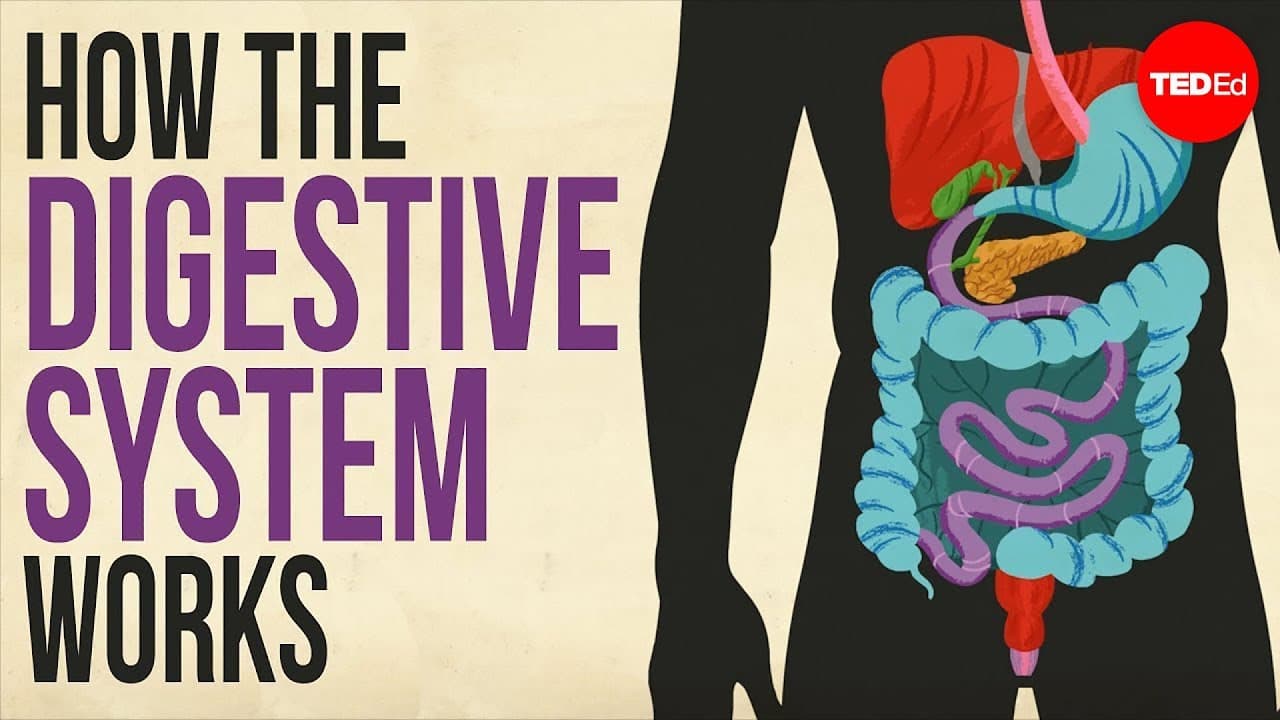
The human digestive system processes food through four main components: the gastrointestinal tract, digestive organs (like the pancreas and liver), enzymes and hormones, and the mesentery. It begins in the mouth with saliva breaking down food and concludes in the large intestine, where waste is expelled after a journey that typically lasts 30 to 40 hours.
Transcript
Across the whole planet, humans eat on average between one and 2.7 kilograms of food a day. That's over 365 kilograms a year per person, and more than 28,800 kilograms over the course of a lifetime. And every last scrap makes its way through the digestive system. Comprised of ten organs covering nine meters, and containing over 20 specialized ce... Read More
Key Insights
- 🅰️ The digestive system is diverse and complicated, with ten organs and over 20 specialized cell types.
- 🤒 The gastrointestinal tract has an internal surface area of 30-40 square meters, facilitating nutrient absorption.
- 😋 Enzymes, hormones, and digestive juices from organs like the pancreas and liver aid in breaking down food.
- 🛩️ Villi in the small intestine maximize nutrient absorption into the bloodstream.
- 💦 The large intestine removes excess water and forms stool for elimination.
- ⌛ The entire digestion process typically lasts between 30 and 40 hours.
- 🖐️ The liver plays an essential role in producing bile, which helps digest fats.
Install to Summarize YouTube Videos and Get Transcripts
Explore YouTube Video Summarizer or Get YouTube Transcript Extractor
Questions & Answers
Q: What are the main components of the digestive system?
The digestive system consists of the gastrointestinal tract, pancreas, gallbladder, liver; body's enzymes, hormones, nerves, and blood; and the mesentery, all working together for digestion and nutrient absorption.
Q: How does the digestive process begin?
The process starts in the mouth with saliva breaking down starch. Chewing and swallowing push the food through the esophagus into the stomach.
Q: How does the small intestine absorb nutrients?
The small intestine, specifically the jejunum and ileum, is lined with villi that maximize absorption. Enzyme-rich juices break down molecules into easily absorbable forms, which are transferred into the bloodstream.
Q: What happens in the large intestine?
The large intestine, or colon, absorbs most of the remaining fluid from digested food, forming stool. The rectum stores the stool until it is expelled through the anus.
Key Insights:
- The digestive system is diverse and complicated, with ten organs and over 20 specialized cell types.
- The gastrointestinal tract has an internal surface area of 30-40 square meters, facilitating nutrient absorption.
- Enzymes, hormones, and digestive juices from organs like the pancreas and liver aid in breaking down food.
- Villi in the small intestine maximize nutrient absorption into the bloodstream.
- The large intestine removes excess water and forms stool for elimination.
- The entire digestion process typically lasts between 30 and 40 hours.
- The liver plays an essential role in producing bile, which helps digest fats.
- Nerves throughout the digestive system sense and control the movement of food and waste.
Summary
The digestive system is one of the most diverse and complicated systems in the human body, comprising ten organs covering nine meters and over 20 specialized cell types. It transforms food into nutrients and energy to sustain life. This system includes the gastrointestinal tract, pancreas, gallbladder, liver, enzymes, hormones, nerves, blood, and mesentery. The digestive process involves the mouth, esophagus, stomach, small intestine, and large intestine, with various organs and juices playing vital roles in breaking down food.
Questions & Answers
Q: How much food does the average human eat in a day?
On average, humans consume between one and 2.7 kilograms of food per day.
Q: How much food does the average human eat in a year?
The average person consumes over 365 kilograms of food in a year.
Q: What is the purpose of the digestive system?
The digestive system transforms the raw materials of food into nutrients and energy to sustain life.
Q: What are the main components of the digestive system?
The digestive system consists of the gastrointestinal tract, pancreas, gallbladder, liver, body's enzymes, hormones, nerves, and blood, as well as the mesentery that supports and positions the digestive organs in the abdomen.
Q: What happens in the mouth during the digestive process?
Glands in the mouth produce saliva, which starts breaking down starch in the food. Chewing combines with saliva to form a moist lump called the bolus.
Q: How does food move from the mouth to the stomach?
The bolus enters the 25-centimeter-long tube called the esophagus, which triggers peristalsis. Peristalsis is a series of muscular contractions that move the food into the stomach.
Q: What happens in the stomach during digestion?
In the stomach, the muscular walls break the bolus into chunks. Hormones trigger the release of acids and enzyme-rich juices, which dissolve the food and break down its proteins.
Q: What role do the liver and gallbladder play in digestion?
The liver produces bile, which is sent to the gallbladder. The gallbladder secretes bile into the small intestine, where it dissolves fats in the chyme.
Q: How are fats, proteins, and carbohydrates further broken down in the small intestine?
Enzyme-rich juices from the pancreas and intestines break down fat molecules into fatty acids and glycerol, proteins into amino acids, and carbohydrates into glucose.
Q: How do nutrients get absorbed into the body?
The small intestine's villi, tiny projections, provide a large surface area for maximum absorption of molecules into the bloodstream, allowing nutrients to reach the body's organs and tissues.
Takeaways
The digestive system is a complex and diverse system responsible for transforming food into nutrients and energy. Its various components, including the gastrointestinal tract, pancreas, gallbladder, liver, enzymes, hormones, nerves, and blood, work together to break down food and facilitate absorption into the body. The process involves the mouth, esophagus, stomach, small intestine, and large intestine, with each organ and juice playing a specific role. Understanding the intricacies of the digestive system can help us make conscious choices about our diet and overall health.
Summary & Key Takeaways
-
Humans consume between one and 2.7 kilograms of food daily, with the digestive system processing it all.
-
The digestive system comprises four main components: the gastrointestinal tract, pancreas, gallbladder, liver; body's enzymes, hormones, nerves, and blood; and the mesentery.
-
The digestive process begins in the mouth, where saliva helps break down starch, and ends in the large intestine where waste is expelled.
Read in Other Languages (beta)
Share This Summary 📚
Summarize YouTube Videos and Get Video Transcripts with 1-Click
Try YouTube Summary with ChatGPT & Claude or YouTube Transcript Generator
Explore More Summaries from TED-Ed 📚




Summarize YouTube Videos and Get Video Transcripts with 1-Click
Try YouTube Summary with ChatGPT & Claude or YouTube Transcript Generator