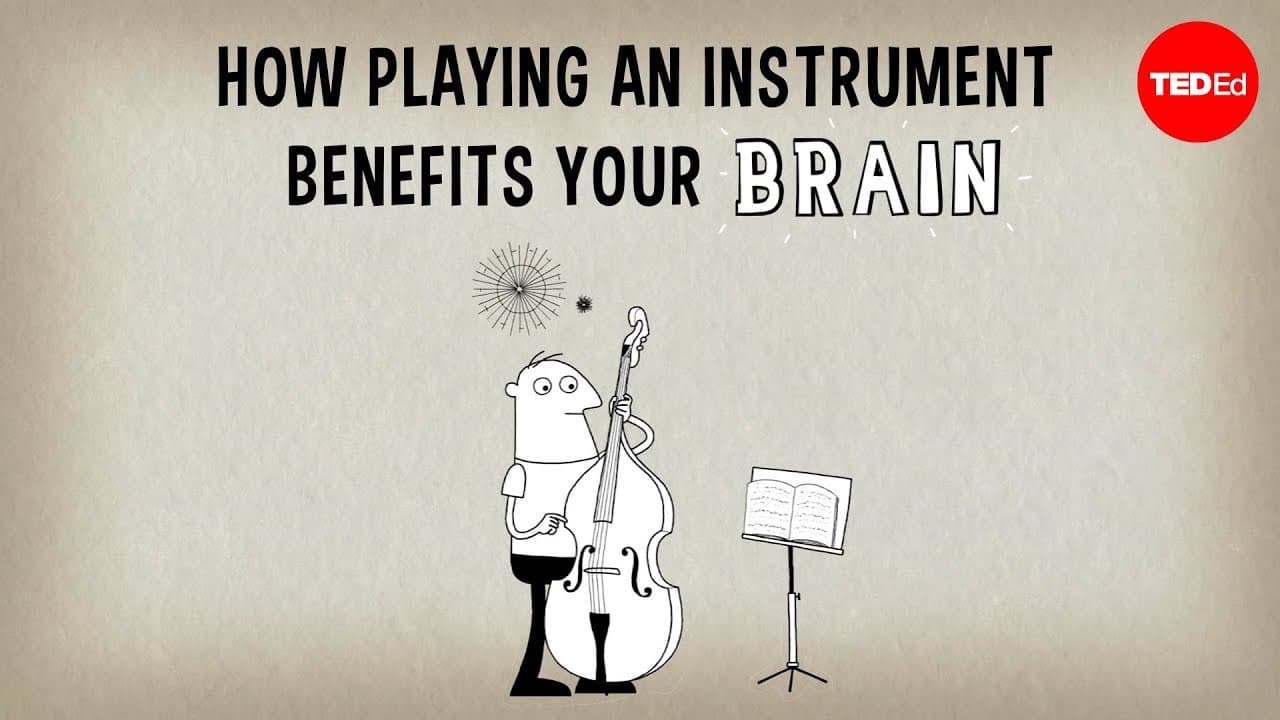
How playing an instrument benefits your brain - Anita Collins
TL;DR
Playing an instrument activates multiple brain areas simultaneously, making it akin to a full-body workout for the brain. This engagement enhances cognitive functions such as memory, problem-solving, and emotional intelligence, allowing musicians to process information more effectively and creatively. Moreover, disciplined music practice strengthens brain connectivity, leading to improved memory retrieval and executive function.
Transcript
Did you know that every time musicians pick up their instruments, there are fireworks going off all over their brain? On the outside, they may look calm and focused, reading the music and making the precise and practiced movements required. But inside their brains, there's a party going on. How do we know this? Well, in the last few decades, neuros... Read More
Key Insights
- 🧠 Playing music engages multiple areas of the brain simultaneously and is equivalent to a full-body workout for the brain.
- 👻 Disciplined practice in playing music strengthens brain functions, allowing the application of these strengthened functions in other activities.
- 🏪 Musicians demonstrate enhanced memory functions and utilize multiple tags to store and retrieve memories efficiently.
- 🖐️ Playing music enhances problem-solving skills and cognitive function by combining fine motor skills, linguistic and mathematical precision, creativity, and emotional understanding.
- 🥰 The mental benefits of playing music are unique and different from other activities, including other arts.
- 🥺 Randomized studies have shown that music learning leads to enhancement in multiple brain areas compared to control groups.
- 🖐️ Playing music improves executive function, which includes tasks like planning, strategizing, and attention to detail, benefiting both academic and social settings.
Install to Summarize YouTube Videos and Get Transcripts
Explore YouTube Video Summarizer or Get YouTube Transcript Extractor
Questions & Answers
Q: How does playing music engage the brain differently than just listening to music?
When listening to music, the brain experiences interesting activities. However, playing music is like a full-body workout for the brain. Multiple areas of the brain light up simultaneously, processing different information in intricate sequences.
Q: How does playing music enhance cognitive function and problem-solving skills?
Playing music engages practically every area of the brain, strengthening brain functions and allowing the application of this strength to other activities. It combines fine motor skills, linguistic and mathematical precision, creativity, and emotional understanding, resulting in improved problem-solving abilities in various settings.
Q: Does playing music have an impact on memory function?
Yes, musicians exhibit enhanced memory functions. They give each memory multiple tags, such as conceptual, emotional, audio, and contextual tags, which allows for quicker and more efficient memory storage and retrieval.
Q: Are the mental benefits of playing music unique to this activity?
Studies have shown that the artistic and aesthetic aspects of learning to play a musical instrument are different from any other activity studied, including other arts. Randomized studies have found that participants exposed to music learning experienced enhancement in multiple brain areas compared to others, suggesting the uniqueness of music's mental benefits.
Key Insights:
- Playing music engages multiple areas of the brain simultaneously and is equivalent to a full-body workout for the brain.
- Disciplined practice in playing music strengthens brain functions, allowing the application of these strengthened functions in other activities.
- Musicians demonstrate enhanced memory functions and utilize multiple tags to store and retrieve memories efficiently.
- Playing music enhances problem-solving skills and cognitive function by combining fine motor skills, linguistic and mathematical precision, creativity, and emotional understanding.
- The mental benefits of playing music are unique and different from other activities, including other arts.
- Randomized studies have shown that music learning leads to enhancement in multiple brain areas compared to control groups.
- Playing music improves executive function, which includes tasks like planning, strategizing, and attention to detail, benefiting both academic and social settings.
- Making music involves crafting and understanding emotional content, resulting in higher levels of executive function and interconnected cognitive and emotional analysis.
Summary
In this video, neuroscientists have made breakthroughs in understanding how our brains work by monitoring them in real time with instruments like fMRI and PET scanners. They found that musicians' brains are highly active and engaged when playing music, with multiple areas of the brain lighting up simultaneously. Playing a musical instrument engages practically every area of the brain at once, especially the visual, auditory, and motor cortices. This full-body workout for the brain strengthens brain functions and enhances memory, problem-solving, and executive function. The benefits of playing music are unique to the artistic and aesthetic aspects of learning to play a musical instrument.
Questions & Answers
Q: How do neuroscientists observe the activity in the brain in real time?
Neuroscientists use instruments like fMRI and PET scanners to monitor brain activity in real time. These machines allow them to see which areas of the brain are active when performing specific tasks.
Q: What happens in the brain when people listen to music?
When people listen to music, multiple areas of their brains light up at once. The brain processes the sound, analyzes elements like melody and rhythm, and then integrates everything into a unified musical experience.
Q: What happens in the brain when musicians play music?
When musicians play music, multiple areas of their brains light up simultaneously, processing different information in intricate and interconnected sequences. Playing music engages practically every area of the brain, including the visual, auditory, and motor cortices.
Q: How does playing music strengthen brain functions?
Playing a musical instrument is like a full-body workout for the brain. The disciplined and structured practice involved in playing music strengthens brain functions, allowing musicians to apply that strength to other activities.
Q: What are the differences between listening to music and playing it?
The most obvious difference is that playing music requires fine motor skills, which are controlled in both hemispheres of the brain. Playing music also combines linguistic and mathematical precision with novel and creative content, engaging both hemispheres. Listening to music, on the other hand, primarily involves processing and experiencing the sound.
Q: What impact does playing music have on the brain's corpus callosum?
Playing music increases the volume and activity in the brain's corpus callosum, which is the bridge between the two brain hemispheres. This allows messages to travel across the brain faster and through more diverse routes, potentially enhancing problem-solving and creativity in academic and social settings.
Q: How does playing music affect executive function?
Playing music involves crafting and understanding emotional content, requiring high levels of executive function. Musicians often excel in tasks such as planning, strategizing, and attention to detail. This ability to analyze both cognitive and emotional aspects simultaneously has a positive impact on memory systems as well.
Q: Do the benefits of playing music extend to other activities?
Research suggests that the artistic and aesthetic aspects of learning to play a musical instrument are unique in their benefits. Several randomized studies have shown that participants who were exposed to a period of music learning exhibited enhancement in multiple brain areas compared to those who did not. This indicates that the mental benefits of playing music are distinct from other activities.
Q: Are people who go into music already smarter to begin with?
Neuroscientists have explored the correlation between intelligence and musical ability, but so far, artistic and aesthetic aspects of learning to play a musical instrument have been found to have unique benefits. Randomized studies have shown that participants with the same levels of cognitive function and neural processing at the start demonstrated enhanced brain areas after a period of music learning.
Q: What has recent research about the mental benefits of playing music revealed?
Recent research has revealed the inner rhythms and complex interplay that make up the amazing orchestra in our brains. It has advanced our understanding of mental function and highlighted the unique benefits of playing music, including enhanced memory function, problem-solving skills, and executive function.
Takeaways
Playing a musical instrument engages multiple areas of the brain simultaneously and is equivalent to a full-body workout for the brain. It strengthens brain functions and has unique benefits for memory, problem-solving, and executive function. These benefits are different from other activities and are associated with the artistic and aesthetic aspects of learning to play a musical instrument.
Summary & Key Takeaways
-
Music engages the brain in complex activities, both when listening to it and more intensely when playing an instrument.
-
Playing music requires fine motor skills and combines linguistic and mathematical precision with creative elements, resulting in increased brain activity and improved problem-solving abilities.
-
Musicians exhibit enhanced memory function, as they use multiple tags to store and retrieve memories quickly and efficiently.
Read in Other Languages (beta)
Share This Summary 📚
Summarize YouTube Videos and Get Video Transcripts with 1-Click
Try YouTube Summary with ChatGPT & Claude or YouTube Transcript Generator
Explore More Summaries from TED-Ed 📚


Summarize YouTube Videos and Get Video Transcripts with 1-Click
Try YouTube Summary with ChatGPT & Claude or YouTube Transcript Generator