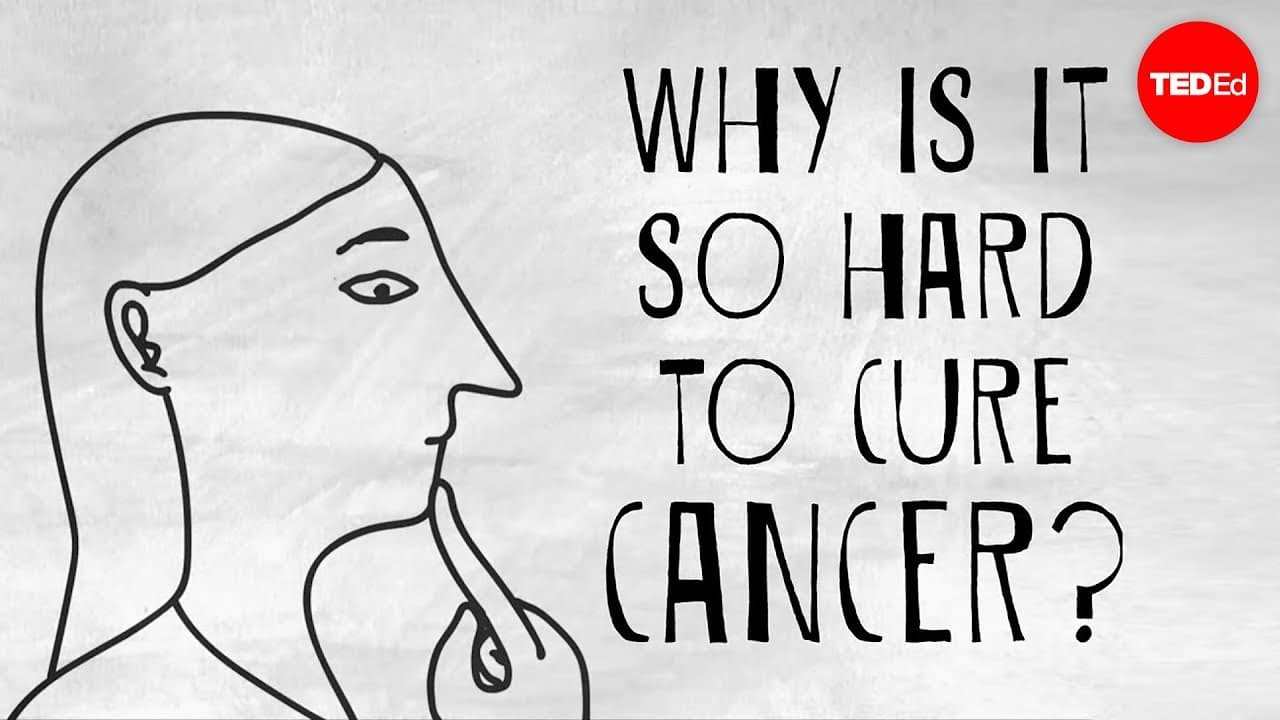
Why is it so hard to cure cancer? - Kyuson Yun
TL;DR
Curing cancer is challenging due to its complexity, including numerous types and genetic mutations within tumors. Cancer cells can adapt and communicate with surrounding healthy cells, complicating treatment. Progress is being made, but researchers must address issues like tumor heterogeneity and uncover effective ways to target resilient cancer stem cells.
Transcript
Why is it so difficult to cure cancer? We've harnessed electricity, sequenced the human genome, and eradicated small pox. But after billions of dollars in research, we haven't found a solution for a disease that affects more than 14 million people and their families at any given time. Cancer arises as normal cells accumulate mutations. Most of the ... Read More
Key Insights
- ♋ Cancer's complexity arises from mutations and heterogeneity within tumors.
- 🎯 Treatment involves surgery, radiation, chemotherapy, and targeted therapies.
- ♋ Challenges include tumor heterogeneity, communication within tumors, targeting cancer stem cells, and cancer cells' adaptive resistance.
Install to Summarize YouTube Videos and Get Transcripts
Explore YouTube Video Summarizer or Get YouTube Transcript Extractor
Questions & Answers
Q: Why is cancer so difficult to cure?
Cancer's complexity, mutations, heterogeneity, and adaptive behavior make finding a universal cure challenging, requiring tailored treatments for each type.
Q: What treatments are typically used for cancer patients?
Treatments include surgery, radiation, chemotherapy, targeted therapies, immunotherapy, and hormone therapy, tailored to specific cancer types.
Q: What are some challenges in cancer research?
Challenges include tumor heterogeneity, communication within the tumor, targeting cancer stem cells, and cancer cells' adaptive resistance mechanisms.
Q: How has the average mortality rate for cancer changed over the years?
The average mortality rate for most cancers has significantly decreased since the 1970s, showing that advancements in research and treatment are making progress.
Summary
Cancer is a difficult disease to cure due to its complex nature and the fact that it is not just one disease but more than 100 different types. The development of effective treatments is hindered by the lack of accurate representation of tumors in lab-grown cell lines, the presence of clonal heterogeneity within tumors, the communication between cancer cells and healthy cells, the existence of cancer stem cells, and the adaptability of cancer cells. However, despite these challenges, progress is being made in improving cancer mortality rates and every new piece of knowledge gained brings us closer to finding cures.
Questions & Answers
Q: Why is it difficult to cure cancer?
Cancer is a complex disease with over 100 different types, making it challenging to find a universal cure. Additionally, cancer cells are able to grow unchecked and invade other tissues or organs, making treatment more difficult once metastasis occurs.
Q: What are the usual treatments for cancer?
Cancer treatments often involve a combination of surgery to remove tumors, radiation therapy, and chemotherapy to kill any remaining cancer cells. Hormone therapies, immunotherapy, and targeted treatments tailored to specific types of cancer may also be used.
Q: Why do many cancer treatments fail in clinical trials?
Most cancer treatments are developed using lab-grown cell lines, which lack the complexity of a tumor in a living organism. Thus, drugs that work on these cell lines may not be effective when tested on real patients.
Q: What is clonal heterogeneity and why does it make treatment difficult?
Some aggressive tumors have multiple populations of slightly different cancerous cells, each with distinct genetic mutations. This clonal heterogeneity means that a drug effective on one subclone may have no effect on another, posing a challenge for treatment.
Q: How do cancer cells communicate with healthy cells?
Cancer cells communicate with healthy cells through various mechanisms such as inducing the formation of blood vessels to feed the tumor and removing waste products. They can also interact with the immune system to suppress its function, making it harder to recognize or destroy the cancer.
Q: What are cancer stem cells and why are they a challenge?
Cancer stem cells are rare cells within tumors that possess special properties, making them resistant to chemotherapy and radiation. Even if the rest of the tumor shrinks during treatment, a single residual cancer stem cell can trigger the growth of a new tumor.
Q: How do cancer cells adapt to stress?
Cancer cells have the ability to switch on protective mechanisms by changing their gene expression when exposed to radiation or chemotherapy. This adaptation allows them to survive and continue growing despite the stress.
Q: Why is it important to find experimental systems that match the complexity of cancer?
In order to defeat cancer, it is necessary to develop experimental systems that mimic the complexity of malignant cancers. This will help in monitoring and treating the disease as it evolves and adapts over time.
Q: How has mortality rates for cancer changed over the years?
Despite the challenges, the average mortality rate for most types of cancer has significantly decreased since the 1970s and continues to decline. This is a result of ongoing research and the accumulation of knowledge to improve treatment outcomes.
Q: How can each new piece of information about cancer contribute to finding cures?
Each new piece of information about cancer adds to our understanding of the disease and provides researchers with additional tools to develop effective treatments. The continuous learning and progress made in cancer research bring us closer to finding cures for different types of cancer.
Takeaways
Curing cancer is a difficult task due to the complexity of the disease, the variety of cancer types, and the challenges presented by the behavior of cancer cells. However, progress is being made in improving cancer mortality rates through advancements in treatments and a deeper understanding of the disease. While there is still much to learn, each new discovery brings us closer to finding cures and saving more lives.
Summary & Key Takeaways
-
Cancer arises from mutations allowing unchecked cell growth and invasion.
-
Treatment involves surgery, radiation, chemotherapy, targeted therapies.
-
Challenges include tumor heterogeneity, communication, cancer stem cells, and adaptive resistance.
Read in Other Languages (beta)
Share This Summary 📚
Summarize YouTube Videos and Get Video Transcripts with 1-Click
Try YouTube Summary with ChatGPT & Claude or YouTube Transcript Generator
Explore More Summaries from TED-Ed 📚
Summarize YouTube Videos and Get Video Transcripts with 1-Click
Try YouTube Summary with ChatGPT & Claude or YouTube Transcript Generator