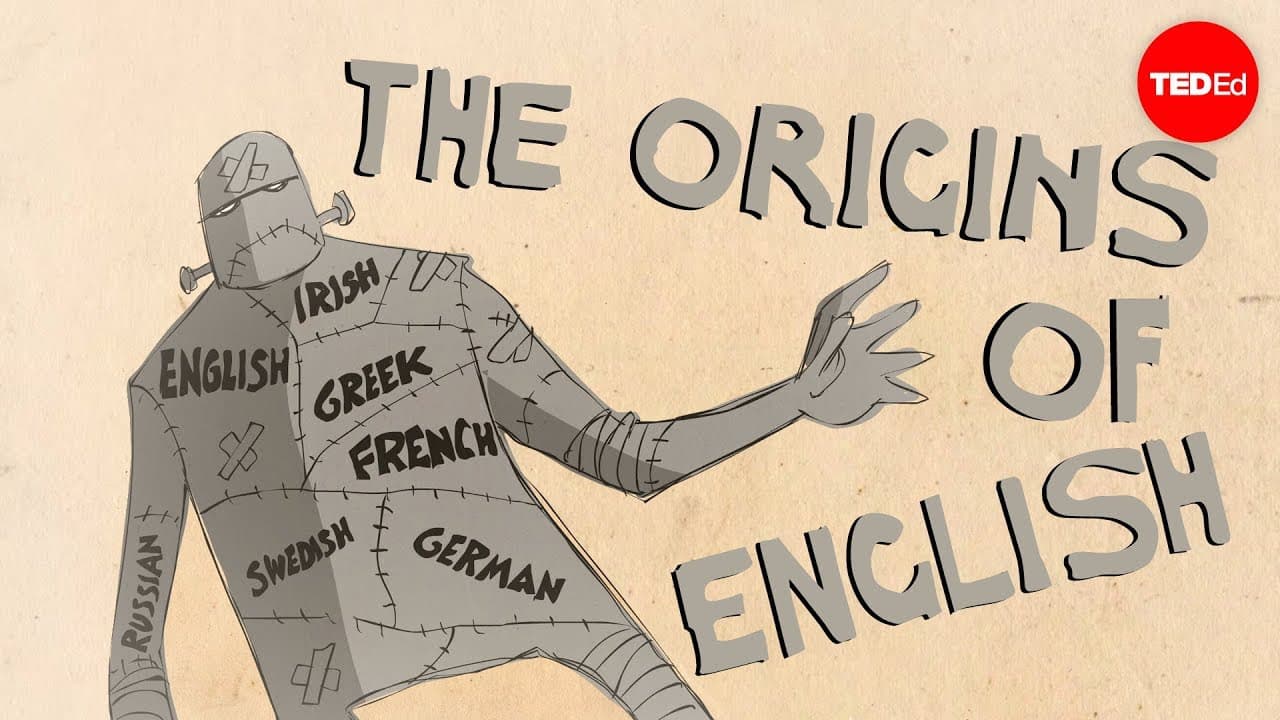
Where did English come from? - Claire Bowern
TL;DR
The English language evolved from Old English, influenced by Germanic roots, Latin, and French due to historical invasions. It traces back to Proto-Germanic and further to Proto-Indo-European, showcasing connections to languages like Latin, Hindi, and Persian. English's development is shaped by over 6,000 years of linguistic evolution.
Transcript
When we talk about English, we often think of it as a single language but what do the dialects spoken in dozens of countries around the world have in common with each other, or with the writings of Chaucer? And how are any of them related to the strange words in Beowulf? The answer is that like most languages, English has evolved through generatio... Read More
Key Insights
- 🇬🇫 English evolved from Old English, influenced by French, Latin, and Old Norse.
- 🫚 Comparative linguistics helps trace English's roots to Proto-Germanic and Proto-Indo-European.
- 🇪🇺 Proto-Indo-European is the ancestor of the Indo-European language family, including English, Latin, and Celtic languages.
- 💁 The Norman invasion added French and Latin vocabulary, shaping English into its modern form.
- 🏤 English shares systematic similarities with other Indo-European languages.
- ❓ The Germanic tribes introduced Anglo-Saxon, the precursor to Old English.
- 🇪🇺 Proto-Indo-European originated on the Pontic steppe, connecting various languages spoken in Europe and Asia.
Install to Summarize YouTube Videos and Get Transcripts
Explore YouTube Video Summarizer or Get YouTube Transcript Extractor
Questions & Answers
Q: How did the Norman invasion impact the English language?
The Norman invasion in 1066 brought a wave of French and Latin vocabulary, significantly enriching the English language and forming Old English as we know it today.
Q: What role did Germanic tribes like the Angles, Saxons, and Jutes play in shaping English?
The Germanic tribes brought their language to Britain in the 5th and 6th centuries, laying the foundation for the development of Old English, which later evolved into Modern English.
Q: How can comparative linguistics help in tracing the evolution of the English language?
Comparative linguistics analyses grammatical structures, sound changes, and core vocabulary to trace language roots, linking English to Proto-Germanic and Proto-Indo-European.
Q: What is the significance of Proto-Indo-European in understanding the origins of languages?
Proto-Indo-European, spoken 6000 years ago, is the ancestor of the Indo-European language family, providing insights into the relationship between languages like English, Latin, and Celtic.
Summary
This video explains how the English language evolved over generations, tracing it back to its ancient roots. It explores the influences of Norman invasion, Germanic dialects, Old Norse, and other languages on English. The concept of comparative linguistics is introduced to understand the grammatical structure and patterns of sound changes in different languages. The video also discusses the existence of a common ancestor language, Proto-Germanic, and its origins in Proto-Indo-European. Despite the remaining mysteries, it is fascinating to realize that billions of people around the world speak words shaped by 6000 years of history.
Questions & Answers
Q: How did the Norman invasion in 1066 contribute to the evolution of the English language?
The Norman invasion involved the conquest of England by French-speaking Normans. As they became the ruling class, they brought a significant amount of French and Latin vocabulary, which added to the English language previously spoken there. This period in English language evolution is known as Old English.
Q: What were the origins of Old English?
Old English belongs to the Germanic language family and was brought to the British Isles by the Angles, Saxons, and Jutes in the 5th and 6th centuries. These Germanic dialects, known as Anglo-Saxon, formed the basis of Old English. Additionally, Viking invaders in the 8th to 11th centuries added more borrowings from Old Norse, further shaping the language.
Q: How can comparative linguistics help trace the roots of English?
Comparative linguistics focuses on analyzing grammatical structure, patterns of sound changes, and core vocabulary across different languages. By examining these aspects, similarities and correspondences can be found, allowing researchers to trace the origins and evolution of languages. Comparative linguistics helps us see the connection between English and its ancient roots.
Q: What are some examples of linguistic changes in the English language?
One example is the sound shift from "p" to "pf" in Germanic words after the 6th century, while Old English words maintained the "p" sound. Another example is the shift from "sk" to "sh" in English, while Swedish maintained the "sk" sound. The presence of "sk" in certain English words today is due to borrowings from Old Norse after this shift.
Q: What is Proto-Germanic and how is it related to English?
Proto-Germanic is the common ancestor language from which English and other Germanic languages descended. Proto-Germanic was spoken around 500 B.C.E and can be reconstructed by comparing its descendants. This language serves as an intermediate step in tracing the origins of English.
Q: How far back can the origins of English be traced using historical and archaeological evidence?
The origins of English can be traced back to Proto-Indo-European, a language spoken about 6000 years ago on the Pontic steppe in Ukraine and Russia. Proto-Indo-European is the reconstructed ancestor of the Indo-European language family, which encompasses languages historically spoken in Europe and in large parts of Southern and Western Asia.
Q: What similarities can be observed between English and Latin through comparative linguistics?
Comparative linguistics shows that English has "t" where Latin has "d" and "f" where Latin has "p" at the start of words. These systematic similarities or correspondences between related words in different Indo-European branches highlight the connections between English and Latin.
Q: Are there any other languages related to English?
Yes, English has more distant relatives, including Hindi, Persian, and the Celtic languages it displaced in what is now Britain. These languages share common ancestry with English, providing further evidence of the interconnectedness of languages.
Q: What are some mysteries that remain in the study of language evolution?
Despite extensive research, there are still unanswered questions. One mystery is whether there is a link between the Indo-European language family and other major language families. Additionally, the nature of the languages spoken in Europe prior to the arrival of Indo-European languages remains uncertain due to limited historical and archaeological evidence.
Q: What is the remarkable fact discussed in the video?
The video highlights the fact that nearly 3 billion people around the world, despite their differences and inability to understand each other, are speaking words that have been shaped by 6000 years of history. It showcases the enduring influence and interconnectedness of language across cultures and time.
Takeaways
The English language, like most languages, has evolved over generations, undergoing significant changes influenced by various invasions and migrations. Through comparative linguistics, it is possible to trace the language back to its ancient roots, from Old English to its Germanic origins, and even further back to Proto-Germanic and Proto-Indo-European. The connections and similarities between languages provide a deeper understanding of language evolution. However, there are still mysteries surrounding the origins of language families and the languages spoken prior to their arrival. Nevertheless, it is astounding to realize that billions of people around the world communicate through words shaped by thousands of years of history.
Summary & Key Takeaways
-
English has evolved through influences such as French, Latin, Old Norse, and Proto-Germanic.
-
Comparative linguistics helps trace the language's roots back to Proto-Germanic and Proto-Indo-European.
-
The Indo-European family includes English, Latin, Hindi, Persian, and Celtic languages.
Read in Other Languages (beta)
Share This Summary 📚
Summarize YouTube Videos and Get Video Transcripts with 1-Click
Try YouTube Summary with ChatGPT & Claude or YouTube Transcript Generator
Explore More Summaries from TED-Ed 📚




Summarize YouTube Videos and Get Video Transcripts with 1-Click
Try YouTube Summary with ChatGPT & Claude or YouTube Transcript Generator