What Percentage of Your Brain Do You Actually Use?
TL;DR
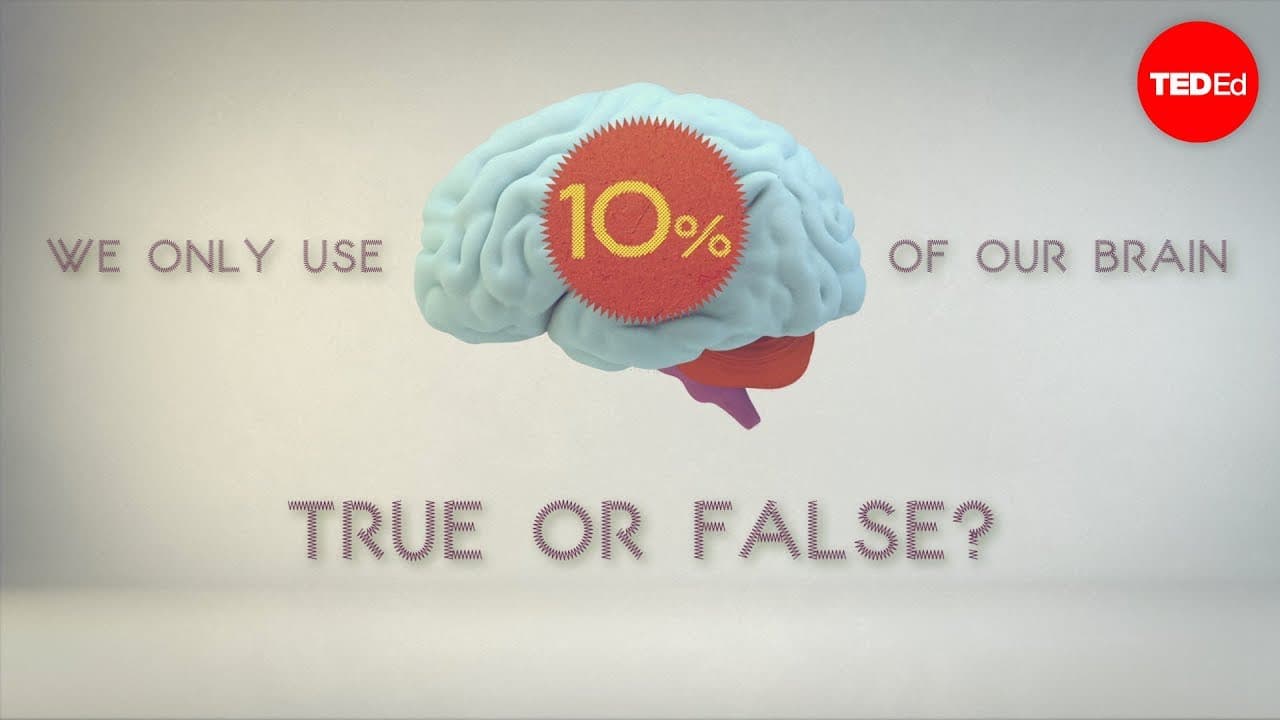
The myth that humans only use 10% of their brains is false; our brains are highly active and consume 20% of daily glucose. Areas once thought to be silent actually support critical functions like reasoning and decision-making, and the need for energy efficiency limits how many neurons can be simultaneously active.
Transcript
An enduring myth says we use only 10% of our brain, the other 90% standing idly by for spare capacity. Hucksters promised to unlock that hidden potential with methods "based on neuroscience," but all they really unlock is your wallet. Two-thirds of the public and nearly half of science teachers mistakenly believe the 10% myth. In the 1890s, William... Read More
Key Insights
- 🧠 The 10% brain myth is widely believed but incorrect, with the human brain being highly active and requiring significant energy to function.
- 🤔 Areas of the brain previously thought to be silent actually play important roles in executive and integrative functions.
- 🧠 The brain's energy consumption disproves the idea of unused capacity, with humans using a substantial amount of energy to maintain brain function.
- 🍳 Cooking and consuming cooked food played a crucial role in human brain development by providing more energy and freeing up time.
- 👻 The brain's energy efficiency relies on sparse coding, allowing for the optimum proportion of cells to be active at once.
- 🥺 Multitasking is inefficient due to the brain's limited energy resources, leading to poorer performance when dividing attention.
- 🧠 The brain is already smart and powerful, requiring a significant amount of energy to maintain its functionality.
Install to Summarize YouTube Videos and Get Transcripts
Explore YouTube Video Summarizer or Get YouTube Transcript Extractor
Questions & Answers
Q: Why do so many people believe that humans only use 10% of their brain?
The 10% myth has persisted due to a misunderstanding of William James' statement about not meeting our mental potential. Additionally, for a long time, scientists didn't fully understand the purpose of certain brain areas, leading to the assumption that they were silent.
Q: How does brain energy consumption differ between humans and other animals?
The brain consumes a significant amount of energy, with adult humans using 20% of daily glucose burned. This is much higher than expected based on relative brain sizes. Even infants, with smaller brains, consume 60% of the body's glucose.
Q: What is the trade-off between brain size and the number of neurons in primates?
There is a trade-off between body size and the number of neurons a primate can sustain. Human brains, although smaller in size compared to elephant or whale brains, pack in more neurons. This dense packing is what allows humans to be highly intelligent.
Q: How does energy efficiency play a role in brain function?
To conserve energy, the brain uses sparse coding, allowing only a small proportion of cells to signal at any given time. This approach carries the most information and is the optimum balance between energy efficiency and functionality.
Summary & Key Takeaways
-
The belief that humans only use 10% of their brain is a misconception held by two-thirds of the public and nearly half of science teachers.
-
Areas of the brain that were once thought to be silent actually play a crucial role in executive and integrative functions, such as abstract reasoning and decision-making.
-
The human brain consumes a substantial amount of energy, accounting for 20% of daily glucose burned, disproving the idea that most of the brain remains inactive.
Read in Other Languages (beta)
Share This Summary 📚
Summarize YouTube Videos and Get Video Transcripts with 1-Click
Try YouTube Summary with ChatGPT & Claude or YouTube Transcript Generator
Explore More Summaries from TED-Ed 📚




Summarize YouTube Videos and Get Video Transcripts with 1-Click
Try YouTube Summary with ChatGPT & Claude or YouTube Transcript Generator