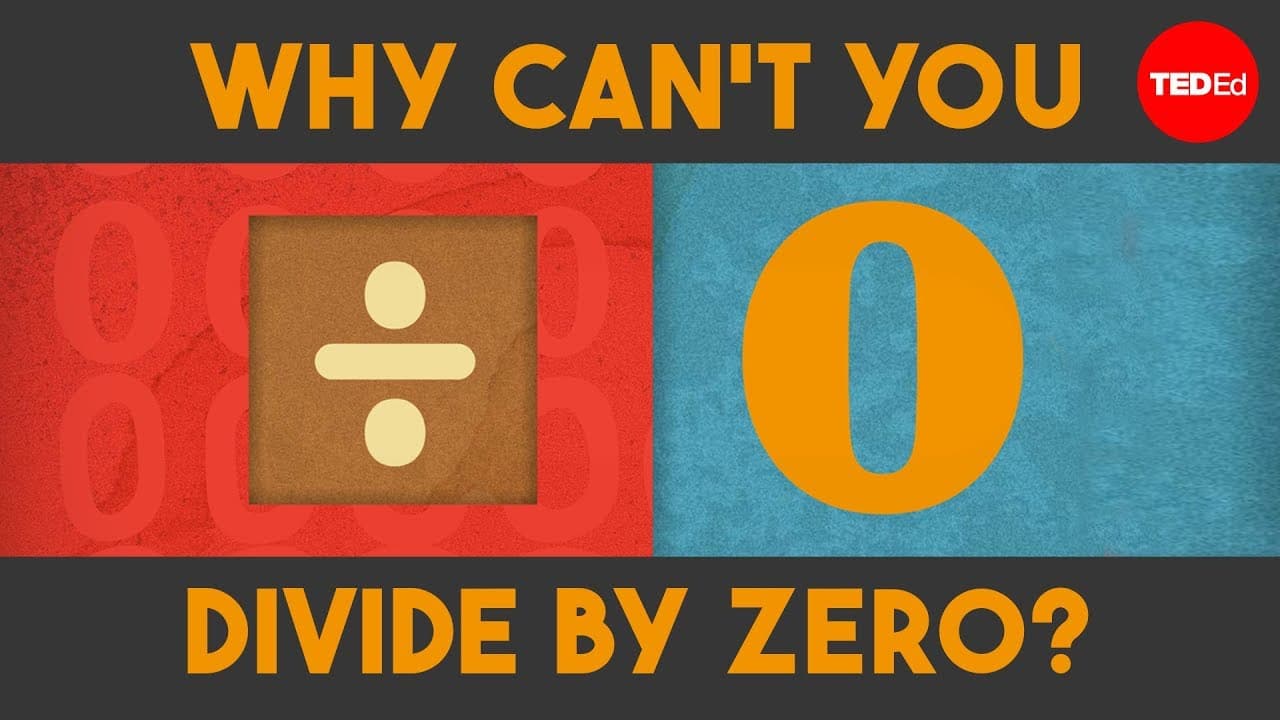
Why can't you divide by zero? - TED-Ed
TL;DR
Dividing by zero is impossible because zero has no multiplicative inverse. While it may seem that dividing by smaller numbers approaches infinity, this does not mean that division by zero equals infinity. Attempting to define division by zero leads to inconsistencies and challenges in mathematics.
Transcript
In the world of math, many strange results are possible when we change the rules. But there’s one rule that most of us have been warned not to break: don’t divide by zero. How can the simple combination of an everyday number and a basic operation cause such problems? Normally, dividing by smaller and smaller numbers gives you bigger and bigger... Read More
Key Insights
- 🥺 Traditional rules of mathematics break down when dividing by zero, leading to conceptual challenges.
- 🪡 Defining division by zero as infinity results in mathematical inconsistencies, highlighting the need for precise definitions.
- 0️⃣ Theoretical exploration, like the Riemann sphere, offers alternative perspectives on dividing by zero.
- 🥺 Mathematics history shows that breaking rules can lead to innovation and the discovery of new mathematical concepts.
- 🖐️ Multiplicative inverses play a crucial role in understanding division operations in mathematics.
- 👶 Experimenting with mathematical rules can inspire new worlds of exploration and creativity.
- 🫷 Division by zero poses unique challenges in mathematics, pushing mathematicians to explore unconventional solutions.
Install to Summarize YouTube Videos and Get Transcripts
Explore YouTube Video Summarizer or Get YouTube Transcript Extractor
Questions & Answers
Q: Why is dividing by zero a rule not to be broken?
Dividing by zero leads to undefined results as zero lacks a multiplicative inverse, halting traditional mathematical operations.
Q: Can defining division by zero as infinity solve the dilemma?
Defining division by zero as infinity creates further mathematical inconsistencies, showcasing the complexity of mathematical operations.
Q: What example from mathematics history highlights rule-breaking?
The introduction of complex numbers by defining the square root of negative one as 'i' showcases mathematicians breaking traditional rules to innovate.
Q: How can mathematics explore division by zero through theoretical methods like the Riemann sphere?
The Riemann sphere offers a different approach to dividing by zero, demonstrating how theoretical exploration can open new avenues for mathematical understanding.
Summary
In this video, we explore the concept of dividing by zero and why it is considered problematic in the world of math. While dividing by smaller and smaller numbers tends to yield larger answers, dividing by zero poses unique challenges. Although it may seem plausible that dividing by zero results in infinity, it is important to understand that dividing a number by a value that approaches zero does not equate to dividing by zero. The video takes a closer look at division and its relationship to multiplication, highlighting the importance of the multiplicative inverse. However, zero does not have a multiplicative inverse, leading to the conclusion that dividing by zero is not possible. While mathematicians have broken rules in the past, such as introducing imaginary numbers, the concept of dividing by zero and defining infinity as one over zero is not mathematically valid or useful.
Questions & Answers
Q: Why is dividing by zero considered problematic in math?
Dividing by zero is problematic because it leads to contradictory results and violates mathematical principles. It is a rule that most of us have been warned not to break.
Q: What happens when we divide by smaller and smaller numbers?
When we divide by smaller and smaller numbers, the quotient tends to grow larger. For example, dividing 10 by 2 yields 5, by 1 yields 10, and so on.
Q: Does dividing by zero result in infinity?
While it may seem logical that dividing by zero would result in infinity, it is important to understand that dividing a number by a value that approaches zero does not equate to dividing by zero. The answer tends towards infinity, but it does not mean that 10 divided by zero equals infinity.
Q: What is the multiplicative inverse?
The multiplicative inverse of a number x is another number that, when multiplied by x, yields the value of 1. For example, the multiplicative inverse of 2 is 1/2, and the multiplicative inverse of 10 is 1/10. The product of any number and its multiplicative inverse is always equal to 1.
Q: Can we find the multiplicative inverse of zero?
No, zero does not have a multiplicative inverse. In order to divide by zero, we would need to find a number that, when multiplied by zero, equals one. However, anything multiplied by zero is still zero, making such a number impossible.
Q: Why can't we just define infinity as one over zero?
While mathematicians have introduced new concepts in the past, defining infinity as one over zero is not mathematically valid or useful. By attempting to do so, we encounter contradictions and fall into inconsistency.
Q: Can we redefine mathematical rules to allow dividing by zero?
While mathematicians have pushed the boundaries and redefined certain concepts in the past, attempting to redefine mathematical rules to allow dividing by zero does not lead to consistent or useful results. It is important to adhere to the principles of mathematics to maintain coherence and practicality.
Q: What happens when we try to establish zero times infinity?
Based on the definition of a multiplicative inverse, zero times infinity should be equal to one. However, if we rearrange the equation using the distributive property, we end up with zero times infinity plus zero times infinity, which suggests that zero times infinity should equal two. This contradiction arises because defining infinity as one over zero leads to inconsistencies.
Q: Why is the concept of infinity equaling zero not useful to mathematicians?
Having infinity equal to zero is not useful to mathematicians because it does not provide meaningful insights or applications. While there are mathematical concepts, like the Riemann sphere, that involve dividing by zero through different methods, they are beyond the scope of this discussion.
Q: Should we stop exploring and breaking mathematical rules?
No, we should not stop exploring and breaking mathematical rules. While dividing by zero in the most obvious way does not yield favorable results, experimenting with mathematical rules allows for the discovery of new concepts and the exploration of exciting new worlds in mathematics.
Summary & Key Takeaways
-
Division by zero leads to infinity confusion, as the answer is not straightforwardly infinity.
-
Finding the multiplicative inverse of zero reveals its impossibility due to zero not having one.
-
Mathematical experimentation with breaking rules can lead to new worlds and exploration.
Read in Other Languages (beta)
Share This Summary 📚
Summarize YouTube Videos and Get Video Transcripts with 1-Click
Try YouTube Summary with ChatGPT & Claude or YouTube Transcript Generator
Explore More Summaries from TED-Ed 📚



Summarize YouTube Videos and Get Video Transcripts with 1-Click
Try YouTube Summary with ChatGPT & Claude or YouTube Transcript Generator