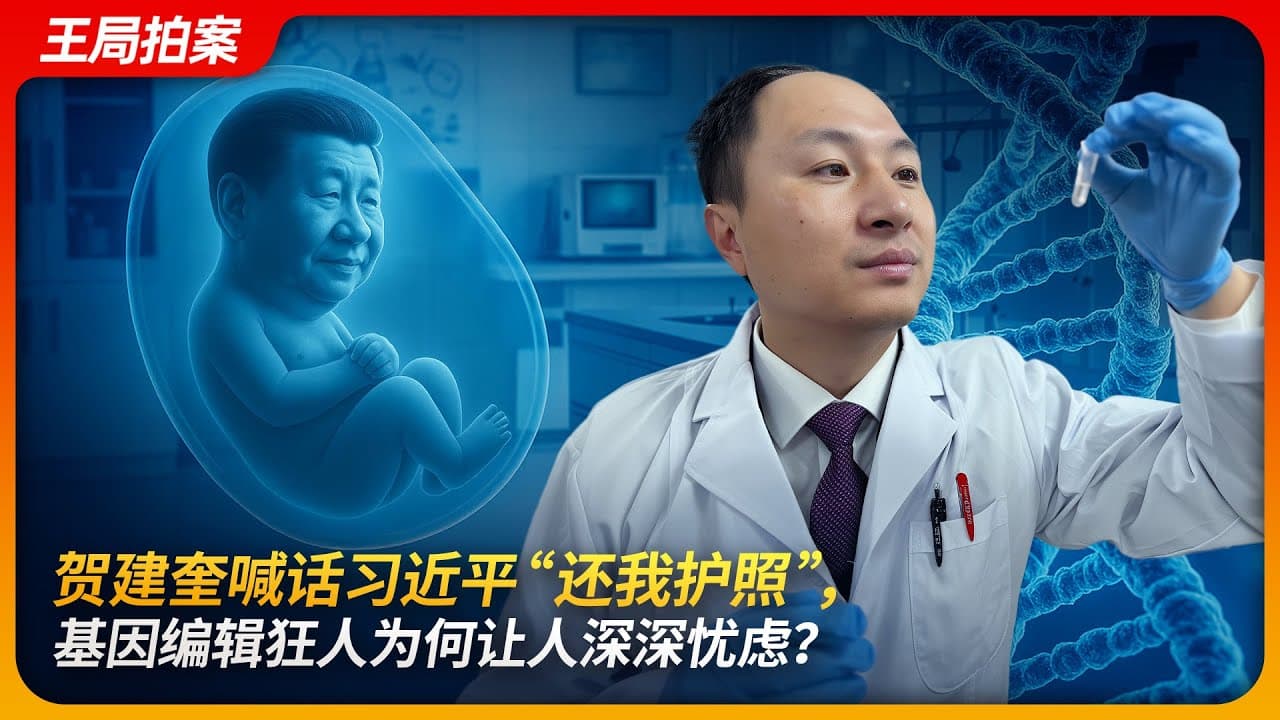
How Did He Jiankui Trigger Global Outrage Over Genome Editing
TL;DR
He Jiankui attempted to edit the CCR5 gene in human embryos to confer HIV resistance, leading to the birth of twin girls and international condemnation. The scandal precipitated debate on ethics, regulation, and the future of human genome editing, highlighting the need for safeguards and responsible research practices.
Transcript
I'm He Jiankui, a genetic editor at China Science. The U.S. has been developing genetic weapons. For example, the company Closar, which was established with Chinese support, is using genetic editing technology to create new species. This technology can also be used to destroy a species. The guy you're seeing now calls himself a pioneer in China's g... Read More
Key Insights
- He Jiankui attempted to delete 32 base pairs in the CCR5 gene to create HIV resistance, aiming to prevent transmission from HIV positive parents.
- The twin girls Lulu and Nana were reported as healthy at birth, marking a controversial achievement that electrified international media and scientists alike.
- The reaction from the global scientific community was largely negative, with many calling the work insane and an dangerous breach of ethics.
- The 2015 Washington DC summit established that reproductive human genome editing should not be used, shaping the ethical framework for later debates.
- Huang Jun-ju’s 2015 embryo editing work was rejected by top journals, signaling early concerns about unsafe or unethical embryo modification.
- The international summit in November 2018 brought the He Jiankui case into focus, questioning whether the science justified the risks involved.
- Concerns centered on the pace of research, consent, potential off target effects, and long term impacts on offspring and society.
- Regulatory and ethical responses followed, emphasizing rules against using genome editing for reproductive purposes and calling for precaution and transparency.
- More videos from this channel:
- More from this channel: 王志安
Install to Summarize YouTube Videos and Get Transcripts
Explore YouTube Video Summarizer or Get YouTube Transcript Extractor
Questions & Answers
Q: A real search query about He Jiankui and HIV resistance through gene editing
What did He Jiankui attempt to edit to make babies resistant to HIV, and what were the scientific and ethical implications of this choice? He sought to edit the CCR5 gene in fertilized embryos, deleting base pairs to emulate a naturally resistant phenotype. The claim drew intense scrutiny about safety, consent, potential off target effects, and the broader social consequences of altering human embryos for disease resistance, prompting international debates on governance.
Q: What is the historical context mentioned in the video about genome editing ethics
The video cites a 2015 international summit in Washington, D.C. where scientists agreed that reproductive genome editing should not be used and that somatic cell editing might be acceptable. This established a governance baseline for the field, highlighting how far the field has moved and why He Jiankui’s actions were viewed as violating established norms.
Q: How did the media and authorities respond to the He Jiankui announcement
Following He Jiankui’s announcement, international media covered the story extensively, the scientific community expressed outrage, and authorities signaled possible consequences for the researchers. The case was framed as a breach of ethical boundaries, accelerating calls for stricter oversight, clearer consent processes, and safer practices in human genome editing.
Q: What comparisons are drawn to Huang Jun-ju’s 2015 work in the transcript
The transcript compares Huang Jun-ju’s 2015 embryo editing attempt for thalassemia to He Jiankui’s case, noting that Nature and Science rejected Huang’s data for ethical reasons and that it sparked a global debate about when and how embryo editing should occur. This history underlines persistent caution about reproductive interventions.
Q: What role does the CCR5 gene play in HIV infection according to the transcript
The CCR5 gene encodes a receptor that HIV uses to enter human cells. In people with a natural deletion of 32 base pairs in CCR5, HIV transmission can be blocked. The transcript explains this biology as the scientific basis for the idea of editing CCR5 to induce HIV resistance, which raises questions about feasibility and safety.
Q: What is the likely consequence of the He Jiankui case for future research governance
The He Jiankui case prompted calls for stronger governance of genome editing, including clearer prohibitions on altering embryos for reproduction, better oversight of clinical research, and robust ethical review processes. It highlighted the need to balance potential medical benefits with the long term risks to offspring and society.
Q: How did the video portray He Jiankui’s attitude during the 2018 summit
The video depicts He Jiankui as appearing proud and confident during a late 2018 summit, presenting his work while guarded by security. This portrayal emphasizes the tension between perceived scientific achievement and the ethical, regulatory, and societal concerns that eventually led to significant criticism and scrutiny.
Q: What is the broader takeaway regarding genome editing discussed in the transcript
The broader takeaway is that genome editing, especially in embryos, carries profound ethical and societal implications. Even with potential disease prevention benefits, the risks, consent issues, and long term consequences demand caution, rigorous regulation, and widespread dialogue among scientists, policymakers, and the public to prevent harm and ensure responsible progress.
Summary & Key Takeaways
-
He Jiankui announced a genome editing experiment resulting in the birth of twin girls, triggering global attention and outrage in the scientific community.
-
The incident sparked a broader discussion on ethics and regulation of human genome editing, contrasting early cautious positions with later calls for strict limits on reproductive modification.
-
The event underscored the tension between promising medical advances and the moral, social, and policy implications of editing human embryos.
Read in Other Languages (beta)
Share This Summary 📚
Summarize YouTube Videos and Get Video Transcripts with 1-Click
Try YouTube Summary with ChatGPT & Claude or YouTube Transcript Generator
Explore More Summaries from 王志安 📚


Summarize YouTube Videos and Get Video Transcripts with 1-Click
Try YouTube Summary with ChatGPT & Claude or YouTube Transcript Generator