How Did China’s EV Industry Overtake Rivals?
TL;DR
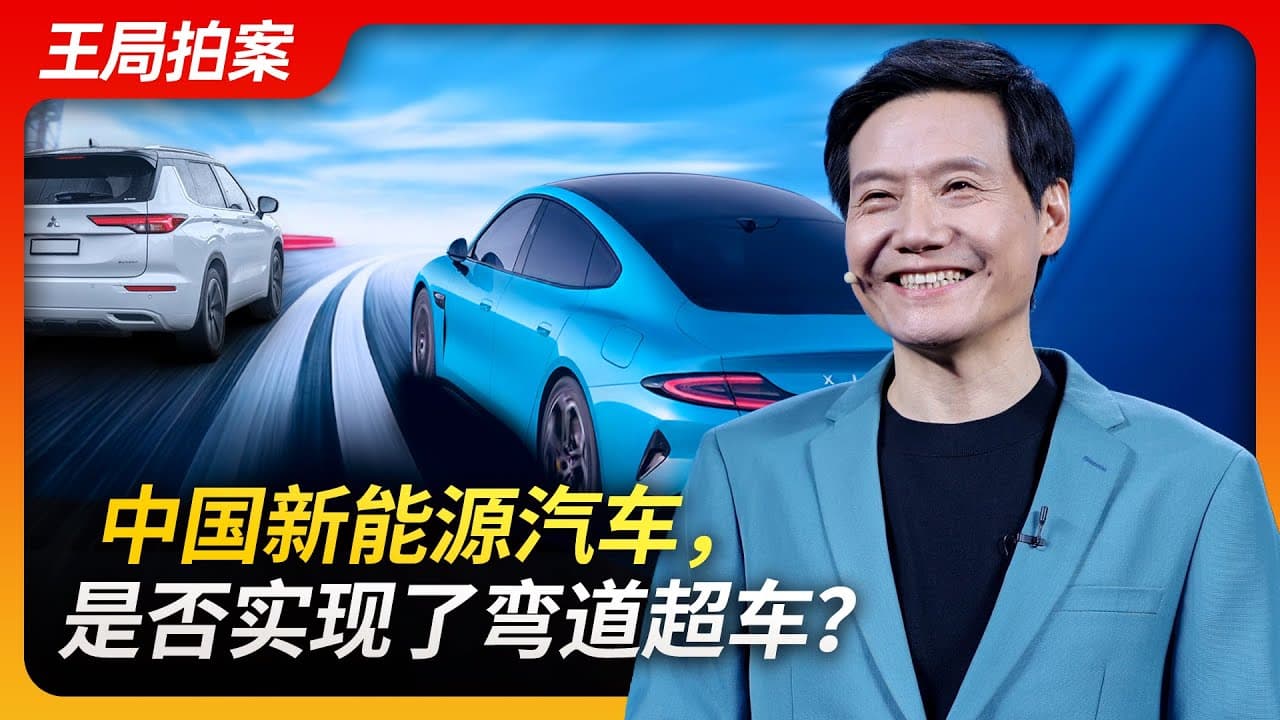
China’s electric vehicle industry achieved a form of leapfrogging by shifting from gasoline cars, where foreign companies held deep technical and patent advantages, to battery-powered vehicles. Xiaomi’s SU7 illustrates the result: aggressive pricing, long claimed range, fast claimed charging, ecosystem integration, and nearly 89,000 orders within 24 hours, although its long-term sales performance remained uncertain.
Transcript
I think the product strength of the Xiaomi SU7 is strong enough. If it's priced the same as the Model 3, I believe many people would choose the Xiaomi SU7. Do you all agree? Okay, so how much do we finally price it at? 215,900. What you're seeing now is the Xiaomi Auto press conference on March 28th. Lei Jun, the chairman of Xiaomi Auto, is current... Read More
Key Insights
- China’s electric vehicle industry achieved leapfrogging by changing the competitive technology path. Instead of trying to overcome decades of accumulated gasoline-engine expertise and patents, Chinese manufacturers entered battery-powered vehicles, where the established barriers described in the discussion were less restrictive.
- The Xiaomi SU7 entry model was priced at 215,900 yuan and offered a claimed range of 700 kilometers. The combination of price, range, vehicle features, and Xiaomi ecosystem integration made the product highly attractive compared with the presenter’s 500-kilometer Tesla Model Y.
- The SU7 Max achieved a claimed range of 810 kilometers despite using four-wheel drive and emphasizing high performance. Lei Jun stated that its battery capacity increased by 13.6 degrees and its range increased by 133 kilometers, illustrating Xiaomi’s focus on performance and efficiency.
- The SU7’s claimed charging performance added to its practical appeal. Lei Jun said five minutes of charging could provide 210 kilometers of range, while 15 minutes could provide 510 kilometers, a speed the presenter characterized as faster than Tesla Supercharger stations.
- Xiaomi received nearly 89,000 SU7 orders within 24 hours of launch. The presenter treated this as an impressive sign of initial demand but cautioned that such early ordering speed could not reliably predict the vehicle’s future sales performance.
- China’s gasoline vehicle industry faced barriers across engines, transmissions, and other complex systems. A gasoline car was described as containing about 30,000 parts divided among six or seven major systems, with extensive patents making technological catch-up extremely difficult.
- China’s foreign automotive joint-venture policy produced limited technological gains. Foreign manufacturers could hold no more than 49 percent while Chinese partners held at least 51 percent, but foreign firms often supplied outdated technology and earned easy profits from rapidly growing Chinese demand.
- China chose battery vehicles after considering battery and hydrogen technology paths. Japan’s early lead in hydrogen vehicles had produced significant technological and patent barriers, while batteries did not present the same problem, making them a more accessible foundation for China’s new energy vehicle strategy.
Install to Summarize YouTube Videos and Get Transcripts
Explore YouTube Video Summarizer or Get YouTube Transcript Extractor
Questions & Answers
Q: Did China’s electric vehicle industry overtake foreign rivals?
The presenter argues that China’s electric vehicle industry definitely achieved a form of leapfrogging. The central reason is not that Chinese manufacturers defeated established companies on every aspect of gasoline vehicle technology. Instead, the industry moved toward battery-powered vehicles, where longstanding engine, transmission, manufacturing, and patent advantages were less decisive, creating a new competitive opportunity for Chinese companies.
Q: Why did China struggle to compete in gasoline-powered cars?
China began two or three generations behind the world’s leading automotive countries and reportedly could not even manufacture a qualified, tightly fitting car door at one stage. Gasoline vehicles also contain about 30,000 parts across six or seven major systems. Engines, transmissions, and related technologies had been refined for decades and protected by patents, making direct catch-up extremely difficult.
Q: How did foreign automotive joint ventures work in China?
Foreign automotive companies were not allowed to establish wholly independent factories under the policy described. They had to form joint ventures with Chinese automotive enterprises, with foreign ownership limited to 49 percent and Chinese ownership at no less than 51 percent. Companies including Volkswagen, Citroën, and Toyota entered through this structure, combining foreign production lines and technology with access to China’s market.
Q: Why did joint ventures provide limited benefits to Chinese manufacturers?
The joint-venture approach initially delivered limited improvements because foreign manufacturers often introduced outdated technology rather than their most advanced capabilities. After 2000, rising incomes and surging private-car consumption also made the Chinese market highly profitable. Joint ventures such as FAW-Volkswagen and SAIC Volkswagen became major sources of profit, reducing the incentive to innovate or strengthen independent domestic production capabilities.
Q: Why did China choose batteries instead of hydrogen vehicles?
Battery and hydrogen vehicles were presented as the two early technological paths for new energy transportation. Japan had started earlier in hydrogen vehicles, developed a large technological lead, and filed patents that created barriers for later entrants. The battery industry did not face the same issue, so China selected battery vehicles and ultimately followed a direction similar to Tesla’s approach.
Q: What were the Xiaomi SU7’s price and claimed range?
The entry-level Xiaomi SU7 was priced at 215,900 yuan and had a claimed range of 700 kilometers. The top Max version had a claimed range of 810 kilometers despite being a high-performance, four-wheel-drive model. The presenter contrasted those figures with his Tesla Model Y, which had a range of only 500 kilometers, and considered the difference practically significant.
Q: How fast did Xiaomi claim the SU7 could charge?
Lei Jun claimed that five minutes of charging could add 210 kilometers of driving range and that 15 minutes could add 510 kilometers. The presenter described this charging rate as faster than Tesla Supercharger stations. Combined with the entry model’s claimed 700-kilometer range, this performance was presented as a meaningful response to charging inconvenience and range anxiety.
Q: Why was the Xiaomi SU7’s launch considered successful?
The SU7 received nearly 89,000 orders within 24 hours of its launch, exceeding what some new energy vehicle companies sell in an entire year. Its initial appeal was attributed to the 215,900-yuan entry price, claimed long range, fast claimed charging, strong performance, and integration with Xiaomi’s ecosystem. The presenter nevertheless warned that first-day demand could not establish future sales performance.
Summary & Key Takeaways
-
China’s traditional automotive industry began far behind leading manufacturing countries and struggled to master gasoline vehicle technology. Joint ventures brought foreign production into China, but the supplied technology was often outdated, while easy profits reduced incentives for domestic innovation. Engines, transmissions, complex systems, and patent barriers made direct catch-up especially difficult.
-
Electric vehicles created a new competitive opening because China could move away from entrenched gasoline technology. When battery and hydrogen vehicles emerged as competing paths, Japanese companies already held significant hydrogen-related advantages and patents. China therefore chose battery vehicles, aligning its direction with Tesla’s approach and beginning policy support for domestic new energy vehicles in 2009.
-
Xiaomi’s SU7 is presented as evidence of China’s stronger electric vehicle capabilities. Its entry model was priced at 215,900 yuan with a claimed 700-kilometer range, while the Max model reached a claimed 810 kilometers. Fast charging, Xiaomi ecosystem integration, cost control, and nearly 89,000 orders within 24 hours strengthened its initial market reception.
Read in Other Languages (beta)
Share This Summary 📚
Summarize YouTube Videos and Get Video Transcripts with 1-Click
Try YouTube Summary with ChatGPT & Claude or YouTube Transcript Generator
Explore More Summaries from 王志安 📚



Summarize YouTube Videos and Get Video Transcripts with 1-Click
Try YouTube Summary with ChatGPT & Claude or YouTube Transcript Generator