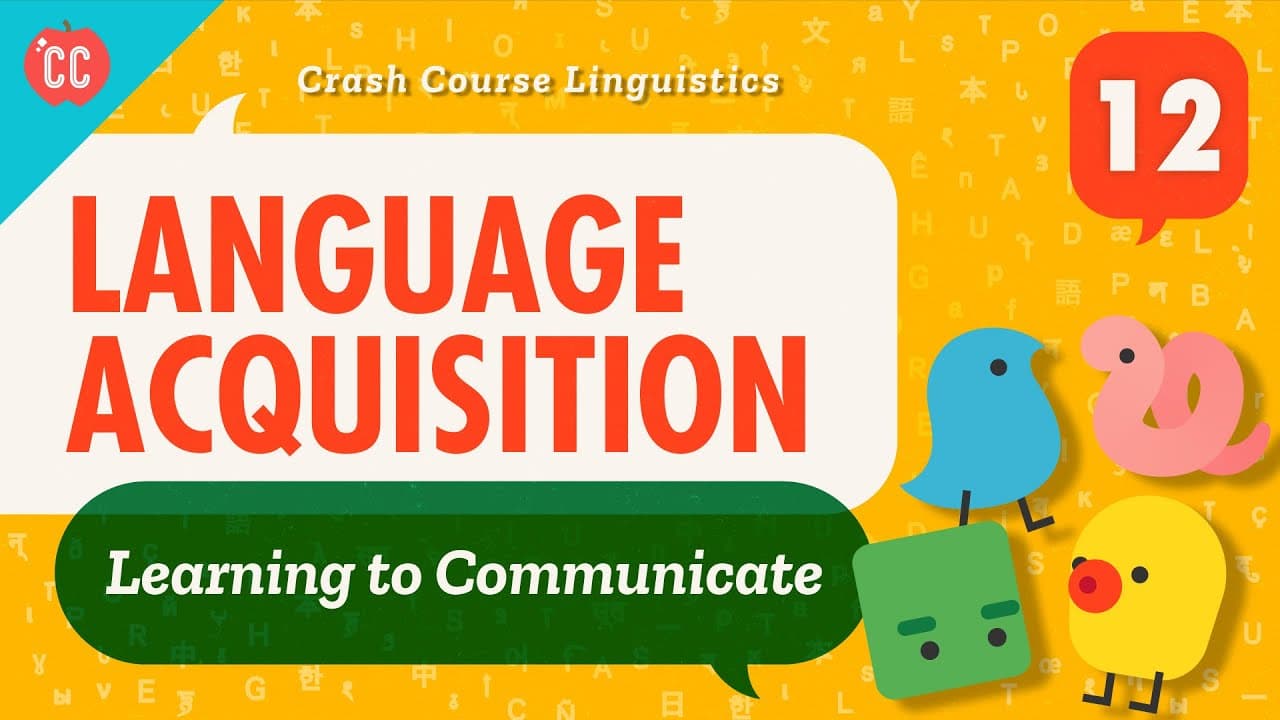
What Are the Key Stages of Language Acquisition?
TL;DR
Language acquisition progresses through distinct milestones, starting with sound recognition in infancy and leading to babbling and first words by around one year. While children typically learn language in a critical period influenced by exposure, adults can also acquire new languages effectively with motivation, practice, and leveraging existing knowledge.
Transcript
Hi, I'm Taylor and welcome to Crash Course Linguistics! What was your first word? Maybe it was ‘mama’ or ‘dada’ or some other family name, or ‘dog,’ or ‘ta’ for thank you. I’ve been told my first word was dada, so I was a super original baby. Before a child says their first word, they’ve already had to learn lots of other language stuff. Babies ne... Read More
Key Insights
- 👂 Language acquisition involves various factors, including fine motor skills, brain development, and exposure to language sounds.
- 👶 Babies demonstrate language learning through milestones like babbling and the one-word phase.
- ❓ The critical period for language acquisition provides a foundation for advanced language skills and learning multiple languages.
- 🧑 Language acquisition in adults can be influenced by motivation, goals, and existing language skills.
- 💨 There are different ways to be multilingual, including knowing heritage languages and engaging in code-switching.
- ❓ Language transfer and the influence of existing languages can impact the learning process.
- 👶 Language acquisition is a lifelong process, with individuals continuously learning new words and adjusting their language skills.
Install to Summarize YouTube Videos and Get Transcripts
Explore YouTube Video Summarizer or Get YouTube Transcript Extractor
Questions & Answers
Q: How do researchers study language acquisition in babies?
Researchers use methods like high-amplitude sucking to determine if babies are paying attention and can hear differences in sounds. They also observe babies' responses to new stimuli to gauge their language learning abilities.
Q: What is the significance of the "wug test"?
The "wug test" demonstrated that children can generalize language rules and apply them to new words, even ones they have never encountered before. This suggests that language acquisition involves figuring out system-level rules rather than simply mimicking others.
Q: How does language transfer affect adult language learners?
Language transfer is when existing language skills influence the learning process in a new language. For example, an English speaker learning Italian might struggle with word order. However, existing language skills can also be beneficial, such as when learning to read in a new language.
Q: What is receptive bilingualism?
Receptive bilingualism refers to understanding a language but not being able to speak it easily. This can occur when someone grows up with a language but doesn't have many opportunities to use it actively.
Summary & Key Takeaways
-
Babies learn language through a series of milestones, starting with fine motor skills and brain development before saying their first words.
-
Linguists study both child language acquisition and adult language acquisition, with some believing they occur through different processes and others viewing them as similar processes with some adjustments.
-
The critical period for language acquisition varies, but exposure to at least one language in infancy provides a foundation for advanced language skills and learning additional languages later in life.
Read in Other Languages (beta)
Share This Summary 📚
Summarize YouTube Videos and Get Video Transcripts with 1-Click
Try YouTube Summary with ChatGPT & Claude or YouTube Transcript Generator
Explore More Summaries from CrashCourse 📚



Summarize YouTube Videos and Get Video Transcripts with 1-Click
Try YouTube Summary with ChatGPT & Claude or YouTube Transcript Generator