What Is Falsifiability and Why Is It Important in Science?
TL;DR
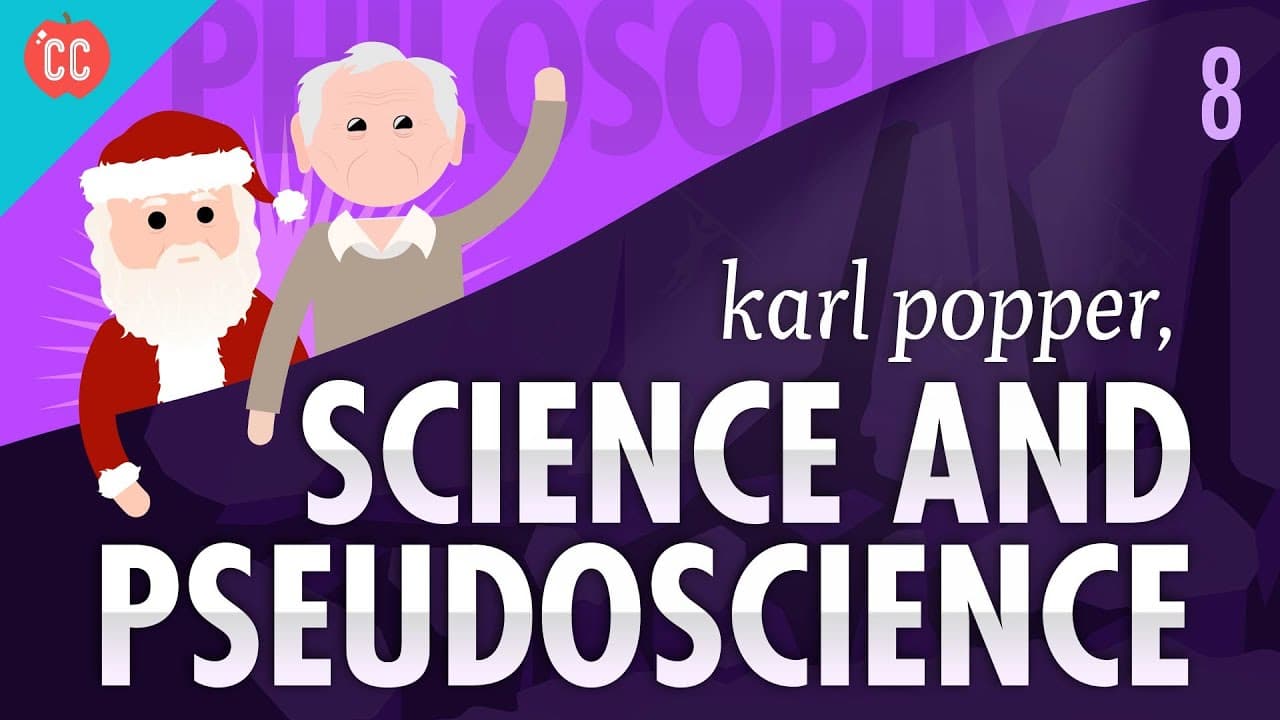
Falsifiability is the core principle distinguishing science from pseudoscience, as emphasized by Karl Popper. He argued that scientific theories must be able to make risky predictions that can be disproven, unlike pseudoscientific theories that only seek confirmation. Adopting a mindset open to revision in light of new evidence is crucial for the pursuit of knowledge.
Transcript
Crash Course Philosophy is brought to you by Squarespace. Squarespace: share your passion with the world. Imagine being alive when Albert Einstein was developing his theories of relativity. Or witnessing the birth of psychology, as Sigmund Freud and psychoanalysis took over the scientific mainstream. The early 1900s was an amazing time for Western ... Read More
Key Insights
- Karl Popper distinguished between science and pseudoscience by emphasizing the importance of falsifiability in scientific theories.
- Popper criticized Freud's psychoanalytic theories for being unfalsifiable, as they could be made to fit any data point.
- Einstein's theories were considered scientific because they made risky predictions that could potentially be disproven.
- Popper argued that true scientific inquiry seeks to disprove theories rather than confirm them.
- Irrefutable theories, according to Popper, lack scientific value because they cannot be tested or falsified.
- Popper believed that acknowledging false beliefs is beneficial as it brings us closer to the truth.
- Knowledge, for Popper, is provisional and should be revised when new evidence emerges.
- Popper's philosophy underscores the importance of being open to the possibility of being wrong to achieve closer approximations of truth.
Install to Summarize YouTube Videos and Get Transcripts
Explore YouTube Video Summarizer or Get YouTube Transcript Extractor
Questions & Answers
Q: What was Karl Popper's main contribution to the philosophy of science?
Karl Popper's main contribution to the philosophy of science was his distinction between science and pseudoscience based on the criterion of falsifiability. He argued that for a theory to be considered scientific, it must be testable and capable of being proven false. This approach challenged the traditional view of science, which often focused on confirming theories, and instead emphasized the importance of attempting to disprove them to gain more reliable knowledge.
Q: How did Popper view Freud's psychoanalytic theories?
Popper viewed Freud's psychoanalytic theories as examples of pseudoscience because they were unfalsifiable. He observed that Freud's theories could accommodate any data point, making them immune to disproof. For instance, Freud could interpret a person's behavior as evidence of his theories regardless of the specifics, which meant they could not be tested in a way that might prove them false. This lack of falsifiability was a key reason Popper categorized them as pseudoscience.
Q: Why did Popper consider Einstein's theories scientific?
Popper considered Einstein's theories scientific because they made risky predictions that could potentially be disproven. For example, Einstein's theory of relativity predicted specific outcomes that could be tested, such as the bending of light during a solar eclipse. If the observations had contradicted his predictions, the theory would have been disproven. This willingness to risk falsification was a hallmark of scientific inquiry for Popper, distinguishing it from pseudoscience.
Q: What does Popper mean by saying 'science disconfirms, while pseudoscience confirms'?
When Popper says 'science disconfirms, while pseudoscience confirms,' he means that genuine scientific inquiry seeks to test and potentially disprove theories, rather than merely finding evidence to support them. Scientific theories should be structured in a way that allows for the possibility of falsification. In contrast, pseudoscience tends to focus on confirming existing beliefs, often using evidence selectively to support preconceived notions, without subjecting them to rigorous testing that could disprove them.
Q: How does Popper's philosophy impact our understanding of knowledge?
Popper's philosophy impacts our understanding of knowledge by emphasizing its provisional nature. He argued that knowledge should be seen as contingent and subject to revision in light of new evidence. This approach contrasts with the quest for certainty, which Popper believed could lead to closed-mindedness. By remaining open to the possibility of being wrong, we can refine our beliefs and get closer to the truth, making knowledge a dynamic process rather than a fixed state.
Q: What role does falsifiability play in Popper's view of science?
In Popper's view, falsifiability is a central criterion that distinguishes scientific theories from pseudoscientific ones. A theory is considered scientific if it can be tested and potentially proven false. Falsifiability ensures that theories are subjected to rigorous scrutiny and that they make predictions that could be contradicted by evidence. This approach encourages the development of robust theories that can withstand attempts at disproof, thus contributing to the advancement of knowledge.
Q: How does Popper's approach differ from traditional scientific methods?
Popper's approach differs from traditional scientific methods by focusing on the importance of falsification rather than confirmation. Traditional methods often emphasized observation and confirmation of hypotheses based on empirical data. In contrast, Popper argued that scientific progress is made by attempting to disprove theories, thereby eliminating false beliefs and refining our understanding. This shift in focus encourages scientists to design experiments that challenge existing theories, leading to more reliable and robust knowledge.
Q: What is the significance of Popper's philosophy in modern scientific thinking?
Popper's philosophy is significant in modern scientific thinking because it has shaped how we approach the development and testing of scientific theories. His emphasis on falsifiability as a criterion for scientific validity has become a foundational principle in scientific inquiry. By advocating for the rigorous testing of theories and the willingness to discard them if proven false, Popper's ideas have encouraged a more critical and open-minded approach to science, fostering an environment where knowledge is continually refined and improved.
Summary & Key Takeaways
-
Karl Popper, a philosopher, distinguished between science and pseudoscience by emphasizing the importance of falsifiability. He criticized Freud's psychoanalytic theories for being unfalsifiable and praised Einstein's theories for making risky predictions that could be disproven, thus aligning with scientific principles.
-
Popper argued that scientific inquiry should focus on disproving theories rather than confirming them. He believed that irrefutable theories lack scientific value because they cannot be tested. Acknowledging false beliefs is beneficial as it brings us closer to the truth, according to Popper.
-
For Popper, knowledge is provisional and should be revised when new evidence emerges. His philosophy emphasizes the importance of being open to the possibility of being wrong to achieve closer approximations of truth, challenging the traditional understanding of scientific methods.
Read in Other Languages (beta)
Share This Summary 📚
Summarize YouTube Videos and Get Video Transcripts with 1-Click
Try YouTube Summary with ChatGPT & Claude or YouTube Transcript Generator
Explore More Summaries from CrashCourse 📚




Summarize YouTube Videos and Get Video Transcripts with 1-Click
Try YouTube Summary with ChatGPT & Claude or YouTube Transcript Generator