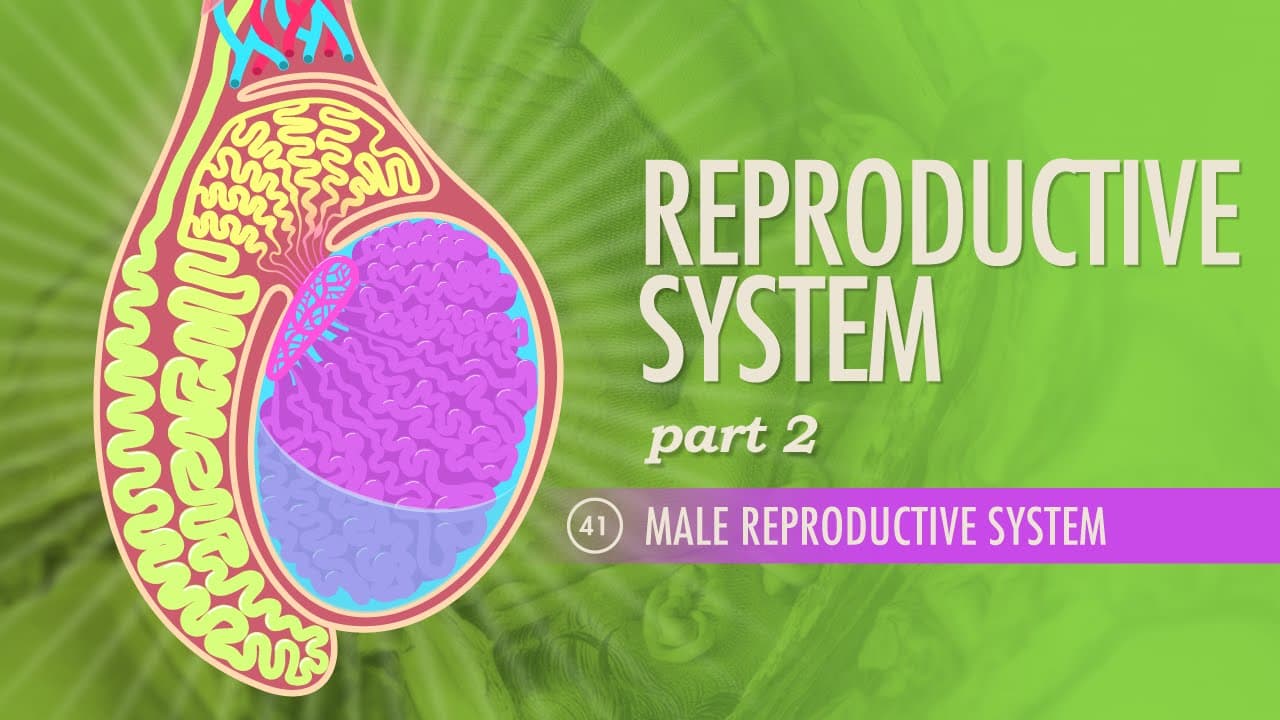
Reproductive System, Part 2 - Male Reproductive System: Crash Course Anatomy & Physiology #41
TL;DR
Explores male reproductive system anatomy and sperm production.
Transcript
Sex is a big gamble. I mean, the mental risks alone that we take with our relationships are taxing enough: When is he going to text me back? Am I good enough? What if she doesn’t like the real me? But the emotional price we pay for intimacy can almost seem paltry compared to the physical investments that our bodies make in order to reproduce. And t... Read More
Key Insights
- The male reproductive strategy contrasts with the female's by focusing on quantity over quality, producing vast numbers of sperm with minimal investment.
- Testes are located outside the body to maintain the lower temperature necessary for efficient sperm production, highlighting their temperature sensitivity.
- Spermatogenesis involves a sequence of cell divisions and transformations, ultimately producing motile sperm capable of fertilization.
- Hormones like gonadotropin and testosterone play crucial roles in initiating and regulating sperm production during male puberty.
- Sperm maturation involves a journey through the epididymis, where they gain mobility and energy resources for successful fertilization.
- Various glands contribute to semen composition, providing nutrients, mobility, and protection for sperm during their journey.
- The penis functions as a delivery system for sperm, ensuring their proximity to female gametes for potential fertilization.
- The male reproductive system's complexity is underscored by its intricate anatomy and the coordinated actions of multiple organs and hormones.
Install to Summarize YouTube Videos and Get Transcripts
Explore YouTube Video Summarizer or Get YouTube Transcript Extractor
Questions & Answers
Q: Why are the testes located outside the body?
The testes are located outside the body in the scrotum to maintain a lower temperature necessary for efficient sperm production. Sperm are sensitive to temperature, and the core body temperature of 37 degrees Celsius is too high for optimal spermatogenesis. The external location helps achieve the cooler environment required for sperm development.
Q: How does spermatogenesis differ from oogenesis?
Spermatogenesis differs from oogenesis in that it focuses on producing a large number of small, motile sperm with minimal investment, whereas oogenesis involves creating a single, large, nutrient-rich egg. Spermatogenesis is a continuous process throughout a male's life, while oogenesis involves a limited number of eggs that develop over time.
Q: What role do hormones play in male reproduction?
Hormones, particularly gonadotropin-releasing hormone (GnRH), follicle-stimulating hormone (FSH), and luteinizing hormone (LH), play critical roles in male reproduction. They regulate the production of testosterone and the initiation of spermatogenesis at puberty. These hormones orchestrate the development and maturation of sperm, ensuring the reproductive system functions effectively.
Q: What is the function of the epididymis in sperm maturation?
The epididymis is crucial for sperm maturation, providing an environment where sperm gain the ability to move and acquire energy resources. As sperm travel through the epididymis, they undergo changes that prepare them for fertilization, including gaining mitochondria for energy and developing the capacity for motility, essential for reaching and fertilizing an egg.
Q: How do seminal vesicles contribute to reproduction?
Seminal vesicles secrete a yellowish, alkaline fluid that nourishes and transports sperm. This fluid contains fructose for energy, coagulating enzymes, and prostaglandins that aid sperm success by decreasing cervical mucus viscosity and stimulating uterine contractions, helping sperm reach the egg more efficiently during reproduction.
Q: What is the significance of the prostate gland in male reproduction?
The prostate gland plays a significant role by secreting a fluid that contains citric acid and enzymes. This secretion helps liquefy semen, making it easier for sperm to move and swim through the female reproductive tract. The prostate's contribution ensures that sperm remain viable and capable of fertilization after ejaculation.
Q: Why is the penis considered a delivery system in reproduction?
The penis is considered a delivery system because its primary function is to deposit sperm as close as possible to the female gametes. During sexual arousal, the penis becomes erect, facilitating penetration of the vagina and ensuring the efficient transfer of sperm, thereby maximizing the chances of fertilization.
Q: How do glandular secretions aid sperm function during ejaculation?
Glandular secretions from the seminal vesicles, prostate, and bulbo-urethral glands combine with sperm to form semen. These secretions provide transportation, nutritional energy, and chemical protection, activating sperm motility. They create an optimal environment for sperm to survive and function effectively, increasing the likelihood of successful fertilization.
Summary & Key Takeaways
-
The male reproductive system focuses on producing large quantities of sperm with minimal investment. Testes are located outside the body to maintain a lower temperature for efficient sperm production. Hormones like gonadotropin and testosterone regulate sperm production, beginning at puberty.
-
Sperm maturation involves a journey through the epididymis, where sperm gain mobility and energy resources. Various glands contribute to semen composition, providing nutrients, mobility, and protection for sperm. The penis serves as a delivery system, ensuring sperm proximity to female gametes.
-
The male reproductive system's complexity is highlighted by its intricate anatomy and the coordinated actions of multiple organs and hormones. The system's design emphasizes quantity over quality, with the goal of maximizing fertilization potential through vast sperm production.
Read in Other Languages (beta)
Share This Summary 📚
Summarize YouTube Videos and Get Video Transcripts with 1-Click
Try YouTube Summary with ChatGPT & Claude or YouTube Transcript Generator
Explore More Summaries from CrashCourse 📚


Summarize YouTube Videos and Get Video Transcripts with 1-Click
Try YouTube Summary with ChatGPT & Claude or YouTube Transcript Generator