What Led to the Heliocentric Astronomy Revolution?
TL;DR
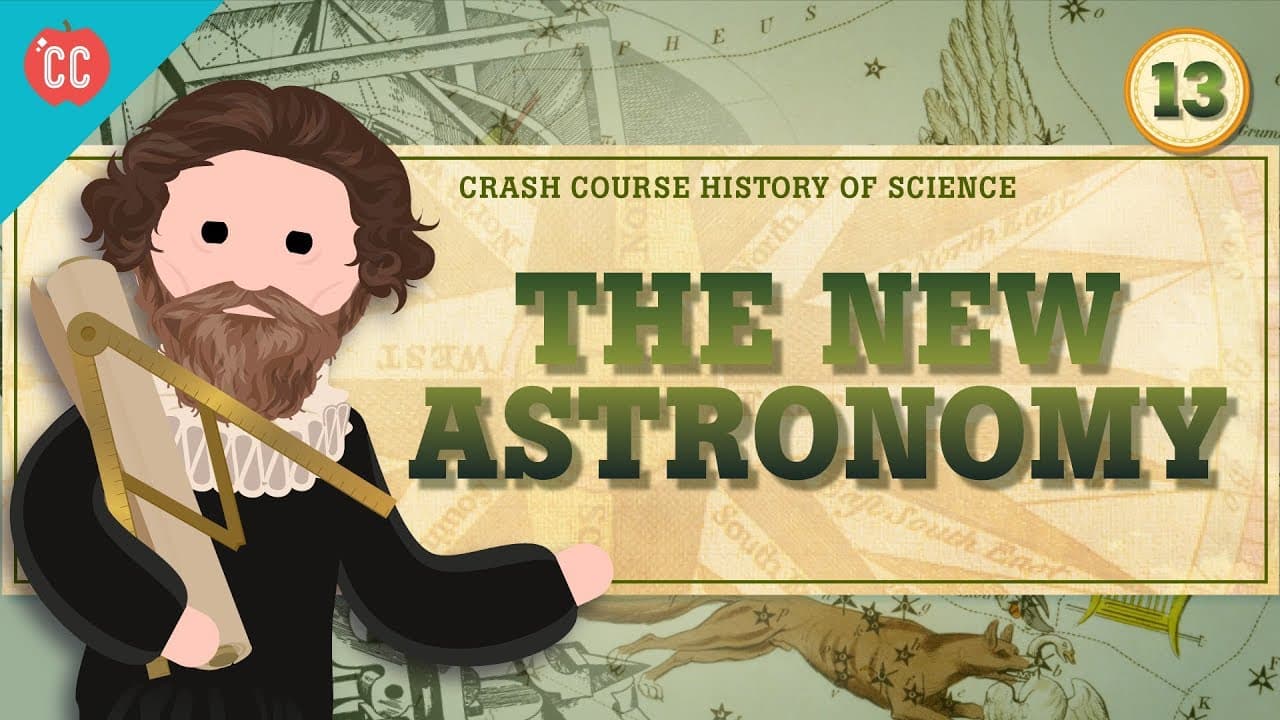
Heliocentrism revolutionized European astronomy, with Tycho Brahe and Johannes Kepler bridging the gap between Copernicus and Galileo. Tycho's precise observations and Kepler's laws of planetary motion laid the groundwork for modern astronomy. Kepler's elliptical orbits and Galileo's telescope observations challenged the geocentric model, marking a paradigm shift in scientific thought.
Transcript
Heliocentrism was central to revolution in European astronomy. We’ll follow this idea to its conclusion with Galileo. But before we get there, there are two critical links between Copernicus and Galileo. This is the story of Tycho Brahe and Johannes Kepler… and a violent math duel. [INTRO MUSIC PLAYS] There are a lot of quirky characters in the his... Read More
Key Insights
- Heliocentrism was a central idea that revolutionized European astronomy.
- Tycho Brahe, a Danish aristocrat, made precise naked-eye observations of the night sky.
- Tycho's geo-heliocentric model solved many mathematical problems of previous models.
- Johannes Kepler developed laws of planetary motion, introducing elliptical orbits.
- Kepler's first law states that planets orbit the sun in an ellipse, not a circle.
- Galileo's telescope observations provided empirical evidence supporting heliocentrism.
- Galileo's work faced opposition from the Church, leading to his publications being banned.
- Kepler's work harmonized empirical data, religious ideas, and mathematics.
Install to Summarize YouTube Videos and Get Transcripts
Explore YouTube Video Summarizer or Get YouTube Transcript Extractor
Questions & Answers
Q: How did Tycho Brahe contribute to astronomy?
Tycho Brahe made significant contributions to astronomy with his precise naked-eye observations of the night sky. His geo-heliocentric model addressed mathematical issues in previous models, and his meticulous data collection laid the groundwork for future astronomers like Kepler. Tycho's observations, which included comets and supernovae, challenged the notion of an unchanging cosmos and advanced the understanding of celestial phenomena.
Q: What are Kepler's laws of planetary motion?
Kepler's laws of planetary motion describe the orbits of planets around the sun. The first law states that planets orbit in ellipses with the sun at one focus. The second law, known as the law of equal areas, explains that a planet sweeps out equal areas in equal times, meaning it moves faster when closer to the sun. The third law relates the orbital period of a planet to its average distance from the sun.
Q: Why was Galileo's use of the telescope significant?
Galileo's use of the telescope was significant because it allowed him to make unprecedented observations of celestial bodies, providing empirical evidence for the heliocentric model. His detailed observations of the moon, Jupiter's moons, and other planets challenged the geocentric view and demonstrated the importance of empirical evidence in scientific inquiry. Galileo's work marked a pivotal moment in the transition from theoretical to observational astronomy.
Q: What was Tycho Brahe's model of the cosmos?
Tycho Brahe's model of the cosmos, known as the geo-heliocentric model, proposed that the sun orbits the Earth while other planets orbit the sun. This model was a compromise between the geocentric and heliocentric models, addressing some mathematical issues of the Ptolemaic system. Although it was not entirely accurate, Tycho's model represented a significant step towards a more accurate understanding of planetary motion.
Q: How did Kepler's work influence modern astronomy?
Kepler's work influenced modern astronomy by providing a mathematical framework for understanding planetary motion. His laws of planetary motion introduced the concept of elliptical orbits, which replaced the circular orbits of earlier models. Kepler's emphasis on empirical data and mathematical precision laid the foundation for Newton's laws of motion and universal gravitation, shaping the future of astronomical research and our understanding of the solar system.
Q: What challenges did Galileo face from the Church?
Galileo faced significant challenges from the Church due to his support of the heliocentric model, which contradicted the Church's geocentric teachings. His work was scrutinized by the Inquisition, leading to a ban on publishing new works. Despite these challenges, Galileo found ways to disseminate his ideas, and his contributions to science, particularly his advocacy for empirical evidence, played a crucial role in the scientific revolution.
Q: What role did religion play in Kepler's scientific work?
Religion played a significant role in Kepler's scientific work, as he saw the heliocentric model as harmonizing his faith with empirical data and mathematics. Kepler viewed the sun as a symbol of God, central to the cosmos, and believed that his discoveries reflected a divine order in the universe. This perspective allowed Kepler to reconcile his scientific pursuits with his religious beliefs, driving his contributions to the development of modern astronomy.
Q: How did Tycho Brahe's observations impact future astronomy?
Tycho Brahe's observations had a lasting impact on future astronomy by providing a wealth of precise data that challenged existing models and informed subsequent theories. His detailed records of planetary positions and celestial events, such as comets and supernovae, offered a foundation for Kepler's laws of planetary motion. Tycho's work demonstrated the importance of accurate data collection and observation, setting a standard for future astronomical research.
Summary & Key Takeaways
-
Heliocentrism emerged as a revolutionary concept in European astronomy, with significant contributions from Tycho Brahe and Johannes Kepler. Tycho's precise observations and Kepler's laws of planetary motion, including elliptical orbits, challenged the geocentric model. This shift laid the foundation for modern astronomy and was further supported by Galileo's telescope observations.
-
Tycho Brahe's geo-heliocentric model addressed mathematical issues of previous models, while Kepler's laws of planetary motion introduced the concept of elliptical orbits. Kepler's work harmonized empirical data, religious ideas, and mathematics, providing a more accurate understanding of planetary motion and contributing to the scientific revolution.
-
Galileo's telescope observations of celestial bodies provided empirical evidence for heliocentrism, challenging the geocentric model and leading to significant opposition from the Church. Despite this, Galileo's work, alongside Kepler's mathematical insights, marked a paradigm shift in scientific thought, emphasizing the importance of empirical evidence and observation in astronomy.
Read in Other Languages (beta)
Share This Summary 📚
Summarize YouTube Videos and Get Video Transcripts with 1-Click
Try YouTube Summary with ChatGPT & Claude or YouTube Transcript Generator
Explore More Summaries from CrashCourse 📚




Summarize YouTube Videos and Get Video Transcripts with 1-Click
Try YouTube Summary with ChatGPT & Claude or YouTube Transcript Generator